How to Get Cited by Perplexity AI means making your website accessible, structured, and trustworthy enough for Perplexity to reference it inside AI-generated answers. Perplexity does not simply rank pages like Google. It retrieves sources, evaluates relevance, and cites information that helps answer a user question. Strong SEO remains the foundation, but AEO and GEO practices improve citation readiness. Triomize helps WordPress teams check these signals before they publish.
Table of Contents
- How to Get Cited by Perplexity AI and Why Does It Matter?
- What Is a Perplexity AI Citation?
- How Does Perplexity AI Find Websites?
- How Does Perplexity Choose Sources to Cite?
- How Do SEO, AEO, and GEO Help Perplexity Citations?
- What Content Is Most Likely to Get Cited by Perplexity AI?
- How Can You Optimize a Page to Get Cited by Perplexity AI?
- Why Might Perplexity Not Cite Your Website?
- What Are Common Mistakes When Trying to Get Cited by Perplexity AI?
- What Is the Perplexity Citation Checklist?
How to Get Cited by Perplexity AI and Why Does It Matter?
How to Get Cited by Perplexity AI means optimizing your website so Perplexity can find, understand, verify, and reference your content in its cited answers. The goal is not to game a secret ranking formula. The goal is to become a useful source for a specific question.
Perplexity AI is built around answers with citations. A user asks a question, Perplexity retrieves relevant sources, writes a response, and links to pages that support its claims. If your website is cited, your brand appears inside the answer journey instead of waiting below a list of search results.
The opportunity is measurable. StatCounter reported that Perplexity held 7.73% of global AI chatbot referral share in April 2026, while ChatGPT held 76.85%, Gemini held 9.0%, Copilot held 3.76%, and Claude held 2.66%. Business Insider reported that Perplexity passed $150 million in annual recurring revenue by mid-2025, more than four times its roughly $35 million ARR a year earlier. Public usage estimates also place Perplexity near 22 million monthly active users, 100 million weekly queries, 13.9 million app downloads, and roughly 780 million monthly queries in May 2025.
Those numbers do not guarantee citations. Perplexity has not published a complete source-selection algorithm. The safest strategy is to improve the signals that are documented, observable, and aligned with good SEO: crawlability, answer clarity, source evidence, entity consistency, schema markup, topical authority, and trust.
This is where the Triomize plugin fits naturally. Triomize scores SEO, AEO, and GEO separately because AI citation readiness depends on all three layers.
What Is a Perplexity AI Citation?
A Perplexity AI citation is a source link that appears inside or near a Perplexity answer to support a claim, definition, statistic, or recommendation. It tells the user where the information came from.
This is different from a normal organic ranking. In Google Search, the user sees a ranked list of pages. In Perplexity, the user sees a synthesized answer first, then cited sources that support parts of that answer. That changes the content goal.
A page may be cited because it provides:
- A clear definition.
- A recent statistic.
- A comparison table.
- A technical explanation.
- A product or vendor fact.
- A step-by-step process.
- A credible source for a claim.
The citation is valuable because it can drive qualified traffic. Users who click citations are often in research mode. They already trust the answer enough to inspect the source.
How Does Perplexity AI Find Websites?
Perplexity AI finds websites through crawler access, user-triggered fetching, and retrieval systems that locate relevant public pages. Site owners should understand this discovery layer before expecting citations.
Perplexity’s official crawler documentation lists two important agents:
- PerplexityBot. Perplexity says
PerplexityBotis designed to surface and link websites in search results on Perplexity. It is not used to crawl content for AI foundation model training. Perplexity recommends allowing this bot inrobots.txtand permitting requests from its published IP ranges. - Perplexity-User. Perplexity says
Perplexity-Usersupports user actions. When someone asks Perplexity a question, it may visit a web page to help provide an accurate answer and include a link in the response. Since a user requested the fetch, Perplexity says this fetcher generally ignoresrobots.txtrules.
That distinction matters. You may allow Perplexity search discovery without treating it as model training. Perplexity documents two separate agents, two published IP-range JSON endpoints, and WAF guidance for Cloudflare and AWS.
A practical discovery setup includes:
- Allowing
PerplexityBotto crawl public content. - Checking WAF and CDN rules that may block Perplexity requests.
- Keeping XML sitemaps current and accessible.
- Returning fast
200responses for public pages. - Protecting private content with authentication and
noindexwhere needed.
For a broader crawler policy, read AI Crawlers Explained. If you use llms.txt, treat it as supporting documentation, not a replacement for crawlable pages.
How Does Perplexity Choose Sources to Cite?
Perplexity chooses sources by retrieving candidate pages and selecting information that best supports a useful, cited answer. The exact weighting is not public, so any honest guide should separate official documentation from practical inference.
Official documentation confirms crawler names, source access behavior, IP verification, and the role of source links. Practical testing suggests that cited pages often share several traits.
Pages that earn citations tend to have:
- Direct relevance. The page answers the exact user question, not only the broad topic.
- Clear structure. H2s, lists, tables, and short paragraphs make extraction easier.
- Verifiable claims. Statistics, named sources, and outbound links reduce ambiguity.
- Entity consistency. Schema markup, organization details, and topical context help machines map the source.
- Freshness. Current topics need recent examples, updated dates, and current figures.
- Topical authority. A cluster of related pages can signal deeper expertise than one isolated post.
Research on Generative Engine Optimization supports this pattern. The Princeton University, Georgia Tech, Allen Institute, and IIT Delhi GEO study tested optimization tactics across 10,000 queries and nine datasets. It found that adding statistics, citing sources, and adding quotations improved position-adjusted word count by 30% to 40% and subjective impression by 15% to 30%.
That does not prove a Perplexity-specific ranking factor. It does support the broader principle that AI answer engines favor content that is easy to verify, cite, and summarize.
How Do SEO, AEO, and GEO Help Perplexity Citations?
SEO, AEO, and GEO help Perplexity citations by solving different parts of the citation problem. SEO makes the page discoverable. AEO makes the answer extractable. GEO makes the source trustworthy enough to reference.
Traditional SEO still matters because Perplexity needs accessible web documents. Google Search Central’s guidance on helpful content, crawlability, structured data, and page quality remains relevant. Schema.org also matters because structured data helps machines understand page type, entities, breadcrumbs, authorship, and FAQ relationships.
| Layer | What it does | Why it matters for Perplexity |
|---|---|---|
| SEO | Makes pages crawlable, relevant, fast, and internally linked | Perplexity cannot cite a page it cannot find or access |
| AEO | Structures direct answers, questions, tables, and FAQs | Perplexity can extract clear passages faster |
| GEO | Adds evidence, entity clarity, citations, and trust signals | Perplexity can treat the page as a stronger source |
This is the same stack explained in SEO vs AEO vs GEO, AEO vs SEO, and GEO vs SEO. Perplexity citations sit at the intersection of all three.
The practical takeaway is simple. Do not choose between SEO and GEO. Use SEO as the foundation, AEO as the extraction layer, and GEO as the citation layer.
What Content Is Most Likely to Get Cited by Perplexity AI?
Content most likely to get cited by Perplexity AI is specific, useful, source-backed, and easy to parse. It answers a clear question better than competing pages.
Strong citation candidates include:
- Original data pages. Surveys, benchmarks, pricing studies, and industry research.
- Definition guides. Clear explanations of technical terms or emerging topics.
- Comparison pages. Side-by-side tables that help users choose between options.
- How-to guides. Step-based processes with precise instructions.
- Statistics pages. Curated, dated, and sourced data points.
- Official documentation. Product docs, API pages, policy pages, and changelogs.
- Expert explainers. Articles with named sources, examples, and practical judgment.
Thin pages struggle. A generic 600-word article with no examples, no statistics, no structure, and no entity clarity gives Perplexity little reason to cite it. A focused article with a direct answer, table, current data, and credible outbound references is far stronger.
Triomize helps writers see this before publication. It flags weak structure, missing links, thin evidence, and gaps across the SEO, AEO, and GEO layers.
How Can You Optimize a Page to Get Cited by Perplexity AI?
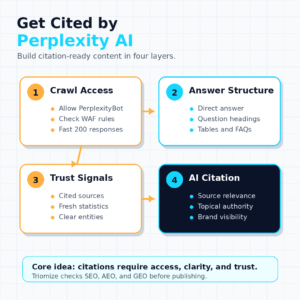
You can optimize a page to get cited by Perplexity AI by improving technical access, answer structure, evidence, schema, and topical authority. The goal is to make the page easy to retrieve and safe to reference.
Use this workflow:
- Choose a citation-worthy query. Target a specific question that users actually ask.
- Open with a direct answer. Put the clearest answer in the first 100 words.
- Use question-led headings. Match how users phrase research questions.
- Add a table or checklist. Structured formats are easier to parse and cite.
- Include sourced statistics. Use credible external references and date-sensitive data.
- Clarify entities. Make your brand, topic, author, product, and category signals consistent.
- Add schema markup. Use Article, Organization, BreadcrumbList, and FAQPage where appropriate.
- Build internal links. Connect the page to relevant cluster content.
- Keep it fresh. Update fast-changing topics within 12 months.
- Check crawler access. Confirm PerplexityBot can reach important public pages.
Internal links matter. Connect this guide to What is GEO?, Google AI Overviews Explained, and How to Optimize for ChatGPT Search. These links help users and crawlers understand your AI search cluster.
Use Triomize as a final checkpoint. If the page passes classic SEO but fails AEO or GEO, it may rank without being citation-ready.
Why Might Perplexity Not Cite Your Website?
Perplexity might not cite your website if the page is hard to access, weak on topical authority, unclear about entities, or too generic to support a specific answer. This is often a content quality issue, not only a crawler issue.
Based on common Search Console patterns, practical reasons include:
- Weak topical authority. One isolated article rarely proves deep expertise. Build a cluster of related pages around the topic.
- Poor internal linking. If important pages are orphaned or buried, crawlers and users struggle to find them.
- Thin or generic content. Perplexity has little reason to cite a page that repeats the same advice found everywhere else.
- Lack of clear entities. Your brand, author, product, topic, and category signals should be consistent across the site.
- Missing schema where appropriate. Schema is not a magic ranking switch, but it helps machines understand page type and relationships.
- Low trust signals. Unsupported claims, outdated statistics, no citations, and vague author context make a source harder to trust.
- Blocked crawler access.
robots.txt, WAF rules, rate limits, and CDN bot protection can prevent Perplexity from reading the page. - Weak answer formatting. Long introductions, unclear headings, and dense paragraphs make extraction harder.
Fix the weakest layer first. If Perplexity cannot access the page, solve technical access. If it can access the page but never cites it, improve topical depth, evidence, structure, and internal links.
What Are Common Mistakes When Trying to Get Cited by Perplexity AI?
Common mistakes when trying to get cited by Perplexity AI come from chasing shortcuts instead of improving source quality. Perplexity citations are not guaranteed by one file, one keyword, or one schema type.
Avoid these mistakes:
- Promising guaranteed citations. Perplexity has not published a guaranteed citation formula.
- Blocking useful crawler access. Check
PerplexityBot, WAF rules, rate limits, and IP verification. - Writing vague introductions. Perplexity needs clear answers, not long setup paragraphs.
- Publishing unsupported claims. Cite official docs, studies, and primary sources when possible.
- Ignoring entity SEO. Inconsistent author, organization, and topic signals make trust harder to verify.
- Relying only on llms.txt. A documentation file cannot replace structured pages and strong architecture.
- Forgetting the visitor. If a cited user lands on your page, the content still needs to convert.
The best strategy is practical. Make the page accessible. Answer the query. Prove the answer. Keep it current. Build authority around the topic.
What Is the Perplexity Citation Checklist?
The Perplexity citation checklist is a pre-publish workflow for improving your chance of being cited by Perplexity AI. Use it before publishing or updating any citation-focused article.
- Use the focus keyword in the H1, URL slug, SEO title, meta description, first paragraph, and at least one H2.
- Confirm that public pages are crawlable, indexable, fast, and mobile friendly.
- Allow
PerplexityBotfor public content unless you have a policy reason not to. - Verify Perplexity user agents against official IP ranges before whitelisting at the WAF level.
- Add a direct answer within the first 100 words.
- Use clear H2s, H3s, tables, lists, and FAQ answers for extraction.
- Add original data, statistics, or named examples when possible.
- Link out to credible sources and official documentation.
- Add Article, Organization, BreadcrumbList, and FAQPage schema where relevant.
- Build internal links to related SEO, AEO, GEO, and AI crawler guides.
- Review Search Console for weak pages, poor internal links, and thin query coverage.
- Monitor analytics for Perplexity referrals and landing page behavior.
- Recheck the post in Triomize after every major edit.
Frequently Asked Questions
What does it mean to get cited by Perplexity AI?
Can I guarantee that Perplexity will cite my website?
Does Perplexity use Google rankings to choose sources?
Does schema markup help Perplexity citations?
Why is my website not cited by Perplexity AI?