Share of model tracking is a practical framework for measuring how often a brand appears in AI-generated answers for a defined set of relevant prompts. It tracks brand mentions, recommendations, citations, competitor visibility, and answer context across AI search systems. The term is still emerging, so it should not be treated as a universal industry standard. It is best understood as a way to measure AI visibility over time.
Table of Contents
- What Is Share of Model Tracking?
- How Is Share of Model Different From Share of Voice?
- Why Should Brands Track Share of Model?
- Why Does Conversational Search Matter?
- How Can AI Influence Brand Discovery?
- Why Does Competitor Visibility Matter?
- Why Do Rankings Miss Part of the Picture?
- Why Can AI Visibility Change Over Time?
- What Should You Measure in Share of Model Tracking?
- How Do You Calculate Share of Model?
- Which AI Platforms Should Brands Track?
- What Prompts Should You Track?
- How Often Should You Track Share of Model?
- Why Can AI Visibility Be Volatile?
- How Is Share of Model Different From AI Citation Tracking?
- How Can Brands Improve Share of Model?
- What Are Common Share of Model Tracking Mistakes?
- How Can Triomize Help With Share of Model Tracking?
What Is Share of Model Tracking?
Share of model tracking is the process of monitoring how frequently and prominently a brand appears in AI-generated answers for the questions that matter to its business. It is the AI search equivalent of asking, “How visible are we when people ask about our category?”
Share of model is not a traditional Google ranking metric. It is an emerging measurement framework for AI search visibility. That distinction matters. Google, OpenAI, Anthropic, Perplexity, and Microsoft have not all agreed on one official metric called share of model.
Still, the idea is useful. Traditional SEO often measures where a website ranks for keywords. Share of model tracking looks at whether a brand appears inside AI answers.
An AI system may:
- Mention a brand.
- Recommend a brand.
- Cite a brand’s website.
- Compare a brand with competitors.
- Describe a brand without linking to it.
- Ignore the brand completely.
A simple definition is:
Share of model is a measure of how frequently a brand appears in AI-generated answers for a defined set of relevant questions and prompts.Share of model tracking monitors that visibility over time and can compare a brand’s presence against competitors across AI search and answer engines.
This makes it a natural extension of AI Visibility. AI Visibility asks whether your brand can be discovered. Share of model tracking asks how often it actually appears.
How Is Share of Model Different From Share of Voice?
Share of model is different from share of voice because it measures brand presence inside AI-generated answers rather than traditional media, search results, or social conversations. Share of voice usually tracks visibility across known channels. Share of model tracking focuses on AI answer environments.
| Traditional Share of Voice | Share of Model |
|---|---|
| Tracks visibility across traditional media, search, or social channels | Tracks visibility across AI-generated answers |
| Often based on mentions, impressions, or rankings | Based on AI responses and brand presence |
| Keywords are commonly tracked | Prompts and questions are tracked |
| SERPs, ads, social posts, and media are primary environments | AI answer engines are the environment |
| Rankings are relatively structured | Responses can vary between queries and sessions |
| Measurement is more established | Measurement is emerging and less standardized |
Traditional share of voice might ask, “How often does our brand appear in search results or media compared with competitors?” Share of model asks, “How often does an AI system mention us when someone asks about our category?”
For example, a WordPress SEO plugin might track prompts such as:
What are the best SEO tools for WordPress?
Which WordPress plugins help with AI search optimization?
How can I improve GEO for my WordPress website?
If Triomize appears in 35 of 100 tracked responses, that creates a simple visibility benchmark. If competitors appear in 60 responses, the gap becomes clear.
Why Should Brands Track Share of Model?
Brands should track share of model because AI answers are becoming part of how users discover products, tools, services, and ideas. If a brand is absent from AI-generated answers, it may lose visibility before the user ever reaches a search results page.
Why Does Conversational Search Matter?
Search is becoming more conversational. Users increasingly ask complete questions instead of typing short keywords. This affects how brands are discovered.
A traditional query might be:
WordPress SEO pluginA conversational AI prompt might be:
What WordPress SEO plugin should I use if I want SEO, AEO, and GEO checks in one dashboard?Those prompts are longer, more specific, and more decision-oriented. Share of model tracking helps brands understand whether they appear in those answer journeys.
How Can AI Influence Brand Discovery?
AI can introduce a user to a brand before that user searches for the brand directly. A recommendation inside ChatGPT, Perplexity, Gemini, Claude, or Copilot can shape the user’s shortlist.
StatCounter reported that ChatGPT held 76.85% of global AI chatbot referral share in April 2026, while Gemini held 9.0%, Perplexity 7.73%, Copilot 3.76%, and Claude 2.66%. The exact shares will change, but the pattern is clear: brands should not measure only one AI platform.
Pew Research Center also found that users clicked traditional links 8% of the time when an AI summary appeared, compared with 15% when no AI summary appeared. That shift makes AI visibility measurement more important because classic rankings do not capture every answer-led exposure.
Why Does Competitor Visibility Matter?
You do not only want to know whether your brand appears. You also want to know whether competitors appear instead.
A useful share of model report answers:
- Are we mentioned?
- Are competitors mentioned?
- Are we recommended or only described?
- Are competitors cited more often?
- Do AI systems describe our category accurately?
- Are we missing from high-intent prompts?
Competitor visibility turns AI search monitoring into strategy.
Why Do Rankings Miss Part of the Picture?
A website can rank well in Google but have limited presence in AI-generated answers. The opposite can also happen: a brand may appear in AI answers because it is well known, cited, or discussed, even if one specific page does not rank first.
Traditional rankings track URLs. Share of model tracking tracks brand presence in answers.
Why Can AI Visibility Change Over Time?
AI responses can change as models update, retrieval systems change, competitors publish new content, sources refresh, and user prompts evolve. A single response is only a snapshot.
That is why share of model tracking should look at patterns over time.
What Should You Measure in Share of Model Tracking?
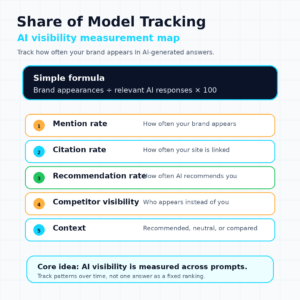
Share of model tracking should measure more than simple mentions. AI answer visibility has several layers: whether a brand appears, whether it is cited, whether it is recommended, how competitors appear, and how the answer describes the brand.
| Metric | What it measures | Why it matters |
|---|---|---|
| Brand mention rate | How often the brand appears | Basic AI visibility |
| Citation rate | How often the brand website is linked or cited | Source authority and traffic potential |
| Recommendation rate | How often the brand is recommended | Commercial influence |
| Competitor visibility | How often competitors appear | Category share and market context |
| Prominence | Where the brand appears in the answer | Visibility strength |
| Sentiment or context | Whether the brand is recommended, neutral, criticized, or compared | Quality of visibility |
| Prompt coverage | Which prompt categories mention the brand | Strategic gaps |
Be careful with sentiment. AI sentiment is not perfectly reliable. Use it as a directional signal, not a final truth.
A brand mention is not the same as a citation. A citation is stronger when it links to or references your website. A recommendation is different again because it suggests the AI system is actively placing your brand into a user’s decision set.
This is why AI Search Ranking Factors and AI Search Optimization matter. They explain the signals that can influence retrieval, trust, and citation readiness.
How Do You Calculate Share of Model?
You can calculate share of model with a simple measurement model: brand appearances divided by total relevant AI responses, multiplied by 100. This is not a universal industry standard, but it is a practical starting point.
Share of Model = Brand appearances ÷ Total relevant AI responses × 100Example:
Tracked prompts: 100
Responses where your brand appears: 35
Share of Model = 35%
That simple number gives you a baseline. If you repeat the same prompt set every week or month, you can track whether brand visibility is improving.
Real-world tracking can become more sophisticated. You may weight:
- Prominence in the answer.
- Whether the brand is cited.
- Whether the brand is recommended.
- Whether competitors appear.
- Whether the answer is positive, neutral, or negative.
- Whether the platform is ChatGPT, Perplexity, Gemini, Copilot, Claude, or Google AI.
For example, a brand mention in a neutral paragraph may count as 1 point. A recommendation may count as 2 points. A cited recommendation may count as 3 points. That is a custom scoring model, not a universal rule.
The key is consistency. Use the same prompt set, same platforms, and same scoring method over time.
Which AI Platforms Should Brands Track?
Brands should track multiple AI platforms because different systems can produce different answers for the same query. Tracking only one model gives an incomplete picture.
Important environments include:
- ChatGPT.
- Google AI search and AI Overviews.
- Perplexity.
- Gemini.
- Microsoft Copilot.
- Claude where applicable.
Each platform has different retrieval methods, interfaces, source behavior, and answer styles. Perplexity is citation-heavy. ChatGPT Search can use web retrieval and source links. Google AI Overviews connect to Google Search systems. Copilot connects to Bing and Microsoft experiences. Claude may vary depending on user-directed retrieval and search features.
According to Google’s AI features documentation, AI Overviews and AI Mode may use different models and techniques, so the set of responses and links may vary. That same principle applies across AI platforms more broadly.
The practical approach is to track the platforms your audience actually uses. A B2B SaaS brand may care about ChatGPT, Perplexity, Gemini, Copilot, and Google AI. A developer tool may also care about Claude and coding assistants.
What Prompts Should You Track?
Share of model tracking should use prompt categories, not only branded prompts. A brand query like “What is Triomize?” is useful, but it does not show whether your brand appears in category discovery.
Track these prompt types:
| Prompt category | Example |
|---|---|
| Category questions | What are the best SEO tools for WordPress? |
| Problem questions | How can I improve my website’s AI search visibility? |
| Comparison questions | What is better for SEO, Tool A or Tool B? |
| Recommendation questions | Which WordPress SEO tools should I use? |
| Commercial questions | What are the best AI SEO plugins for WordPress? |
| Brand questions | What is Triomize? |
Category and problem questions are often the most valuable. They show whether your brand appears before the user has decided what product to search for.
Do not track only prompts that include your brand. That inflates confidence. Real discovery happens when the user does not know your brand yet.
For example, a strong prompt set for Triomize might include:
- What tools help with SEO, AEO, and GEO?
- Which WordPress plugins help with AI search optimization?
- How do I monitor AI crawlers on WordPress?
- What is the best plugin for AI visibility?
- Which tools help optimize for Google AI Overviews?
- What is Triomize?
This creates a more realistic view of AI category visibility.
How Often Should You Track Share of Model?
There is no universal frequency for share of model tracking. The right cadence depends on brand size, content velocity, market competition, and how volatile the AI answers are.
A practical cadence:
| Brand stage | Suggested cadence |
|---|---|
| Early-stage brand | Monthly |
| Growing brand | Weekly or biweekly |
| High-volume brand | Daily or near-daily |
| Active launch campaign | Daily during the campaign |
| Low-change market | Monthly or quarterly |
For a growing brand, weekly or biweekly tracking can establish a useful trend. For high-volume brands, daily monitoring may be appropriate.
The most important rule is consistency. Compare the same prompt set over time before drawing conclusions.
If you change the prompt set every week, the trend becomes unreliable. Add new prompts when needed, but keep a stable core set.
Why Can AI Visibility Be Volatile?
AI visibility can be volatile because AI-generated answers are not fixed rankings. Responses may change based on prompts, model updates, retrieval systems, source freshness, location, personalization, and competitor content.
Common causes of volatility include:
- Model updates.
- Search retrieval changes.
- Source freshness.
- Different wording of prompts.
- Location or language differences.
- Personalization.
- Source availability.
- Competitor content updates.
- Changing citations.
- Platform experiments.
This is why a single AI answer should not be treated as a definitive ranking position. AI search is probabilistic and context-sensitive.
Use patterns instead:
- Does the brand appear across many prompts?
- Does the brand appear across multiple platforms?
- Does visibility improve over time?
- Are competitors appearing more often?
- Are citations increasing or decreasing?
- Is the brand being recommended or only mentioned?
A single prompt result can be interesting. A trend across 100 prompts is more useful.
How Is Share of Model Different From AI Citation Tracking?
Share of model tracking and AI citation tracking measure different things. Share of model measures presence or visibility. AI citation tracking measures whether your website is actually referenced or linked.
| Metric | Measures | Example |
|---|---|---|
| Share of model | Brand presence in AI answers | Triomize mentioned in 35 of 100 prompts |
| AI citation tracking | Source links or citations | Triomize.com cited in 12 of 100 prompts |
| Recommendation tracking | Active endorsement | Triomize recommended in 9 prompts |
| Sentiment tracking | Context of mention | Positive, neutral, negative, compared |
A brand can have high share of model and low citation rate. This means AI systems mention the brand but do not often link to it.
A brand can also have low share of model and high citation rate. This means the brand appears less often, but when it appears, it is cited as a source.
Both metrics matter. They answer different strategic questions.
For a source-specific strategy, read How to Get Cited by Perplexity AI.
How Can Brands Improve Share of Model?
Brands can improve share of model by improving the signals that make them easier to discover, understand, trust, and recommend across AI search systems.
Focus on these actions:
- Create genuinely useful content.
- Answer important category questions.
- Build topical authority.
- Demonstrate expertise.
- Maintain accurate company information.
- Strengthen entity signals.
- Earn authoritative external mentions.
- Improve internal linking.
- Keep important content fresh.
- Make content easy to understand and extract.
- Ensure AI and search crawlers can access important public content.
This is where share of model tracking becomes actionable. If your brand is absent from category prompts, publish stronger category education. If competitors are cited more often, improve source pages and original data. If AI systems misunderstand your brand, strengthen entity SEO and structured data.
Useful supporting guides include Internal Linking Strategy, Content Readability for AI, Structured Data Types, and Topical Authority.
What Are Common Share of Model Tracking Mistakes?
Common share of model tracking mistakes happen when brands treat AI answers like static rankings. AI answer visibility needs a different measurement mindset.
Avoid these mistakes:
- Tracking only branded prompts. This misses category discovery.
- Tracking only one AI platform. Different platforms produce different answers.
- Treating one response as a ranking. Look for patterns over time.
- Measuring mentions without context. A negative mention is not the same as a recommendation.
- Ignoring competitors. Share is relative.
- Changing the prompt set every week. This breaks trend analysis.
- Confusing citations with mentions. A mention is not always a source link.
- Assuming every AI response is deterministic. Responses can vary.
- Treating the metric as a universal industry score. The framework is still emerging.
The solution is to define your method and use it consistently.
How Can Triomize Help With Share of Model Tracking?
Triomize can help with share of model tracking by connecting AI visibility work to SEO, AEO, and GEO signals inside the WordPress workflow. Share of model tracking measures the outcome, but website owners still need to improve the inputs.
Triomize helps with those inputs by supporting:
- SEO analysis.
- AEO answer structure.
- GEO trust signals.
- Schema opportunities.
- AI crawler monitoring.
- Internal linking checks.
- Content readability improvements.
- Topical authority workflows.
- AI visibility planning.
If a brand is missing from AI answers, the issue may be weak content, unclear entities, poor internal links, missing schema, blocked crawlers, weak topical authority, or lack of trusted mentions. Triomize helps teams identify those gaps before they try to measure outcomes.
Share of model tracking tells you where your brand appears. Triomize helps improve the website signals that can make stronger AI visibility more likely.
Frequently Asked Questions
What is share of model?
What is share of model tracking?
How is share of model different from share of voice?
How do you measure AI brand visibility?
How do you track brand mentions in ChatGPT?
How do AI citations differ from AI mentions?
Which AI platforms should brands track?
How can a brand improve its share of model?