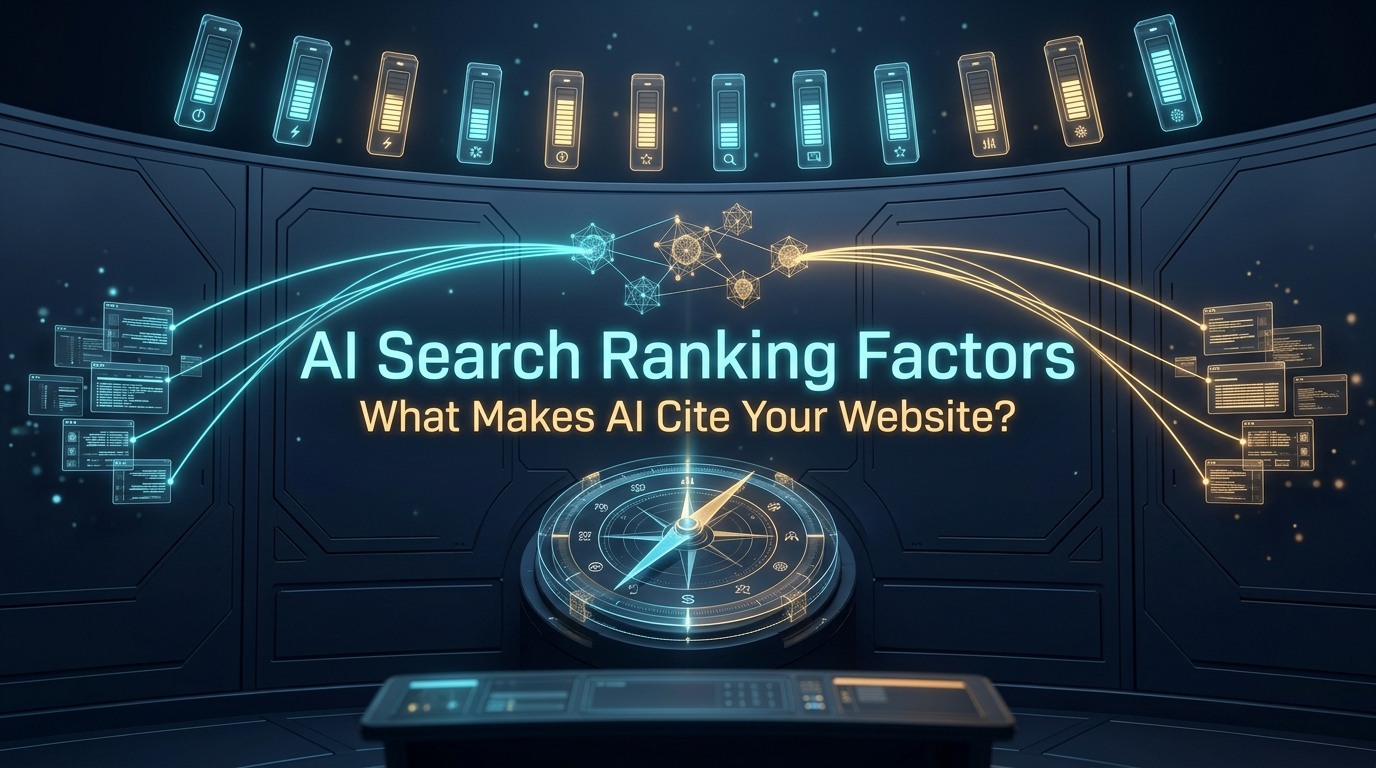
AI Search Ranking Factors are the technical, content, authority, and trust signals that help AI-powered search systems decide which websites to retrieve, summarize, cite, or recommend. They include crawlability, indexing, structured data, entity clarity, EEAT, topical authority, freshness, source quality, internal links, answer formatting, and brand trust. These factors do not work like one fixed algorithm. They work together across ChatGPT Search, Google AI Overviews, Gemini, Perplexity, Claude, Bing, and other AI search platforms.
Table of Contents
- What Are AI Search Ranking Factors?
- How Does AI Search Differ from Traditional Search Rankings?
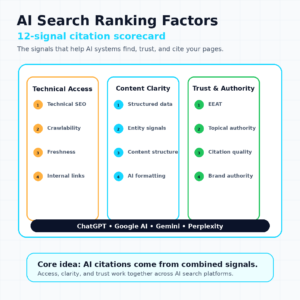
- What Are the 12 Most Important AI Search Ranking Factors?
- 1. Why Does Technical SEO Matter for AI Search Rankings?
- 2. Why Does Crawlability Matter for AI Search?
- 3. How Does Structured Data Affect AI Search Ranking Factors?
- 4. Why Do Entity Signals Matter for AI Search?
- 5. Does EEAT Matter for AI Search Rankings?
- 6. Why Is Topical Authority an AI Search Ranking Factor?
- 7. How Does Freshness Influence AI Search Rankings?
- 8. Why Does Citation Quality Matter?
- 9. How Does Internal Linking Improve AI Search Visibility?
- 10. Why Does Content Structure Matter for AI Search?
- 11. What Is AI-Friendly Formatting?
- 12. Why Does Brand Authority Matter for AI Search?
- How Do AI Search Ranking Factors Differ by Platform?
- How Does ChatGPT Choose Websites?
- How Does Google AI Overviews Select Sources?
- How Does Perplexity Choose Sources?
- How Does Gemini Use Website Signals?
- How Do You Measure AI Search Ranking Factors?
- What Common Mistakes Reduce AI Visibility?
- What Is the AI Search Ranking Checklist?
- What Is the Future of AI Search Ranking?
What Are AI Search Ranking Factors?
AI Search Ranking Factors are the signals that influence whether an AI search system can find your website, understand your content, trust your claims, and cite your page in an answer. They are not a public checklist from one company. They are a practical framework based on documented crawler behavior, search engine guidance, AI retrieval patterns, and observable citation behavior.
The core question is simple: why does AI cite one website and ignore another? The answer is rarely one factor. A cited page usually satisfies several conditions at once. It is accessible, indexable, relevant, clear, current, trusted, and useful for the user’s question.
Traditional search engines rank pages. AI search systems often retrieve pages, synthesize answers, and display supporting links or citations. That means AI Search Ranking Factors include classic SEO signals, but they also include answer-readiness and citation-readiness signals.
A practical definition looks like this:
| Signal group | What it answers | Example |
|---|---|---|
| Technical access | Can AI find the page? | robots.txt, sitemaps, indexing, crawler access |
| Content clarity | Can AI understand the answer? | direct answers, headings, tables, summaries |
| Trust and evidence | Can AI rely on the source? | citations, EEAT, author clarity, freshness |
| Entity context | Can AI identify the topic and brand? | schema, Knowledge Graph signals, internal links |
| Platform fit | Can a specific AI system use it? | Google eligibility, OAI-SearchBot, PerplexityBot |
This is why AI Search Ranking Factors sit at the center of SEO, AEO, and GEO. SEO makes the page discoverable. AEO makes the answer extractable. GEO makes the source citable.
How Does AI Search Differ from Traditional Search Rankings?
AI search differs from traditional search rankings because AI systems may not simply display a ranked list of links. They may generate an answer, cite sources, summarize pages, compare options, or combine several sources into one response.
Traditional Google Search still matters. Google uses crawling, indexing, links, quality systems, structured data, and helpful content signals. But Google AI Overviews and AI Mode add answer generation on top of that foundation. Google’s AI features documentation says AI Overviews and AI Mode surface relevant links and that pages must be indexed and eligible for Google Search with a snippet to appear as supporting links.
ChatGPT Search uses its own search retrieval layer. OpenAI documents separate agents such as OAI-SearchBot, GPTBot, and ChatGPT-User. OAI-SearchBot is used to surface websites in ChatGPT Search. GPTBot is related to training. ChatGPT-User is used for certain user-triggered actions.
Perplexity is built around cited answers. Perplexity documents PerplexityBot for surfacing and linking websites, plus Perplexity-User for user-triggered visits.
Bing and Copilot also connect classic crawling with AI experiences. Bing Webmaster Guidelines state that core crawling, indexing, ranking, structure, authority, and trust signals support eligibility for AI-generated experiences, grounding results, and citations.
The important difference is the output. In classic search, the user chooses a result. In AI search, the system may choose sources first, synthesize an answer, and then show citations. That changes the optimization target from ranking alone to retrieval, interpretation, citation, and trust.
What Are the 12 Most Important AI Search Ranking Factors?
The 12 most important AI Search Ranking Factors are the signals most consistently tied to AI search discovery, answer extraction, source trust, and citation eligibility. They do not guarantee citations, but they improve your odds across major AI search systems.
1. Why Does Technical SEO Matter for AI Search Rankings?
Technical SEO matters because AI systems cannot cite a page they cannot access, render, or understand. A technically broken website reduces visibility before content quality even matters.
Key technical checks include:
- Clean robots.txt rules.
- XML sitemaps with canonical URLs.
- Correct canonical tags.
- Fast server responses.
- Mobile-friendly templates.
- Valid status codes.
- No accidental
noindextags. - Clean redirects.
- Accessible main content.
For WordPress, plugin conflicts can create hidden technical issues. A caching plugin can break rendering. An SEO plugin can output conflicting canonicals. A security plugin can block helpful crawlers. A theme can hide content behind JavaScript. These technical issues can weaken AI Search Ranking Factors even when the article itself is strong.
If you need a practical workflow, use the Technical SEO Audit Checklist.
2. Why Does Crawlability Matter for AI Search?
Crawlability means search engines and AI crawlers can request and read your public pages. Without crawlability, AI search visibility becomes unreliable.
Crawler access now includes more than Googlebot. Website owners may need to understand OAI-SearchBot, GPTBot, ChatGPT-User, PerplexityBot, Perplexity-User, ClaudeBot, Claude-SearchBot, Bingbot, Googlebot, GoogleOther, and Google-Extended.
Crawlability does not mean you must allow every bot for every purpose. It means your policy should match your goals. For example, a publisher may allow OAI-SearchBot for ChatGPT Search while blocking GPTBot for training. A business may allow PerplexityBot for citation visibility while protecting private content with authentication.
AI crawler management is now part of AI Search Ranking Factors because access controls determine whether AI systems can discover your content at all. Read AI Crawler Monitoring for a deeper workflow.
3. How Does Structured Data Affect AI Search Ranking Factors?
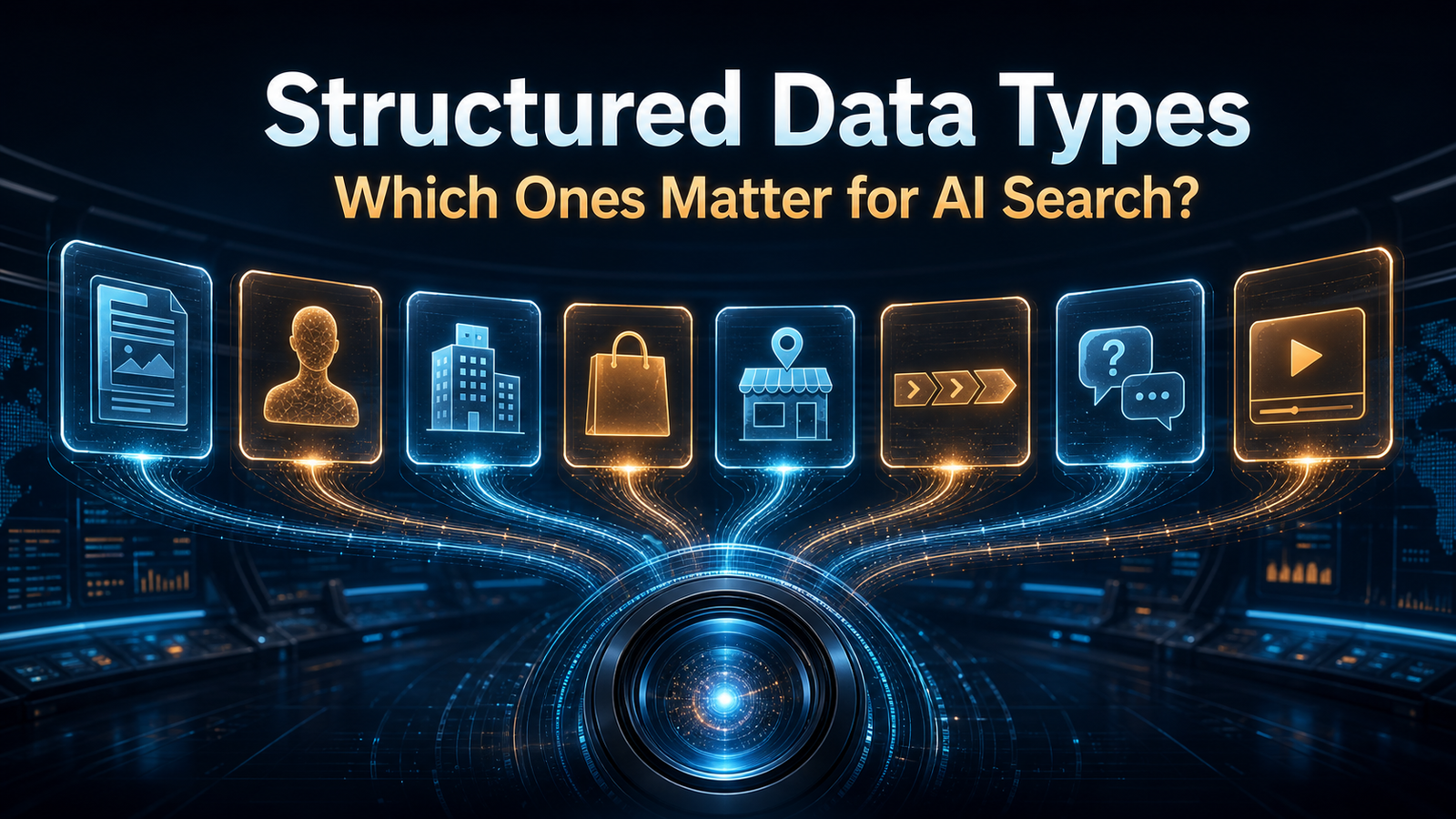
Structured data affects AI Search Ranking Factors by clarifying page type, entities, authors, organizations, breadcrumbs, products, and FAQs. Schema does not guarantee AI citations. It reduces ambiguity.
Important schema types include:
- Article Schema.
- Organization Schema.
- Author or Person Schema.
- BreadcrumbList Schema.
- FAQPage Schema.
- Product Schema where appropriate.
- LocalBusiness Schema where appropriate.
Structured data adoption is widespread. The 2024 HTTP Archive Web Almanac reported JSON-LD on 41% of pages, up from 34% in 2022. WebDataCommons reported structured data in 1.7 billion HTML pages out of 3.4 billion pages in its October 2023 crawl, equal to 50.60% of the crawl.
For AI search, schema helps machines understand what each page represents. That supports entity recognition, topical authority, and citation confidence. See Schema Markup for AI Search for implementation guidance.
4. Why Do Entity Signals Matter for AI Search?
Entity signals matter because AI systems need to understand real-world things, not only keywords. Entities include people, companies, products, places, topics, tools, and concepts.
For example, a page about “Perplexity” needs enough context to show whether it means the AI search engine or the general state of confusion. Related terms like PerplexityBot, citations, AI search, source links, and retrieval clarify the entity.
Strong entity signals include:
- Consistent brand names.
- Organization schema.
- Author profiles.
- sameAs links.
- Descriptive internal links.
- Clear topic clusters.
- External references.
- Consistent product or service names.
Google’s Knowledge Graph shows why entities matter. In 2020, Google said the Knowledge Graph had amassed over 500 billion facts about 5 billion entities. AI systems also depend on entity understanding to produce accurate answers. Read the Entity SEO guide for the full strategy.
5. Does EEAT Matter for AI Search Rankings?
EEAT matters because AI systems need trustworthy sources. EEAT stands for Experience, Expertise, Authoritativeness, and Trustworthiness.
Google’s helpful content documentation says its systems identify factors that help determine whether content demonstrates experience, expertise, authoritativeness, and trustworthiness. It also says trust is the most important aspect.
EEAT signals include:
- Clear author identity.
- Real experience.
- Professional expertise.
- Reliable citations.
- Transparent company details.
- Updated content.
- Editorial standards.
- Secure browsing.
AI systems may not use Google’s exact EEAT framework by name, but they still need similar trust signals. A page with anonymous claims, no sources, outdated facts, and vague authorship is less attractive as a citation source.
For a deeper workflow, use EEAT for AI Search.
6. Why Is Topical Authority an AI Search Ranking Factor?
Topical authority matters because AI systems evaluate whether a website covers a subject deeply enough to be trusted. One page can answer one question. A cluster of pages shows broader expertise.
A strong topical authority cluster includes:
- A pillar page.
- Supporting articles.
- Internal links.
- Entity consistency.
- Related FAQs.
- Schema markup.
- Updated examples.
- External citations.
A 2024 Graphite study reported that pages with high topical authority gained traffic 57% faster than pages with low topical authority. Other industry analyses of AI topic clusters report that websites with topic clusters receive more AI citations than single-page competitors.
Topical authority is one of the most important AI Search Ranking Factors because AI systems need confidence that a site understands the topic, not just one phrase. Read Topical Authority for a cluster-building workflow.
7. How Does Freshness Influence AI Search Rankings?
Freshness influences AI search rankings because many AI search queries involve current tools, policies, prices, studies, product changes, and platform behavior. Outdated content can reduce trust.
Freshness signals include:
- Accurate modified dates.
- Updated statistics.
- Current screenshots.
- Recently reviewed recommendations.
- Fresh crawler policy references.
- Updated schema when content changes.
- Removal of claims that are no longer true.
Freshness does not mean changing dates without improving the page. It means keeping the page accurate. AI search systems are especially sensitive to fast-changing topics such as Google AI Overviews, ChatGPT Search, Perplexity, Gemini, Claude, AI crawlers, schema, and GEO.
A stale article may still rank for a keyword, but it is less reliable as an AI citation.
8. Why Does Citation Quality Matter?
Citation quality matters because AI systems need evidence. Pages that cite credible sources are easier to verify and safer to summarize.
High-quality citation sources include:
- Official platform documentation.
- Search engine documentation.
- Academic studies.
- Government sources.
- Standards bodies.
- Original reports.
- Primary company announcements.
The GEO study from Princeton University, Georgia Tech, Allen Institute, and IIT Delhi tested optimization methods across 10,000 queries and nine datasets. It found that adding citations, statistics, and authoritative language improved position-adjusted word count by 30% to 40% and subjective impression by 15% to 30%.
This does not mean adding random links will help. Citation quality depends on relevance, credibility, and accuracy. Link to the closest primary source whenever possible.
9. How Does Internal Linking Improve AI Search Visibility?
Internal linking improves AI search visibility by helping crawlers discover pages and understand relationships between topics. It also helps users move through a content cluster.
Google’s link guidance says internal links help people and Google make sense of a site more easily. For AI search, internal links also help clarify topical depth and entity relationships.
Strong internal linking practices include:
- Link from pillar pages to supporting articles.
- Link from supporting articles back to the pillar.
- Cross-link related cluster pages.
- Use descriptive anchor text.
- Avoid generic anchors like “click here.”
- Link to pages that genuinely help the reader.
Internal links turn disconnected posts into a semantic network. That network supports AI Search Ranking Factors such as topical authority, entity clarity, and retrieval depth.
10. Why Does Content Structure Matter for AI Search?
Content structure matters because AI systems need to extract answers quickly and accurately. A dense wall of text is harder to parse than a well-structured page.
Useful structure includes:
- A direct answer near the top.
- Question-led H2s and H3s.
- Short paragraphs.
- Comparison tables.
- Ordered steps.
- Bulleted lists.
- FAQ sections.
- Clear definitions.
- Summary blocks.
Structured content supports AEO because answer engines need clean passages. It supports GEO because cited answers often depend on clear, self-contained sections.
If the user asks, “How does Perplexity choose sources?” the page should contain a section that answers that exact question. This is one of the simplest AI Search Ranking Factors to improve.
11. What Is AI-Friendly Formatting?
AI-friendly formatting is the practice of organizing content so machines can parse it without guessing. It is not about writing for robots. It is about making helpful content easier to understand.
AI-friendly formatting includes:
- HTML headings in a logical hierarchy.
- Tables for comparisons.
- Lists for checklists.
- Clear labels for examples.
- Descriptive image alt text.
- Visible FAQs.
- Schema that matches visible content.
- Avoiding important text inside images only.
- Avoiding content hidden behind interactions.
This matters for AI Search Ranking Factors because retrieval systems need accessible text. If your best answer is trapped inside an image, script, or PDF that crawlers cannot parse, AI systems may ignore it.
12. Why Does Brand Authority Matter for AI Search?
Brand authority matters because AI systems often prefer sources that are recognizable, consistent, and trusted. A brand with clear identity signals is easier to evaluate than an anonymous website.
Brand authority signals include:
- Branded searches.
- Mentions from credible sources.
- Consistent Organization schema.
- Clear About page.
- SameAs links.
- Author profiles.
- Social and professional profiles.
- Case studies.
- Product documentation.
- Reviews and external references.
Brand authority also supports entity SEO. If AI systems can identify your brand as a real entity connected to a topic, your content becomes easier to evaluate.
For emerging sites, brand authority grows through consistency. Publish around a clear topic, cite sources, connect content, and make your identity obvious.
How Do AI Search Ranking Factors Differ by Platform?
AI Search Ranking Factors differ by platform because each system uses different discovery methods, source policies, and answer formats. The same foundation helps everywhere, but platform-specific details matter.
How Does ChatGPT Choose Websites?
ChatGPT Search depends on retrieval, crawler access, and source usefulness. OpenAI documents OAI-SearchBot for search visibility, GPTBot for training, and ChatGPT-User for user-triggered actions.
For ChatGPT Search, focus on:
- OAI-SearchBot access.
- Crawlable public content.
- Direct answers.
- Source citations.
- Current information.
- Strong internal links.
- Entity clarity.
- Schema markup.
ChatGPT may cite pages that answer the query clearly and can be retrieved. It is not enough to have a keyword on the page. The content needs to satisfy the question.
How Does Google AI Overviews Select Sources?
Google AI Overviews are connected to Google Search. Google’s AI features documentation says pages need to be indexed and eligible to show in Google Search with a snippet. It also says there are no additional technical requirements beyond Google Search eligibility.
For Google AI Overviews, focus on:
- Indexability in Google.
- Helpful content.
- Clear structure.
- Strong SEO fundamentals.
- Topical authority.
- Entity clarity.
- Schema that matches the page.
- EEAT signals.
Google AI ranking factors should not be treated as a separate secret algorithm. Google says standard SEO fundamentals remain relevant.
How Does Perplexity Choose Sources?
Perplexity chooses sources for cited answers. It documents PerplexityBot for surfacing and linking websites, plus Perplexity-User for user-triggered fetching.
For Perplexity, focus on:
- PerplexityBot access.
- Clear source pages.
- Direct answers.
- Fresh statistics.
- Credible citations.
- Entity clarity.
- Concise paragraphs.
- Strong topical authority.
Perplexity rewards content that can support a source-backed answer. For deeper guidance, read Perplexity SEO and How to Get Cited by Perplexity AI.
How Does Gemini Use Website Signals?
Gemini visibility is closely tied to Google’s broader ecosystem, including Google Search, Gemini Apps, AI Overviews, AI Mode, and structured web understanding. Google-Extended controls certain Gemini-related uses, but it does not remove pages from Google Search.
For Gemini-related visibility, focus on:
- Google Search eligibility.
- Entity clarity.
- Structured data.
- Helpful content.
- EEAT.
- Topic authority.
- Strong technical SEO.
- Consistent brand identity.
Gemini search optimization should start with Google fundamentals, then add AI-ready content structure and trust signals.
How Do You Measure AI Search Ranking Factors?
You measure AI Search Ranking Factors by tracking technical health, AI crawler access, content quality, citations, brand mentions, and AI referrals. Since AI search measurement is still emerging, use multiple signals together.
Track these areas:
| Measurement area | What to monitor |
|---|---|
| Technical SEO | Indexing, sitemaps, canonicals, status codes, Core Web Vitals |
| Crawler access | OAI-SearchBot, PerplexityBot, Claude agents, Bingbot, Googlebot |
| Content structure | Direct answers, headings, tables, FAQs, summaries |
| Entity clarity | Schema, author identity, Organization data, internal links |
| Trust | Citations, EEAT, freshness, policies, source quality |
| AI visibility | ChatGPT citations, Perplexity citations, AI referrals, brand mentions |
| Topic coverage | Pillar pages, supporting content, internal link depth |
This is where Triomize fits naturally. Triomize gives WordPress teams a practical way to compare SEO, AEO, and GEO signals against the same page instead of guessing which layer is weak. Want to know how your website performs against the most important AI Search Ranking Factors? Triomize analyzes your website across SEO, AEO, and GEO, helping you identify the technical, structural, and content improvements needed to increase visibility in AI-powered search. Triomize is especially useful when a page has good keyword targeting but weak answer structure, missing schema, poor internal links, or thin citation signals.
A strong measurement system should show not only whether a page ranks, but whether it is findable, answer-ready, entity-clear, and citation-ready.
What Common Mistakes Reduce AI Visibility?
Common mistakes reduce AI visibility by weakening the signals that AI search systems need for retrieval, understanding, and trust.
Avoid these mistakes:
- Blocking useful crawlers. Review robots.txt, WAF rules, and bot policies carefully.
- Publishing generic AI content. Shallow summaries rarely earn citations.
- Ignoring Google and Bing indexing. AI systems often depend on search indexes.
- Skipping schema markup. Machines need structured context.
- Weak entity signals. Inconsistent names and unclear authors reduce confidence.
- No topical authority. One page rarely proves expertise.
- No source citations. Unsupported claims are weaker than evidence-backed content.
- Outdated facts. AI systems need current information.
- Poor internal links. Isolated content is harder to discover and interpret.
- No measurement. You cannot improve what you do not track.
The biggest mistake is chasing one platform trick. AI Search Ranking Factors work together. Fix the system, not just one signal.
What Is the AI Search Ranking Checklist?
The AI Search Ranking Checklist helps website owners review the signals most likely to affect discovery, extraction, and citation across AI search platforms.
| Factor | Checked |
|---|---|
| Technical SEO health | ☐ |
| Crawlability | ☐ |
| Indexing eligibility | ☐ |
| XML sitemap | ☐ |
| Canonical tags | ☐ |
| Structured data | ☐ |
| Entity clarity | ☐ |
| EEAT signals | ☐ |
| Topical authority | ☐ |
| Content freshness | ☐ |
| Source citations | ☐ |
| Internal linking | ☐ |
| Direct answer formatting | ☐ |
| Tables and lists | ☐ |
| FAQ section | ☐ |
| AI crawler access | ☐ |
| Brand authority | ☐ |
| AI referrals tracked | ☐ |
| Perplexity citations checked | ☐ |
| ChatGPT Search visibility reviewed | ☐ |
Use this checklist before publishing new content and during quarterly audits. Triomize can help turn the checklist into an editor workflow, so ranking factors are checked before the page goes live. AI search changes quickly, so static optimization is not enough.
What Is the Future of AI Search Ranking?
The future of AI search ranking will likely move further toward entity understanding, source trust, topical depth, and answer usefulness. Keyword matching will still matter, but it will be less useful without context.
Expect more emphasis on:
- Crawler transparency.
- Source attribution.
- Entity graphs.
- Author credibility.
- Freshness verification.
- Structured data.
- User trust signals.
- Original research.
- Brand authority.
- Content clusters.
- Cross-platform measurement.
Search will not become one AI box. It will become a mix of classic search, AI summaries, answer engines, chat interfaces, citations, product recommendations, and agentic browsing.
The websites that win will be the ones that combine strong SEO fundamentals with AEO clarity and GEO trust. AI Search Ranking Factors are not a shortcut. They are a quality framework for being discovered, understood, and cited.
Frequently Asked Questions
What are AI Search Ranking Factors?
How does ChatGPT choose websites?
Does EEAT matter for AI search?
How does Google AI rank websites?
How does Perplexity choose sources?
Does schema help AI search?
What is the difference between SEO ranking factors and AI Search Ranking Factors?