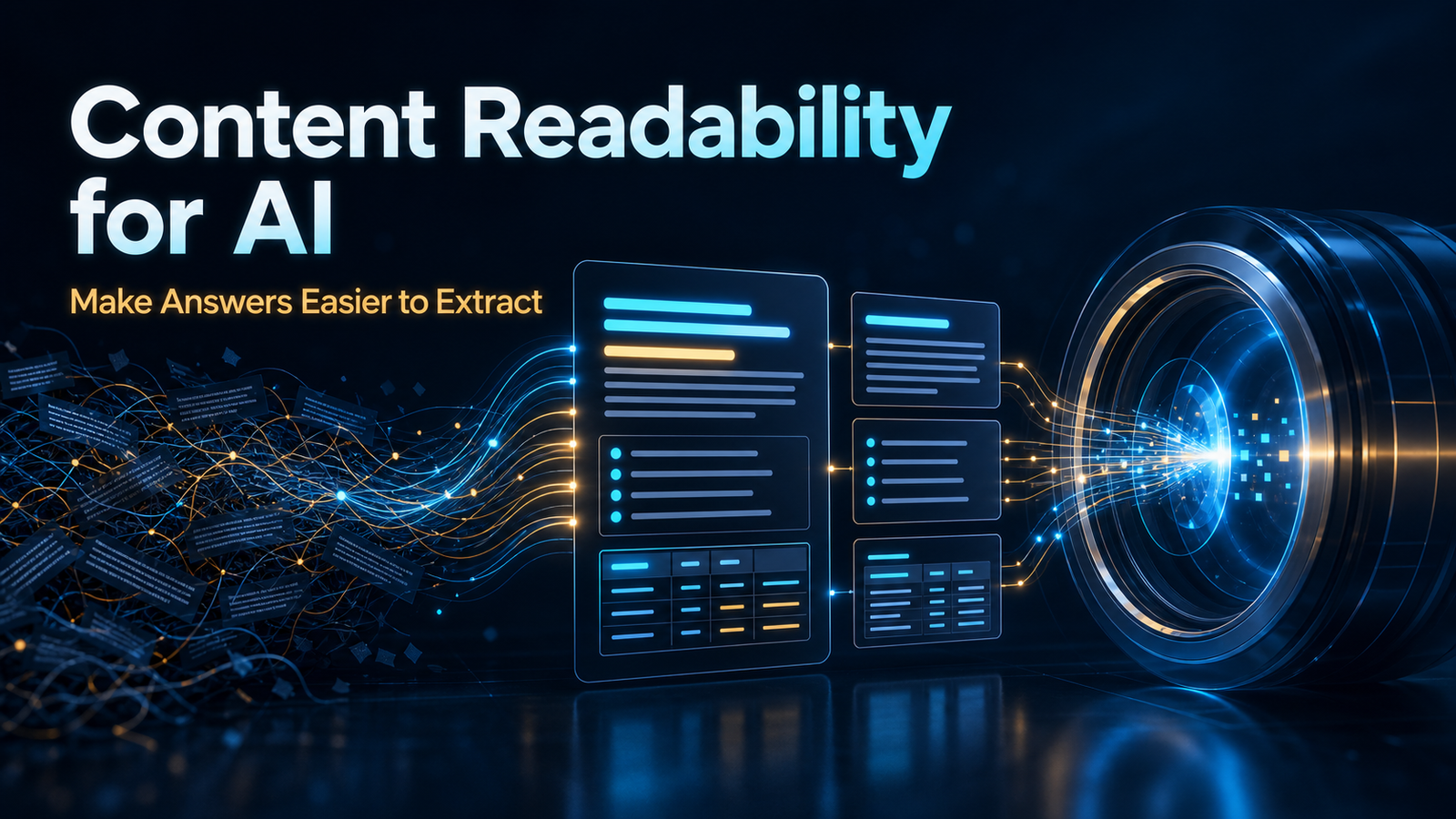
Content readability for AI is the practice of writing and structuring webpages so AI systems can identify questions, extract answers, understand relationships, and retrieve useful passages with less ambiguity. It is not about chasing a single readability score. Clear headings, concise answers, consistent terminology, short paragraphs, lists, tables, and logical information flow make content easier for humans and machines to process.
Table of Contents
- What Does Content Readability for AI Mean?
- Can AI Engines Understand Difficult or Complex Content?
- What Makes Content Easy for AI to Extract?
- How Do Clear Headings Help?
- How Do Direct Answers Help?
- Why Do Short Paragraphs Help?
- Why Does Consistent Terminology Matter?
- How Do Lists and Tables Help?
- Does Sentence Length Matter for AI Extraction?
- Does Reading Level Affect AI Search Visibility?
- How Should You Structure Content for AI Extraction?
- Why Do Headings Matter for AI Search?
- How Does Readability Relate to AEO?
- Does Readability Affect AI Citations?
- What Are Common Content Readability Mistakes?
- How Do You Improve Content Readability for AI?
What Does Content Readability for AI Mean?
Content readability for AI means making information clear enough for retrieval and extraction systems to identify the main idea, supporting context, and answer-worthy passages. It includes human readability, but it also adds machine extractability.
Human readability focuses on:
- Understanding.
- Clarity.
- Flow.
- Vocabulary.
- Sentence complexity.
- Paragraph length.
AI-oriented readability also considers:
- Clear information hierarchy.
- Explicit relationships.
- Well-defined answers.
- Consistent terminology.
- Structured information.
- Descriptive headings.
- Scannable sections.
A human can often infer meaning from context, design, and prior knowledge. AI systems need content that can be retrieved, parsed, chunked, and matched to a question. Clear structure helps that process.
According to Google’s AI features documentation, Google AI Overviews and AI Mode surface relevant links and use Search fundamentals. That means content must still be crawlable, useful, and understandable. Readability supports that foundation, but it does not replace SEO, AEO, or GEO.
Can AI Engines Understand Difficult or Complex Content?
AI engines can understand difficult and technical content, but unnecessary complexity can make information harder to identify, extract, and present accurately. Complex does not mean impossible for AI. Unclear means risky.
Compare these two sentences:
The implementation of optimization methodologies pertaining to the improvement of website discoverability can enhance indexing outcomes.
SEO improves how easily search engines discover your website.The second sentence is clearer. It uses fewer words, names the subject directly, and states the outcome plainly. It does not remove meaning. It removes friction.
This distinction matters for content readability for AI. Technical content can remain technical when the audience needs precision. But writers should remove needless abstraction, filler, and vague phrasing.
A developer article can use terms like JSON-LD, canonicalization, crawl budget, and server rendering. It should define those terms and connect them clearly. Simplifying important terminology too much can reduce accuracy. The goal is not to dumb down content. The goal is to make complex ideas clear.
What Makes Content Easy for AI to Extract?
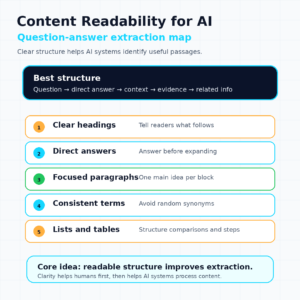
Content is easier for AI to extract when it has clear headings, direct answers, focused paragraphs, consistent terminology, and structured formats like lists and tables. These elements help both readers and retrieval systems locate useful passages.
How Do Clear Headings Help?
Clear headings tell readers and machines what comes next. A vague heading creates uncertainty. A descriptive heading creates an extraction target.
Weak heading:
The Bigger PictureStronger heading:
How Does Internal Linking Improve SEO?The stronger heading is easier to map to a user question. It also helps the page become more scannable.
How Do Direct Answers Help?
Direct answers help because they put the answer close to the question. This is central to AEO for ChatGPT and other answer engine workflows.
Example:
What is AEO?

AEO is the practice of structuring content so answer engines can extract clear, direct answers from a webpage.
Answer first. Then add detail.
Why Do Short Paragraphs Help?
Short, focused paragraphs reduce ambiguity. One paragraph should communicate one main idea whenever possible.
Long paragraphs often mix definitions, examples, caveats, and conclusions. That makes content harder to scan and harder to extract cleanly.
Why Does Consistent Terminology Matter?
Consistent terminology helps machines connect repeated concepts. If an article says AI crawler in one section, then randomly switches to AI spider, artificial intelligence bot, machine crawler, and AI robot, it can create unnecessary ambiguity.
Use synonyms only when they mean something different or when you define them clearly.
How Do Lists and Tables Help?
Lists and tables help when they make information easier to compare, scan, or extract. Use them for:
- Steps.
- Definitions.
- Features.
- Pros and cons.
- Checklists.
- Comparisons.
- Ranking factors.
According to Nielsen Norman Group research, 79% of test users scanned new webpages, while only 16% read word by word. The same research found that concise text improved measured usability by 58%, and scannable layout improved usability by 47%. These are human usability findings, but the same scannable structures also help content become clearer for extraction.
Does Sentence Length Matter for AI Extraction?
Sentence length can affect clarity, but shorter is not automatically better. The goal is clear and natural writing, not robotic writing.
A useful sentence can be moderately long if it expresses one idea clearly:
AI search systems retrieve information from multiple sources and may use different mechanisms to identify relevant passages depending on the system and query.A sentence can also be too fragmented:
AI searches. They retrieve information. They use sources. They find passages.The second version is short, but it feels choppy and less useful. Good content readability for AI balances clarity with natural flow.
Use this rule: if a sentence has several ideas, split it. If several short sentences create a robotic rhythm, combine them. Read the paragraph aloud. If it sounds unnatural, revise it.
Triomize favors short, direct sentences for AEO because answer engines need clean passages. But content should still sound human.
Does Reading Level Affect AI Search Visibility?
There is no known universal AI reading level that guarantees AI search visibility. Technical content can perform well when it is accurate, well-structured, and appropriate for the audience.
A Flesch score or grade-level score can help writers notice dense prose. It should not become the goal. Expert audiences often need technical terms. Removing those terms can make content less accurate.
For example, an article about structured data should use terms like Schema.org, JSON-LD, Article schema, Person schema, and BreadcrumbList. The solution is not to remove those terms. The solution is to define them and explain how they relate.
The correct goal is:
Make complex ideas clear without removing necessary complexity.This is the right approach for AI content readability. Clear does not mean simplistic. It means understandable, organized, and accurate.
How Should You Structure Content for AI Extraction?
You should structure content for AI extraction with a question, direct answer, explanation, evidence, and related information. This creates a predictable flow that supports users, search engines, and AI systems.
A strong structure looks like this:
| Step | Purpose |
|---|---|
| Question | Identifies what the reader wants to know |
| Direct answer | Provides the answer immediately |
| Explanation | Adds context and nuance |
| Evidence or example | Supports the answer |
| Related information | Connects the topic to deeper resources |
Example:
Question: Does internal linking help AI search?
Direct answer: Internal linking can help AI search indirectly by improving discovery and context.
Explanation: Links connect related pages and show topic relationships.
Example: A schema article can link to entity SEO, AI visibility, and technical SEO.
Related information: Link to the internal linking strategy guide.
This structure works because it respects both human reading behavior and machine extraction. It is also useful for AI Search Optimization.
Why Do Headings Matter for AI Search?
Headings matter for AI search because they create an information hierarchy. They help users scan and help machines identify the role of each section.
A clear heading structure might look like this:
H1: How Does Readability Affect AI Search?
H2: What Is Content Readability?
H2: What Makes Content Easy for AI to Extract?
H3: Use Clear Headings
H3: Give Direct Answers
H3: Use Consistent Terminology
This is much clearer than one long page of text with no section labels.
Headings also make internal linking easier. A page with clear sections can link naturally to Internal Linking Strategy, Structured Data Types, or Topical Authority where those topics appear.
Poor headings create weak context. Good headings make the page easier to navigate and easier to extract.
How Does Readability Relate to AEO?
Readability relates to AEO because answer engine optimization depends on clear, extractable answers. SEO makes content discoverable. AEO makes content easier to identify as an answer to a question. Readable structure helps communicate that answer clearly.
Think of it this way:
SEO → discovery
AEO → answer extraction
Readable structure → clear communication
Readability is not a replacement for AEO. It is one component of answer-ready content.
Good AEO content uses:
- Question-based headings.
- Direct answers.
- Short paragraphs.
- Lists.
- Tables.
- FAQs.
- Consistent terminology.
- Clear internal links.
This is why content readability for AI fits naturally into the Triomize approach. SEO helps the page get found. AEO helps the answer get extracted. GEO helps the source become more trustworthy and citable.
Does Readability Affect AI Citations?
Readability alone does not determine whether an AI engine cites a webpage. Citation decisions can depend on relevance, authority, content quality, freshness, accessibility, entity understanding, retrieval systems, and the user’s query.
Readable, well-structured content can make useful information easier to identify. That can support AI citations, but there is no guaranteed citation formula based on readability.
The GEO study from Princeton University, Georgia Tech, Allen Institute, and IIT Delhi tested optimization tactics across 10,000 queries and nine datasets. It found that adding statistics, citations, and authoritative language improved visibility in generative engine responses by roughly 30% to 40% on its primary metric. It also found that fluency and easy-to-understand changes improved visibility by 15% to 30% in tested settings.
That research supports the idea that clearer presentation can help. It does not mean a readability score guarantees citations.
For AI citations, content still needs trust, sources, topical depth, and access. Readability helps AI systems extract the right passage. Trust helps them decide whether to use it.
What Are Common Content Readability Mistakes?
Common content readability mistakes make content harder for humans and machines to understand. Most of them come from trying to sound smarter, longer, or more optimized than necessary.
Avoid these mistakes:
- Writing for algorithms instead of people. Helpful content should still sound human.
- Excessive jargon. Define technical terms when they matter.
- Extremely long paragraphs. Break ideas into focused sections.
- Vague headings. Use headings that describe the answer or topic.
- Answers buried beneath introductions. Answer first, expand second.
- Inconsistent terminology. Use the same term when the concept is the same.
- Excessive keyword repetition. Repetition does not create clarity.
- Over-simplifying technical concepts. Do not remove necessary precision.
- Using AI-generated filler. Empty wording weakens trust and extraction.
- Treating readability scores as ranking scores. Scores are tools, not algorithms.
The best content is clear, useful, and specific. It does not hide weak information behind polished language.
How Do You Improve Content Readability for AI?
You improve content readability for AI by making each section easier to understand, scan, and extract. The goal is to help readers first and make machine interpretation easier as a result.
Use this checklist:
- Start sections with clear questions or topic statements.
- Answer important questions directly.
- Use descriptive headings.
- Keep paragraphs focused.
- Use lists when they improve comprehension.
- Use tables for real comparisons.
- Define technical terms.
- Keep terminology consistent.
- Remove unnecessary filler.
- Preserve necessary technical detail.
- Link to relevant supporting content.
- Review the article for both human and machine clarity.
For example, if a section mentions schema, link to Schema Markup for AI Search. If it mentions AI visibility, link to AI Visibility. If it mentions answer extraction, link to AEO for ChatGPT.
Triomize can help by checking whether content is structured for SEO, AEO, and GEO, including direct answers, headings, readability, schema opportunities, and internal links.
Frequently Asked Questions
What is content readability for AI?
Does readability affect AI search?
Can AI engines understand complex content?
Does Flesch readability affect AI rankings?
How do I make content easier for AI to understand?
Does readable content get more AI citations?
Should I simplify technical content for AI?