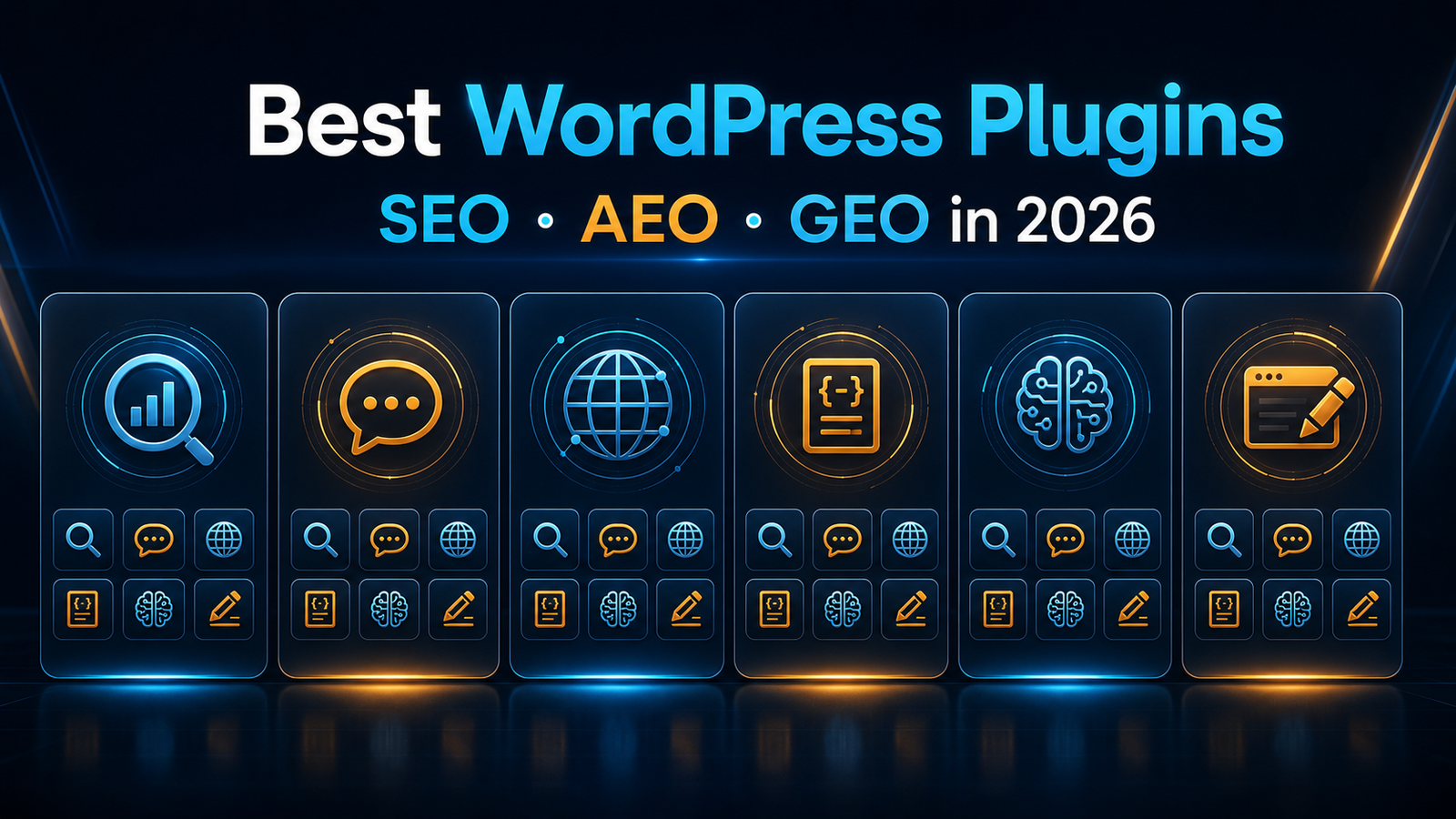
Best WordPress Plugins for SEO, AEO, and GEO are tools that help website owners improve traditional search visibility, answer readiness, and AI citation readiness from inside WordPress. There is no single best plugin for every website. Yoast SEO, Rank Math, AIOSEO, SEOPress, The SEO Framework, and Triomize each serve different needs. The right choice depends on your technical SEO setup, content workflow, schema needs, AI search goals, performance priorities, and budget.
Table of Contents
- What Are the Best WordPress Plugins for SEO, AEO, and GEO in 2026?
- Which Are the Best WordPress Plugins for SEO, AEO, and GEO?
- When Should You Choose Yoast SEO?
- When Should You Choose Rank Math?
- When Should You Choose All in One SEO?
- When Should You Choose SEOPress?
- When Should You Choose The SEO Framework?
- Where Does Triomize Fit?
- What Does Triomize Do Differently?
- How Does Triomize Combine SEO, AEO, and GEO?
- How Does Editor-Based Optimization Help?
- How Does Triomize Handle Indexing Workflows?
- How Do AI Crawler Checks Help?
- How Does Triomize Support Author Trust?
- How Does Triomize Support AEO?
- How Does Triomize Support GEO?
- Can Triomize Replace Yoast, Rank Math, or AIOSEO?
- Which WordPress Plugin Should You Choose?
- What Should You Look for in a WordPress SEO Plugin in 2026?
- Does the Best WordPress SEO Plugin Guarantee Better Rankings?
What Are the Best WordPress Plugins for SEO, AEO, and GEO in 2026?
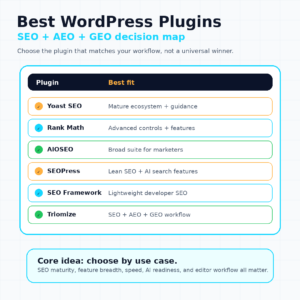
The Best WordPress Plugins for SEO, AEO, and GEO in 2026 include Yoast SEO, Rank Math, AIOSEO, SEOPress, The SEO Framework, and Triomize. Each plugin has a different strength, and the best choice depends on what your website needs.
Here is the practical shortlist:
| Plugin | Best For |
|---|---|
| Yoast SEO | Established all-round SEO plus growing AI capabilities |
| Rank Math | Feature-rich SEO and advanced configuration |
| AIOSEO | Beginners, business owners, and marketing teams |
| SEOPress | Lightweight SEO plus emerging AI, AEO, and GEO capabilities |
| The SEO Framework | Lightweight, developer-focused SEO |
| Triomize | SEO, AEO, and GEO optimization inside the WordPress editor |
This article does not name one universal winner. A plugin that is excellent for a large WooCommerce store may be too complex for a small publisher. A lightweight plugin may be perfect for a developer but too minimal for a beginner. A newer AI search plugin may solve AEO and GEO gaps that traditional SEO plugins do not emphasize.
The important question is not, “Which plugin is famous?” The better question is, “Which plugin matches the search visibility problems my website actually has?”
That means evaluating SEO, AEO, and GEO separately:
- SEO helps pages get crawled, indexed, ranked, and technically understood.
- AEO helps pages answer questions clearly and get extracted by answer engines.
- GEO helps pages become trusted, citable sources for AI search systems.
For the strategy behind those three layers, read SEO vs AEO vs GEO.
Which Are the Best WordPress Plugins for SEO, AEO, and GEO?
The best WordPress SEO plugins in 2026 still include long-established SEO platforms, but the market is shifting. AI search, Google AI Overviews, ChatGPT Search, Perplexity, and Gemini are forcing plugin makers to think beyond meta titles and XML sitemaps.
According to WordPress.org plugin listings and current product positioning, the major plugins now differ by ecosystem maturity, feature breadth, AI readiness, performance, and content workflow. For example, current comparison data reports Yoast at 13M+ active installs, Rank Math at 3M+ to 4M+ installs, AIOSEO at 3M+ installs, SEOPress at about 300K+ installs, and The SEO Framework as a lighter developer-focused option. Recent plugin comparisons also tend to conclude that different plugins win for different use cases rather than one plugin dominating every category.
The following breakdown is practical, not tribal. Each plugin can be the right choice in the right situation.
When Should You Choose Yoast SEO?
Yoast SEO is best for websites that want a mature SEO ecosystem, content guidance, schema handling, XML sitemaps, and a familiar WordPress workflow. It has been one of the most established WordPress SEO plugins for many years.
According to the Yoast SEO WordPress.org listing, Yoast includes automated meta tag optimization, canonical URLs, XML sitemaps, Schema.org integration, breadcrumb control, and real-time guidance. Yoast also now markets itself around AI readiness, built-in AI tools, and improved structured data understanding for search engines and AI systems.
Yoast is strong for:
- On-page SEO guidance.
- Readability checks.
- XML sitemaps.
- Schema output.
- Breadcrumbs.
- Canonicals.
- Large ecosystem maturity.
- Editorial teams familiar with its traffic light workflow.
Yoast is not always the lightest option, and some advanced features require premium products. But for many teams, its maturity and documentation make it a safe choice.
Verdict: Yoast SEO is a strong choice for businesses wanting a mature SEO ecosystem with increasingly sophisticated AI features.
When Should You Choose Rank Math?
Rank Math is best for users who want a large feature set and advanced SEO controls from one plugin. It is popular with site owners who want many SEO tools inside WordPress without installing multiple smaller plugins.
According to the Rank Math WordPress.org listing, the plugin includes content analysis, Google Search Console integration, Google Analytics integration, XML sitemaps, schema types, WooCommerce SEO, Elementor support, Divi support, Local SEO tools, migration from other SEO plugins, and Content AI features.
Rank Math is strong for:
- Feature breadth.
- Schema configuration.
- WooCommerce SEO.
- Local SEO.
- Redirects.
- Search Console data.
- Elementor and Divi integrations.
- Advanced users who want control.
Rank Math may feel feature-heavy for users who want minimal settings. But for power users, that breadth is the appeal.
Verdict: Rank Math is a strong choice for users who want a large feature set and substantial control from one plugin.
When Should You Choose All in One SEO?
All in One SEO, often called AIOSEO, is best for users who want a broad SEO suite designed for business owners, beginners, and marketing teams. It focuses on making common SEO tasks easier inside WordPress.
According to the AIOSEO WordPress.org listing, the plugin includes SEO settings, AI SEO tools, schema markup, XML sitemaps, local SEO, keyword rank tracking, internal linking features, redirects, SEO audits, Author SEO, WooCommerce SEO, and Google Search Console connections.
AIOSEO is strong for:
- Beginner-friendly setup.
- Broad SEO features.
- Schema and rich results.
- Local SEO.
- WooCommerce SEO.
- SEO audits.
- Marketing workflows.
- Author SEO features.
- Internal linking features.
AIOSEO can be a good fit when a team wants one broad toolkit rather than separate specialist plugins.
Verdict: AIOSEO is a good choice for businesses wanting a broad SEO toolkit without assembling multiple specialist plugins.
When Should You Choose SEOPress?
SEOPress is best for users who want a leaner SEO plugin with strong fundamentals and growing AI-search positioning. It is especially interesting because it now explicitly discusses AEO, GEO, llms.txt, and agent readiness.
According to the SEOPress WordPress.org listing, SEOPress advertises AI-powered metadata, Schema, XML sitemaps, redirections, Search Console features, llms.txt, Agent Readiness, Google Indexing API, IndexNow, image SEO, and AEO and GEO capabilities.
SEOPress is strong for:
- Lightweight SEO workflows.
- Privacy-first positioning.
- XML sitemaps.
- Schema.
- Redirects.
- Image SEO.
- IndexNow.
- Google Indexing API.
llms.txtsupport.- AI search positioning.
SEOPress may not have the same mass-market recognition as Yoast or Rank Math, but it is increasingly relevant for AI search conversations.
Verdict: SEOPress is a strong option for users who want a relatively lean SEO plugin while also exploring AI-search optimization.
When Should You Choose The SEO Framework?
The SEO Framework is best for users who value speed, automation, minimalism, and developer-friendly SEO. It is often positioned as the lightweight alternative to larger SEO suites.
Recent WordPress SEO plugin comparisons continue to describe The SEO Framework as a strong choice for developers, agencies, and experienced users who want technical SEO handled quietly without a heavy interface. It focuses more on clean automation and less on aggressive content scoring or AI search workflows.
The SEO Framework is strong for:
- Lightweight performance.
- Minimal interface.
- Automated technical SEO.
- Clean defaults.
- Developer-friendly usage.
- Less dashboard noise.
- Simpler setup.
It is weaker if you want extensive AI search features, AEO guidance, GEO scoring, or a large content optimization suite.
Verdict: The SEO Framework is a good choice if performance, simplicity, and minimal intervention matter more than a large feature suite.
Where Does Triomize Fit?
We cannot call Triomize the best WordPress plugin simply because we built it. That would not be credible.
Triomize is newer than established plugins such as Yoast, Rank Math, AIOSEO, SEOPress, and The SEO Framework. It does not have the installation history, ecosystem depth, documentation footprint, or years of market validation those products have.
Rather than declaring Triomize the winner, it is more useful to explain where Triomize is different.
Triomize is built around the idea that modern visibility now has three layers:
SEO foundation → AEO answer structure → GEO citation readinessMost traditional SEO plugins began with classic SEO needs such as meta titles, descriptions, sitemaps, schema, social previews, and technical settings. Some are now expanding into AI search. Triomize starts from the SEO, AEO, and GEO framework itself.
That makes Triomize useful for teams asking questions like:
- Is this post optimized for Google Search?
- Does this post answer the query clearly?
- Does the content include FAQ structure?
- Does the page have schema opportunities?
- Are AI crawlers able to access important content?
- Does the page include author and brand trust signals?
- Is the content ready for AI search visibility?
Triomize is not trying to pretend that classic SEO no longer matters. It treats SEO as the foundation and then layers AEO and GEO on top.
What Does Triomize Do Differently?
Triomize does a few things differently from traditional WordPress SEO plugins. Its strength is not only in one feature. It is in connecting SEO, AEO, and GEO into the same content workflow.
How Does Triomize Combine SEO, AEO, and GEO?
Triomize does not treat SEO, AEO, and GEO as completely separate products. Its approach is layered:
SEO foundation → AEO → GEOThis matters because a page can rank but fail to answer clearly. A page can answer clearly but lack trust signals. A page can have trust signals but be blocked from crawling. The three layers need to work together.
How Does Editor-Based Optimization Help?
Triomize checks content where it is actually being written and edited. This reduces the need to jump between multiple dashboards.
For WordPress publishers, this is practical. Writers and editors can see optimization gaps while working on the post, not after publication.
How Does Triomize Handle Indexing Workflows?
Triomize can help with indexing submission workflows through supported indexing mechanisms. It should not be described as a tool that guarantees instant indexing on Google. No WordPress plugin can guarantee that.
A more accurate statement is this:
Triomize can help submit eligible content for faster discovery through supported indexing mechanisms.That keeps the claim honest.
How Do AI Crawler Checks Help?
Triomize includes AI crawler accessibility checks and relevant Robots.txt review signals. This helps site owners understand whether important content is accessible to AI crawlers.
This connects directly to AI Crawler Monitoring and Robots.txt for AI Crawlers.
How Does Triomize Support Author Trust?
Triomize’s GEO checks can look at author identity, author bio, external profile links, Person schema, Organization signals, and brand consistency.
That matters because AI search visibility increasingly depends on trust, authorship, and entity clarity. For more detail, read Author Bio SEO.
How Does Triomize Support AEO?
Triomize can evaluate answer intent, FAQ presence, FAQ schema opportunities, answer-oriented structure, and content clarity.
This makes it relevant for AEO and answer-led search workflows.
How Does Triomize Support GEO?
Triomize can evaluate AI crawler access, Organization signals, brand consistency, author signals, content trust, and citation readiness.
That makes it useful for teams thinking beyond rankings and toward AI Visibility.
Can Triomize Replace Yoast, Rank Math, or AIOSEO?
Triomize may replace a traditional SEO plugin for some websites, but not necessarily for every website. The right decision depends on the existing setup, technical needs, migration risk, AI-search priorities, content workflow, budget, and site complexity.
If a website already uses Yoast, Rank Math, or AIOSEO successfully, it may not need to migrate immediately. The team may instead look for AEO or GEO capabilities that complement its existing setup.
Consider these questions before replacing a plugin:
- Does the current plugin manage existing schema?
- Are sitemaps already stable?
- Are redirects stored in the plugin?
- Does WooCommerce depend on SEO plugin settings?
- Would migration affect metadata?
- Does the site need AI crawler checks?
- Does the team need AEO and GEO scoring?
- Does the editorial team work inside the WordPress editor?
No plugin switch should be casual. SEO plugins often store critical metadata.
A safer approach is to audit the current setup first. Then decide whether to migrate, supplement, or keep the existing plugin.
Which WordPress Plugin Should You Choose?
The right WordPress plugin depends on your website’s priorities. There is no universal winner.
Choose Yoast SEO if you want a mature ecosystem, familiar editorial guidance, schema, sitemaps, and growing AI-related capabilities.
Choose Rank Math if you want extensive features, advanced controls, multiple integrations, and a broad SEO toolkit inside WordPress.
Choose AIOSEO if you want a broad SEO suite designed for marketers, business owners, WooCommerce sites, and teams that prefer guided workflows.
Choose SEOPress if you want a leaner plugin with strong SEO fundamentals and increasingly visible AEO, GEO, llms.txt, and AI search positioning.
Choose The SEO Framework if you prioritize simplicity, automation, low overhead, and developer-friendly SEO without a large content optimization interface.
Consider Triomize if you specifically want to optimize SEO, AEO, and GEO together, particularly from within the WordPress editing workflow.
A simple decision table:
| Need | Best fit |
|---|---|
| Mature SEO ecosystem | Yoast SEO |
| Broad feature set | Rank Math |
| Marketing-friendly suite | AIOSEO |
| Lean SEO plus AI-search features | SEOPress |
| Minimal developer-focused SEO | The SEO Framework |
| SEO, AEO, and GEO editor workflow | Triomize |
The best choice is the plugin that matches your workflow and avoids unnecessary complexity.
What Should You Look for in a WordPress SEO Plugin in 2026?
A WordPress SEO plugin in 2026 should support technical SEO, structured data, content optimization, and AI search readiness. The exact features you need depend on the site.
Look for:
- Technical SEO controls.
- XML sitemaps.
- Canonical URL handling.
- Schema markup.
- Breadcrumb support.
- Internal linking guidance.
- Content analysis.
- Indexing controls.
- Author and entity signals.
- AEO capabilities.
- AI crawler accessibility checks.
- GEO analysis.
- Performance-friendly architecture.
- Transparent scoring.
- Ease of use.
- Safe migration options.
For AI search, the key question is whether the plugin helps your content become easier to discover, understand, answer, and cite.
For the broader framework, read AI Search Optimization, Structured Data Types, Content Readability for AI, and Internal Linking Strategy.
Does the Best WordPress SEO Plugin Guarantee Better Rankings?
No WordPress SEO plugin can guarantee rankings, AI citations, or traffic. Plugins can help identify and implement optimization opportunities, but search performance depends on many factors.
Rankings and AI visibility can depend on:
- Content quality.
- Search intent.
- Technical accessibility.
- Authority.
- Competition.
- Internal links.
- Backlinks.
- Topical authority.
- Schema accuracy.
- Page experience.
- Freshness.
- Brand trust.
- AI crawler access.
A plugin is a tool. It can make good workflows easier. It cannot make weak content authoritative by itself.
The best plugins help you make better decisions. They do not replace strategy, expertise, or useful content.
Frequently Asked Questions
What are the Best WordPress Plugins for SEO, AEO, and GEO in 2026?
Which WordPress SEO plugin is best for beginners?
Is Yoast better than Rank Math?
Is Rank Math better than Yoast?
Which WordPress plugin is best for AI search?
Can WordPress plugins optimize content for AI search?
What is the difference between SEO, AEO, and GEO?
Can Triomize replace traditional SEO plugins?
Does an SEO plugin guarantee Google rankings?