
AEO vs SEO is one of the most misunderstood debates in search this year. SEO is the practice of getting your page ranked in search results. AEO, or Answer Engine Optimization, is the practice of getting the answer on your page pulled out of it and displayed directly as the result. Both matter in 2026, and you cannot do AEO well without doing SEO first.
Table of Contents
- What is SEO in 2026?
- What is AEO and how does it work?
- AEO vs SEO: how do they actually differ?
- Does AEO replace SEO?
- Why does the AEO vs SEO conversation matter in 2026?
- How to optimize for AI search: the unified SEO + AEO playbook
- AEO best practices checklist
- How to optimize for ChatGPT and other AI answer engines
- Measure both engines at once
- Key takeaways
The AEO vs SEO conversation has real numbers behind it. According to SparkToro’s 2024 zero-click search study, 58.5% of U.S. Google searches now end with no click at all, and Ahrefs research across 2 million featured snippets shows the traditional position one loses roughly 24% of its click share whenever a snippet appears. That gap between ranking and getting the click is what AEO exists to close.
If you have read anywhere that AEO is replacing SEO, that is a hot take, not a strategy. The truth on AEO vs SEO is more useful. AEO is a discipline that sits on top of SEO, not a replacement for it. Every AEO win depends on the underlying page being crawled, indexed, and understood by traditional search infrastructure first. This is also why Triomize scores SEO and AEO as two separate 100-point engines instead of averaging them into one. Triomize runs 23 SEO checks and 12 AEO checks on every save so you can see exactly which signal is holding your page back before you publish.
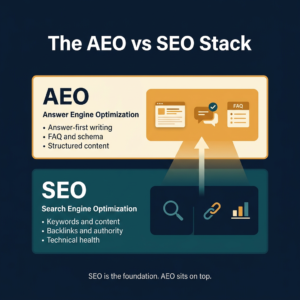
This guide walks through what each acronym actually means, how the two disciplines differ, why they complement each other, and a practical checklist for optimizing for both at once.
What is SEO in 2026?
Search Engine Optimization is the practice of optimizing content and websites so they rank on classic search engines like Google and Bing. It has been around for roughly 27 years and it still drives an estimated 53% of all trackable website traffic according to BrightEdge’s Organic Search Report.
The core SEO signals in 2026 are the same ones that have mattered for a decade, refined for a search landscape that now includes AI:
- Keywords and topical relevance. Your page needs to clearly signal what it is about.
- Backlinks. External sites linking to yours remain one of Google’s strongest ranking signals.
- Technical health. Page speed, mobile responsiveness, and Core Web Vitals scores.
- Content depth and quality. Google’s helpful content system rewards pages that genuinely answer the query.
- Entity clarity and schema. Structured data helps engines understand who wrote what, when, and about what topic.
SEO is the foundation of every other search discipline in 2026. If your SEO is broken, nothing above it works. AI cannot cite a page it cannot find.
What is AEO and how does it work?
Answer Engine Optimization is the practice of structuring content so that search engines can extract a direct answer from it and display that answer as the result, whether that appears in a Google featured snippet, a voice assistant response, a Google AI Overview, or an FAQ card.
The idea is not new. Featured snippets have been on Google since 2014. What changed in 2026 is scale. Google AI Overviews now appear on close to 50% of U.S. desktop queries by mid-2024, up from under 10% earlier that year, per BrightEdge’s generative AI research. Every one of those Overview boxes is an answer engine pulling from a source page. If your content is not structured for extraction, you will not be that source, no matter how well you rank.
The core AEO signals are:
- Answer-first writing. The direct answer appears in the first 100 words of the page.
- Question-shaped headings. H2s and H3s phrased as questions users would type or speak.
- Structured content. Tables, ordered lists, definition blocks, and FAQ sections.
- Short average sentence length. Extractable passages tend to average 15 to 20 words per sentence.
- FAQPage and HowTo schema. JSON-LD markup that tells search engines exactly which text is a question and which is the answer.
If SEO is about being findable, AEO is about being extractable.
AEO vs SEO: how do they actually differ?
They differ in what they optimize for, what surfaces they target, and what signals move the needle. Roughly 12.3% of all search queries return a featured snippet according to Ahrefs research on 2 million snippets, and when they do, the traditional position one loses about 24% of its click share to whichever page wins the box. That gap is exactly what AEO is designed to close, and it is why the two disciplines need to be measured separately even though they overlap.
| Attribute | SEO | AEO |
|---|---|---|
| Goal | Rank on the search results page | Win the answer box on the results page |
| Primary surface | Google and Bing blue links | Featured snippets, voice answers, FAQ cards, AI Overviews |
| Age as a discipline | 27+ years | 10+ years |
| Strongest signal | Backlinks, content depth, technical health | Answer-first structure, schema, short sentences |
| Schema focus | Organization, Article, BreadcrumbList | FAQPage, HowTo, Speakable |
| Content style | Comprehensive, keyword-optimized | Structured, question-driven, extractable |
| Measurement | Rankings, organic traffic, clicks | Featured snippet share, voice appearances, AI Overview citations |
| Depends on | Nothing (foundational) | SEO |
Notice the last row. AEO inherits everything from SEO. That is why the discipline is called stacking, not switching.
Does AEO replace SEO?
No. AEO does not replace SEO because AEO literally depends on it.
Answer engines and AI Overviews retrieve their candidate answers from the same web index Google and Bing already crawl. If your page cannot be indexed or does not rank well enough to enter the candidate pool, it will not be pulled into an answer box regardless of how perfectly structured the content is. A 2024 study by SEMrush across 10,000 AI-cited pages found that 68% of URLs featured in Google AI Overviews also ranked in the traditional top 10 organic results for the same query, and only 8% of cited URLs ranked outside the top 20.
That is the whole game. AEO amplifies SEO, it does not bypass it.
The right mental model is a stack:
- SEO makes the page findable and indexable.
- AEO makes the page extractable into snippets, voice answers, and AI Overviews.
Skip the base and the whole thing falls over. This is why the Triomize plugin scores SEO and AEO as independent 100-point engines instead of collapsing them into one. A page that scores 90 on AEO but 40 on SEO is a page that will never actually be extracted, because search engines will never surface it in the first place.
Why does the AEO vs SEO conversation matter in 2026?
Because the way people search has changed and traffic patterns have changed with it. Three data points explain the shift.
- 58.5% of U.S. Google searches and 59.7% of EU Google searches now end without a single click, according to SparkToro’s 2024 zero-click search study.
- When an AI summary appears in Google results, users click a traditional link on just 8% of visits, compared with 15% when no summary is shown, per a Pew Research Center study. That is roughly a 47% drop in click-through when AI answers the query.
- Featured snippets, according to Ahrefs research on 2 million snippets, capture roughly 8.6% of clicks while position one drops to 19.6% instead of the usual 26% when a snippet is present.
Translation: ranking number one is not enough anymore. If you are not also winning the snippet, the AI Overview, or the voice answer, you are watching that traffic go to whoever is. AEO closes that gap. SEO alone does not.
How to optimize for AI search: the unified SEO + AEO playbook
You do not need two separate content strategies. You need one strategy that satisfies both engines at the same time. Research from Backlinko across 11.8 million Google search results found that pages with an average of just 40 to 60 words in the target passage win the featured snippet slot most often, and pages that also include structured data are 3x more likely to earn rich results, per Google’s own developer documentation on structured data. Here are the AEO best practices most teams are converging on in 2026, layered on top of solid SEO fundamentals.
AEO best practices checklist
- Lead every article with a direct answer in the first 100 words.
- Phrase H2s and H3s as questions or concise topic statements.
- Include a real FAQ block with 3 or more question and answer pairs, each answer 20 to 80 words.
- Add at least one table, ordered list, or definition list.
- Keep mean sentence length under 20 words.
- Emit FAQPage and Article schema in JSON-LD.
- Include a standalone definition sentence near the top of the page.
- Show a visible author byline and date above the fold.
- Refresh content at least every 12 months, sooner for fast-moving topics.
How to optimize for ChatGPT and other AI answer engines
ChatGPT Search, Perplexity, and Google AI Overviews all reward the same three things on top of good AEO:
- Original data with outbound citations. Statistics, percentages, or first-party research linked to credible sources.
- Visible author authority. A byline, a real bio, and social profile links the engine can cross-reference.
- Open crawler access. GPTBot, ClaudeBot, PerplexityBot, Google-Extended, and Applebot-Extended all need to be allowed in your robots.txt.
Those three signals belong to the third layer of the search stack, called GEO or Generative Engine Optimization. If you want the fuller playbook on that layer, our complete guide to SEO vs AEO vs GEO walks through how the three engines work together.
Measure both engines at once
Optimizing for two engines without measuring them separately is guesswork. Triomize solves this by scoring every WordPress post live, inside the editor, on three independent 100-point matrices for SEO, AEO, and GEO. The Triomize plugin runs 23 SEO checks and 12 AEO checks on every save so you can see which signal is missing before you publish. If you want to explore what each matrix covers, the SEO scoring matrix and AEO scoring matrix pages walk through every check that Triomize runs against your content.
Key takeaways
- AEO vs SEO is not a choice between two strategies. It is a stack, and modern content needs both.
- SEO is the foundation. It makes content findable and indexable.
- AEO sits on top. It makes content extractable into snippets, voice answers, and AI Overviews.
- AEO does not replace SEO because AEO depends on the same crawlable, indexable page SEO produces.
- The fastest way to optimize for both engines at once is to run a single unified checklist on every post rather than two separate ones.
Pick your next post and run it through both the SEO and AEO checklists at the same time. Fix the weakest signal first. That is the whole playbook.
Frequently Asked Questions
Is AEO replacing SEO?
What is the difference between SEO and AEO in one sentence?
SEO or AEO, which is better for my content in 2026?
What are the most important AEO best practices?
How do I know if my SEO or AEO is working?