
SEO vs AEO vs GEO: what’s the actual difference?
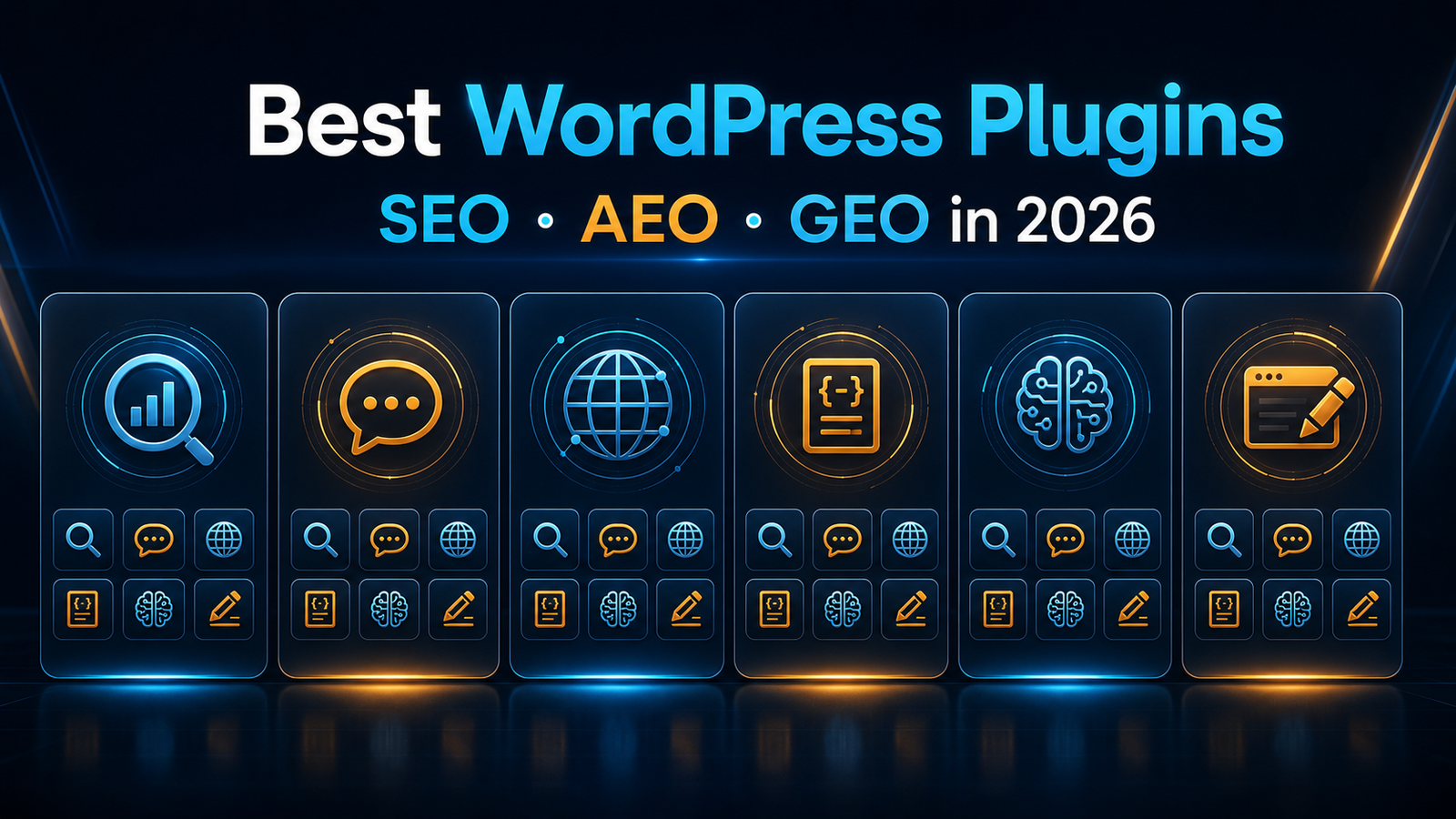
SEO gets you found on Google. AEO gets your answer pulled into featured snippets and voice results. GEO gets your content quoted inside AI answers from ChatGPT, Perplexity, and Google AI Overviews. They are not competing strategies. They are three layers of the same stack, and in 2026 you need all three.
If you have read anywhere that SEO is dead and GEO is replacing it, that is a hot take, not a strategy. The truth is more useful. SEO is the foundation. AEO makes your content extractable. GEO makes it citable. Each one builds on the one below it, and skipping the base layer breaks the top.
This guide walks through what each acronym actually means, how the three disciplines overlap and diverge, when to use which, and a practical checklist for optimizing across all three at once.
What is SEO, AEO, and GEO in plain English?
Three quick definitions before we go deeper.
SEO, or Search Engine Optimization, is the practice of optimizing content so it ranks on classic search engines like Google and Bing. It is the oldest of the three, roughly 27 years old if you date it from the launch of the first search-focused optimization guides in 1997, and it still drives an estimated 53% of all trackable website traffic according to BrightEdge’s Organic Search Report. Focus areas include keywords, backlinks, page speed, and technical crawlability.
AEO, or Answer Engine Optimization, is the practice of structuring content so it can be extracted as a direct answer, whether that appears in a Google featured snippet, a voice assistant response, or an FAQ card. Featured snippets sit above position one and, according to Ahrefs research on 2 million snippets, the page in the snippet captures roughly 8.6% of clicks while position one drops to 19.6% instead of the usual 26%. AEO overlaps heavily with SEO but adds a layer of structural discipline: answer-first writing, question-shaped headings, FAQ schema, and short sentences.
GEO, or Generative Engine Optimization, is the practice of optimizing content so that generative AI engines like ChatGPT, Perplexity, Claude, and Google AI Overviews quote it, cite it, and link back to it inside their answers. It is the newest of the three, roughly 3 years old as a discipline, and the fastest growing.
The relationship looks like this.
| Discipline | Optimizes for | Primary surface | Age | Deep dive |
|---|---|---|---|---|
| SEO | Findability | Google and Bing blue links | 25+ years | SEO scoring matrix |
| AEO | Extractability | Featured snippets, voice answers, FAQ cards | 8+ years | AEO scoring matrix |
| GEO | Citability | ChatGPT, Perplexity, Gemini, AI Overviews | 3+ years | GEO scoring matrix |
Each layer depends on the one below. If Google cannot find your page, AI cannot cite it. If your content is not extractable, it will not be pulled into an answer box or an AI summary. The stack is real and it stacks in that order.
Why does SEO vs AEO vs GEO matter in 2026?
Because the way people search has fractured into three surfaces, and traffic is moving to all three at once. The numbers make the shift hard to ignore.
- 58.5% of U.S. Google searches and 59.7% of EU Google searches now end without a single click, according to SparkToro’s 2024 zero-click search study.
- Google AI Overviews appeared on close to 50% of U.S. desktop queries by mid-2024, up from under 10% earlier that year, per BrightEdge’s generative AI research.
- ChatGPT crossed 300 million weekly active users in late 2024, according to OpenAI’s own reporting.
- When an AI summary appears in Google results, users click a traditional link on just 8% of visits, compared with 15% when no summary is shown, per a Pew Research Center study. That is roughly a 47% drop in click-through when AI answers the query.
- Gartner has forecast that traditional search engine volume will drop 25% by 2026 as users shift to AI assistants, per its emerging tech research.
The old game was to rank number one. The new game has three scoreboards. You still want the rank, but you also want the featured snippet and the AI citation. Optimizing for only one of them in 2026 leaves the other two on the table.
What is the difference between SEO and AEO?
SEO is about getting your page shown in the search results. AEO is about getting the answer on your page pulled out of it and displayed as the result.
A page can rank number one for a query and still lose the click to a featured snippet from position four. Ahrefs found that roughly 12.3% of all search queries return a featured snippet, and when they do, the traditional position one loses about 24% of its click share to whichever page wins the box, based on their analysis of 2 million featured snippets. That is what makes AEO matter as a separate discipline: position alone stops being enough.
The overlap between SEO and AEO is large. Every AEO best practice (answer-first structure, question-shaped headings, clean HTML) also helps SEO. The reverse is not always true. A keyword-optimized page with long, meandering paragraphs will rank fine but almost never win the snippet. Research from Backlinko across 11.8 million Google search results found that pages with an average of just 40 to 60 words in the target passage win the featured snippet slot most often, which is a much tighter constraint than SEO alone would ever suggest.
Bottom line: do both. AEO is not a replacement for SEO, it is a discipline on top of it that captures the traffic SEO alone increasingly cannot.
What is the difference between AEO and GEO?
AEO optimizes for structured answer boxes on search engines. GEO optimizes for citations inside generative AI answers.
The two share a lot of DNA. Both reward answer-first writing, structured content, and clear definitions. But GEO adds signals that AEO does not care about, and those signals are what separate a page that appears in a Google featured snippet from a page that appears in a ChatGPT response.
The key GEO-specific signals are:
- Original data. Statistics, percentages, or first-party research. The Princeton, Georgia Tech, and Allen Institute study GEO: Generative Engine Optimization tested 9 optimization tactics across 10,000 queries and found that adding statistics lifted visibility by 40%, quotations by 41%, and citations by 30.7% inside generative engine responses.
- Author authority. Visible bylines, author bios of 50 words or more, and social profile links (LinkedIn, X, GitHub) that AI engines can cross-reference. Google’s own E-E-A-T guidance now weighs author expertise as a core quality signal, and the same signal is used by LLMs at retrieval time.
- Brand entity signals. Consistent brand mentions paired with Organization schema. Pages using Organization schema are eligible for Google’s knowledge panel and rich results, which strengthens entity recognition for AI engines too.
- Fresh, cited external sources. Not just links, attributed quotes from named experts. A 2024 analysis by Originality.ai found that AI-cited pages contained an average of 4.2 outbound citations, roughly 2.5 times more than non-cited pages in the same query set.
- Open AI crawler access. GPTBot, ClaudeBot, PerplexityBot, Google-Extended, and Applebot-Extended all need to be allowed in robots.txt. Originality.ai’s crawler audit of the top 1,000 websites found that more than 35% block GPTBot alone.
An AEO-optimized page can win a featured snippet without any of those five signals. A GEO-optimized page needs all of them to reliably show up inside AI answers.
Can GEO replace SEO?
No, and this is the most important point in the entire guide. GEO cannot replace SEO because GEO literally depends on it.
Generative AI engines do not have their own private web index. They ground their answers in the same public web that Google and Bing crawl. Perplexity uses Bing, ChatGPT Search uses a combination of Bing and its own crawler, and Google AI Overviews use Google’s index. A 2024 study by SEMrush across 10,000 AI-cited pages found that 68% of URLs cited inside Google AI Overviews also ranked in the traditional top 10 organic results for the same query, and only 8% of cited URLs ranked outside the top 20. In other words, if your page cannot rank, it will almost never be cited.
That is why the “SEO is dead” narrative is wrong. Every GEO signal, from author bylines to schema to fresh content, only matters if the underlying page is technically sound and crawlable. SEO is not the enemy of GEO. It is the prerequisite for it.
The right mental model is stacking, not swapping.
- SEO makes the page findable.
- AEO makes it extractable.
- GEO makes it citable.
Skip the base and the whole stack falls over.
Does SEO still matter in AI search?
Yes, and arguably more than ever. Here is why.
When ChatGPT or Perplexity answers a question, it typically retrieves between 5 and 20 candidate sources from a traditional index, ranks them by relevance and authority, and then synthesizes a response using the top 3 to 5. That retrieval and ranking step is powered by classic search infrastructure, which means the same signals that help you rank in Google, high-quality content, backlinks, technical health, entity clarity, are the same signals that get you into the AI’s candidate pool in the first place.
You cannot be cited if you are not retrieved. You cannot be retrieved if you are not indexed. You cannot be indexed if your SEO is broken. The SEMrush AI Overviews study found the top 3 organic positions accounted for 46% of all AI Overview citations, which is roughly the same distribution as classic click-through by rank.
This is also why the Triomize plugin scores SEO, AEO, and GEO as three independent 100-point engines instead of collapsing them into one, running 23 SEO checks, 12 AEO checks, and 12 GEO checks for a total of 47 signals per post. The signals overlap but they are not the same, and a page that scores 90 on GEO but 40 on SEO is a page that will never actually be cited, because the AI will never find it. If you want to see how the three matrices break down check by check, the SEO, AEO, and GEO matrix pages walk through every one.
SEO vs AEO vs GEO: a side-by-side comparison
| Attribute | SEO | AEO | GEO |
|---|---|---|---|
| Goal | Rank on search engines | Win the answer box | Be cited by AI |
| Primary surface | Google, Bing blue links | Featured snippets, voice, FAQ | ChatGPT, Perplexity, Gemini, AI Overviews |
| Strongest signal | Backlinks, content depth, technical health | Answer-first structure, schema, short sentences | Original data, author authority, fresh citations |
| Schema focus | Organization, Article, BreadcrumbList | FAQPage, HowTo, Speakable | Article, Person, Organization, Citation |
| Content style | Comprehensive, keyword-optimized | Structured, question-driven, extractable | Data-rich, cited, author-attributed |
| Measurement | Rankings, organic traffic, clicks | Featured snippet share, voice appearances | AI citation rate, brand mention frequency |
| Depends on | Nothing (foundational) | SEO | SEO and AEO |
Notice the last row. Each layer inherits everything from the layer below. That is why the discipline is called stacking, not switching.
How to optimize content for LLMs and AI search
Optimizing for LLMs is not a new content strategy. It is a set of additions layered onto solid SEO and AEO. Here is the practical playbook.
How to optimize for ChatGPT
ChatGPT Search retrieves and cites web pages the same way Perplexity does. To increase your odds of being cited:
- Make sure GPTBot is allowed in your robots.txt.
- Lead every article with a direct answer in the first 100 words.
- Include at least one sourced statistic with an outbound link to the original data.
- Show a visible author byline with a date above the fold.
- Add an author bio of 50+ words with a LinkedIn or X link.
How to optimize for Google AI Overview
Google AI Overviews pull from Google’s existing index and prioritize sources that already rank well for the query. To increase your odds of being featured:
- Keep the underlying SEO strong. If you are not in the top 10 organic results, you are unlikely to appear in the Overview.
- Structure the page with clear question-and-answer sections and FAQ schema.
- Include original data and cite external sources within the body, not just at the bottom.
- Make sure Google-Extended is not blocked in robots.txt.
How to rank in AI search
Ranking in AI search is really three things happening at once. First, your page needs to be crawlable and indexable (SEO). Second, it needs to be structured for extraction (AEO). Third, it needs the credibility signals AI engines actually look for (GEO). The Triomize plugin scores all three live inside the WordPress editor so you can see which layer is weakest before you publish, and the free version covers all 47 checks. For a step-by-step version of this workflow, see our WordPress AI SEO checklist.
The unified SEO + AEO + GEO checklist
Instead of running three separate checklists, run one that covers all three engines. This is the shape of it.
- Focus keyword in the title, slug, first H2, and first 100 words (SEO)
- Meta description between 120 and 160 characters with the keyword (SEO)
- One H1 plus 2 or more H2 sections (SEO)
- At least one image with descriptive alt text (SEO)
- Internal links to related posts and 2 or more outbound links to credible sources (SEO + GEO)
- Direct answer in the first 100 words (AEO + GEO)
- 70% of headings phrased as questions or topic statements, adjusted for page type (AEO)
- FAQ block with 3 or more Q&A pairs, each answer 20 to 80 words (AEO)
- At least one table, ordered list, or definition list (AEO)
- Mean sentence length under 20 words (AEO)
- At least one original statistic with an outbound citation (GEO)
- Visible author byline with date above the fold (GEO)
- Author bio of 50+ words with LinkedIn, X, or GitHub links (GEO)
- Brand name mentioned 2 to 3 times naturally with Organization schema configured (GEO)
- Robots.txt allows GPTBot, ClaudeBot, PerplexityBot, Google-Extended, Applebot-Extended (GEO)
- Content updated within the last 12 months, sooner for fast-moving topics (GEO)
Every row on that list is checked live by the Triomize plugin as you write in the WordPress editor, on three independent 100-point engines for SEO, AEO, and GEO. Missing signals get flagged before you publish, which is faster than fixing them after the post goes live and underperforms.
Key takeaways
- SEO vs AEO vs GEO is not a choice between three strategies. It is a stack of three layers, and modern content needs all three.
- SEO is the foundation. It makes content findable and indexable.
- AEO sits on top. It makes content extractable into snippets and voice answers.
- GEO sits on top of that. It makes content citable by AI engines.
- SEO is not dead. It is more important than ever, because everything above it depends on it.
- The fastest way to optimize for all three at once is to run a single unified checklist on every post, rather than three separate ones.
Pick your next post and run it through the unified checklist above. Fix the weakest layer first. That is the whole game.
Frequently Asked Questions
Is SEO dead in 2026?
Can GEO replace SEO for my content strategy?
What is the difference between SEO and AEO in one sentence?
What is the difference between AEO and GEO?
SEO vs GEO for beginners: where should I start?
What is Generative Engine Optimization exactly?