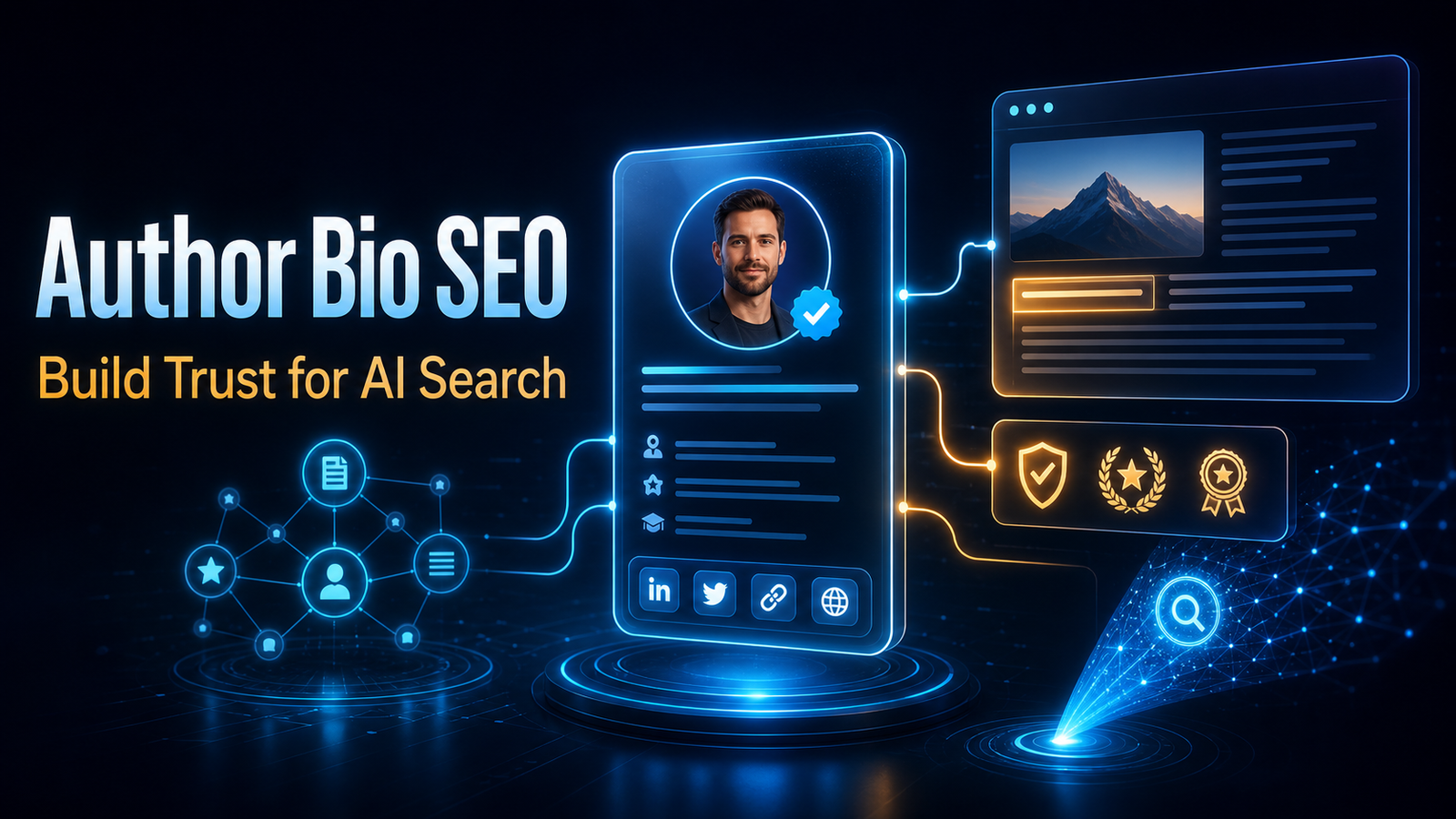
Author bio seo is the practice of using visible author information to prove who created content, why they are qualified, and how readers or search engines can verify their expertise. A strong author bio supports SEO, E-E-A-T, AI search visibility, and trust by connecting each article to a real person or organization. It works best with author pages, author schema, credentials, social profiles, topical expertise, and consistent publishing history.
Table of Contents
- What Is Author Bio SEO?
- Why Do Author Bios Matter for SEO?
- Why Do AI Search Engines Prefer Clear Author Information?
- What Should an Author Bio Include?
- Should Every Blog Have an Author Bio?
- What Is the Difference Between Author Bio and Author Schema?
- How Do You Optimize an Author Page for SEO?
- What Are Common Author Bio Mistakes?
- How Can Triomize Help Optimize Author Trust Signals?
- What Should You Remember About Author Bio SEO?
What Is Author Bio SEO?
Author bio seo is the process of optimizing author information so users, search engines, and AI systems can understand who created the content and why that person or organization deserves trust. It turns a name under a headline into a credibility signal.
An author name is only an attribution label. An author bio gives context. It explains the author’s role, experience, expertise, company, publications, and public profiles. That context matters because search is increasingly focused on trust, entities, and source quality.
A basic author line might say:
A stronger author bio might say:
The second version is stronger because it answers important trust questions. Who is the author? What do they know? What topics do they cover? Which organization are they connected to?
This is why author bios are connected to E-E-A-T for AI Search and Entity SEO. Author identity is an entity signal, not just a design element.
Why Do Author Bios Matter for SEO?
Author bios matter for SEO because they improve trust, transparency, topical authority, and source context. They help users and search systems understand whether the content is written by someone with relevant knowledge or experience.
Google’s helpful content guidance says its systems identify factors that help determine whether content demonstrates experience, expertise, authoritativeness, and trustworthiness. It also says trust is the most important part of that framework.
Author bios support those signals in practical ways:
| Trust area | How an author bio helps |
|---|---|
| Experience | Shows firsthand work, testing, or client experience |
| Expertise | Explains knowledge, credentials, or role |
| Authoritativeness | Connects the author to a brand, topic, or publication history |
| Trustworthiness | Makes responsibility and verification easier |
| Transparency | Shows readers who is behind the content |
| Topical authority | Connects repeated content to a consistent expert entity |
This does not mean adding an author bio guarantees rankings. It means a visible, credible author bio reduces ambiguity. For competitive topics, especially finance, health, legal, technical, SaaS, and AI search topics, ambiguity is a weakness.
A page with no author, no source citations, and no profile context may still rank. But it gives search systems and users fewer trust signals than a page with clear authorship and verifiable expertise.
Why Do AI Search Engines Prefer Clear Author Information?
AI search engines prefer clear author information because generated answers need trustworthy sources. ChatGPT, Gemini, Perplexity, Claude, and Google AI Overviews all need to decide which content is safe to retrieve, summarize, cite, or recommend.
AI systems may not use Google’s exact E-E-A-T framework by name, but they still need similar signals:
- Who created the content?
- Is the source identifiable?
- Does the author have relevant experience?
- Does the website cover the topic consistently?
- Are claims backed by reliable sources?
- Is the information current?
- Can the author or organization be connected to a real entity?
Pew Research Center analyzed 68,879 Google searches and found that users clicked traditional results 8% of the time when an AI summary appeared, compared with 15% when no AI summary appeared. As AI answers take more space, source trust becomes more important. A cited source needs to look reliable before the user clicks.
The GEO study from Princeton University, Georgia Tech, Allen Institute, and IIT Delhi tested optimization tactics across 10,000 queries and nine datasets. It found that adding citations, statistics, and authoritative language improved visibility in generative engine responses by 30% to 40% on one key metric and 15% to 30% on another. Author bios support the same trust direction by making authority easier to verify.
For AI search, anonymous content is harder to trust. Clear authorship helps AI systems and users connect content to real expertise.
What Should an Author Bio Include?
An author bio should include enough information to show identity, expertise, and trust without becoming a long resume. The best author bios are concise, specific, and relevant to the topic.
Include these elements:
| Bio element | Why it matters |
|---|---|
| Name | Identifies the author clearly |
| Expertise | Shows the topic areas the author understands |
| Credentials | Adds formal or professional proof where relevant |
| Experience | Shows real-world involvement with the topic |
| Company | Connects the author to an organization entity |
| Social profiles | Helps verify identity through sameAs links |
| Recent publications | Shows topical consistency |
| Headshot | Adds human trust and recognition |
| Author page | Gives search engines a stable author entity URL |
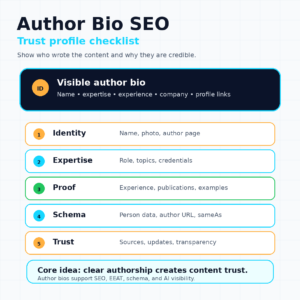
A good author bio is not generic. Avoid writing
“John is passionate about marketing” if the article covers technical SEO. Instead, connect the bio to the subject.
Example for a WordPress SEO article:
Jane Doe is a WordPress SEO consultant who has audited more than 120 plugin, SaaS, and publisher websites. She writes about technical SEO, schema markup, AI crawler monitoring, and content visibility for AI-powered search.
This bio works because it gives a role, topic focus, experience, and relevance.
Should Every Blog Have an Author Bio?
Every serious blog should have author bios, but the level of detail depends on the site type and topic risk. A casual travel blog and a medical advice site do not need the same depth.
Here is a practical guide:
| Website type | Author bio priority | Why |
|---|---|---|
| Business blog | High | Builds trust with prospects and customers |
| SaaS blog | High | Shows product and technical expertise |
| Agency website | High | Helps prove service expertise |
| Affiliate site | Very high | Reduces thin-content and anonymous-review concerns |
| Medical website | Critical | Health content needs strong expertise and review signals |
| Finance website | Critical | Money topics need high trust and accountability |
| News site | Critical | Users need reporter and editorial transparency |
| Personal blog | Medium | Useful for identity and topic consistency |
For YMYL topics, which can affect health, money, safety, or well-being, author bios should be stronger. Include credentials, reviewers, sources, and update processes where appropriate.
For WordPress sites, author bios should appear on posts and link to dedicated author archive or profile pages. That author page should include a fuller bio, article list, photo, social links, and schema.
What Is the Difference Between Author Bio and Author Schema?
An author bio is visible text that users can read. Author schema is structured data that machines can parse. You need both because they serve different audiences.
| Element | Audience | Purpose |
|---|---|---|
| Visible author bio | Human readers | Explains identity, experience, and expertise |
| Author schema | Search engines and AI systems | Identifies the author entity in machine-readable format |
| Author page | Humans and machines | Central profile for all author details |
| sameAs links | Machines and users | Connects the author to verified external profiles |
Google’s Article structured data documentation recommends author markup best practices. It lists author properties such as author.name and author.url, and says author.url can link to a page that uniquely identifies the author, such as an author bio page or profile page.
A simplified author schema example:
{
  "@type": "Person",
  "name": "Jane Doe",
  "url": "https://example.com/authors/jane-doe",
  "sameAs": [
    "https://www.linkedin.com/in/janedoe"
  ]
}
The visible bio should match the structured data. Do not claim credentials in schema that users cannot verify on the page.
For broader implementation, read Schema Markup for AI Search.
How Do You Optimize an Author Page for SEO?
You optimize an author page by making it a clear home for the author’s identity, expertise, and content history. The author page should not be a thin archive with only a list of posts.
A strong author page includes:
- Author name.
- Headshot.
- Professional role.
- Detailed bio.
- Areas of expertise.
- Company connection.
- Social profile links.
- Recent articles.
- Contact or editorial role where relevant.
- Person schema.
- Internal links to major topic clusters.
Author page SEO helps search engines connect a person to repeated topic coverage. If one author writes across technical SEO, schema, AI crawler monitoring, and AI search optimization, the author page should make that pattern obvious.
This supports Topical Authority because a consistent author entity can strengthen a site’s expertise around a subject.
What Are Common Author Bio Mistakes?
Common author bio mistakes make the page look less trustworthy or less useful. Many websites have an author name but no meaningful author context.
Avoid these mistakes:
- No expertise. A bio should explain why the author can write on the topic.
- Generic bios. Avoid vague lines that could describe anyone.
- Missing profile photo. A headshot can support human trust.
- No social links. LinkedIn, GitHub, X, or professional profiles can help verify identity.
- No author page. A small post bio is useful, but a dedicated author page is stronger.
- AI-generated biographies without review. Do not invent experience or credentials.
- Inconsistent names. Use the same author name across posts, schema, and profiles.
- No publication history. Show recent or related articles.
- No reviewer info for sensitive topics. YMYL content may need expert review.
- No organization connection. Connect the author to the publisher where relevant.
The worst author bio is one that sounds polished but says nothing. Search systems and users need specifics.
How Can Triomize Help Optimize Author Trust Signals?
Triomize can help optimize author trust signals by making authorship part of the SEO, AEO, and GEO workflow. Author information affects trust, entity clarity, and AI readiness, so it should not be treated as a design afterthought.
Triomize can support author trust improvements through:
- Author visibility checks.
- Author schema validation.
- GEO score improvements.
- AI readiness analysis.
- Structured content recommendations.
- Internal link suggestions.
- Schema opportunities.
- Content quality checks.
For example, a post may have a strong focus keyword and good headings but still lack author credibility. Triomize can help teams spot those trust gaps before publishing.
Author bios are especially valuable for AI search because they connect content to real people and organizations. That makes a page easier to understand, trust, and cite.
What Should You Remember About Author Bio SEO?
Author bio seo is not about adding a decorative paragraph below a post. It is about making expertise visible. Search engines, AI systems, and readers all benefit when a page clearly shows who created the content and why they are qualified.
A good author bio supports SEO by improving trust and transparency. It supports E-E-A-T by showing experience and expertise. It supports AI search visibility by connecting content to identifiable entities.
For WordPress websites, the best workflow is simple. Add a visible author bio, create an author page, connect it with author schema, include relevant social profiles, and keep the author history consistent across the site.
Frequently Asked Questions
Does an author bio improve SEO?
How long should an author bio be?
Should every blog post have an author bio?
What is the difference between author schema and an author bio?
Can AI search engines use author information?