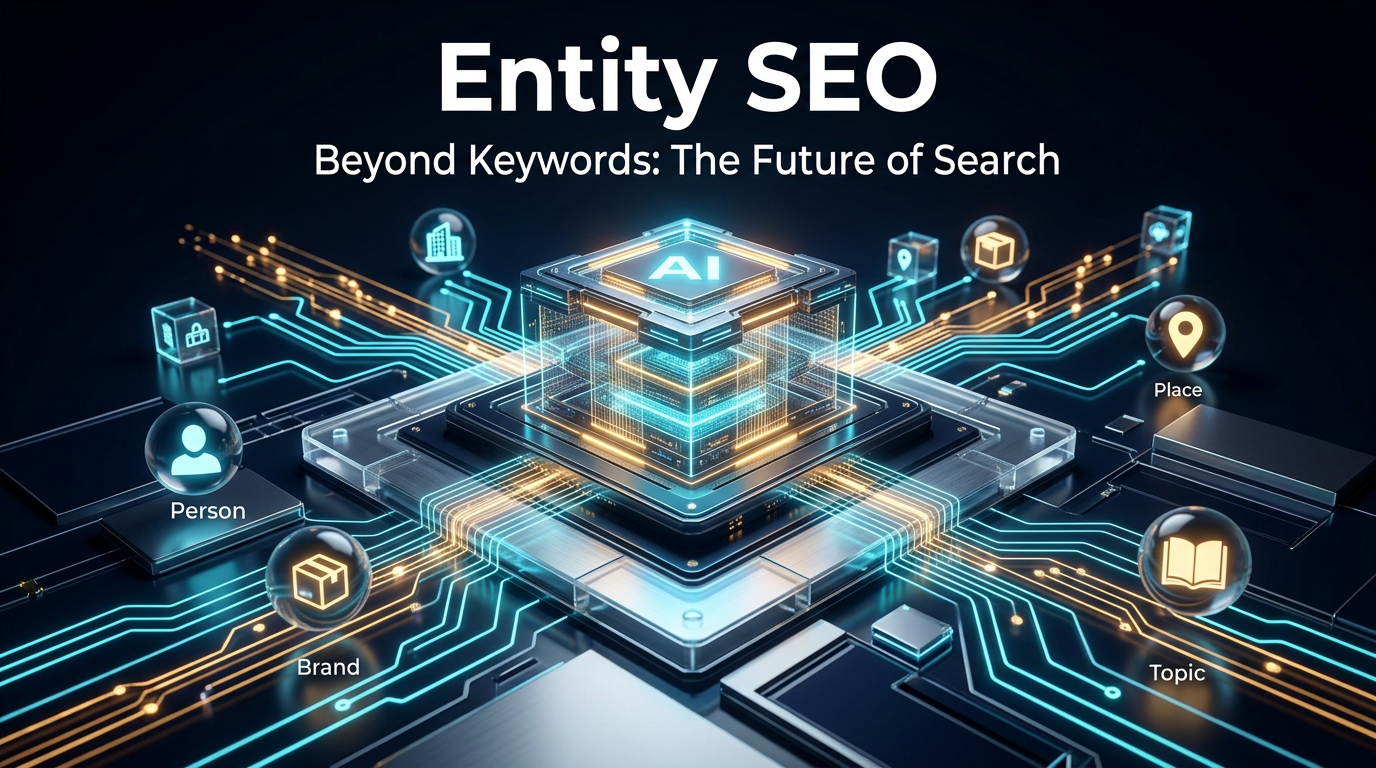
Entity SEO is the practice of optimizing content around real-world people, places, organizations, products, concepts, and the relationships between them. Keywords still matter, but modern search engines increasingly need to understand meaning, context, and entity relationships. Entity-based SEO helps Google, AI search systems, and answer engines connect your content to known topics in a Knowledge Graph. Triomize helps WordPress teams strengthen entity clarity through structured content, schema markup, internal links, and GEO-focused publishing checks.
Table of Contents
- What Is Entity SEO?
- What Is an Entity?
- How Does Entity SEO vs Keyword SEO Compare?
- How Do Search Engines Understand Entities?
- What Is the Google Knowledge Graph?
- Why Do Entities Matter for AI Search?
- How Do You Optimize for Entity SEO?
- How Do You Build Topical Authority with Entities?
- How Do You Use Structured Data for Entity SEO?
- How Do You Create Strong Internal Links for Entities?
- How Do You Build Author Authority as an Entity?
- How Do You Improve Context Around Entities?
- What Are Common Entity SEO Mistakes?
- How Can Triomize Help with Entity SEO?
- What Should You Remember About Entity SEO?
What Is Entity SEO?
Entity SEO is the process of making your website, authors, topics, products, and brand easier for search engines to identify as real-world entities. An entity is a distinct thing that can be named, described, and connected to other things.
Examples of entities include:
- A person, such as an author or founder.
- An organization, such as Triomize.
- A place, such as Dhule or Maharashtra.
- A product, such as a WordPress plugin.
- A concept, such as Generative Engine Optimization.
- An event, book, dataset, or service.
Traditional keyword SEO asks, “Which words does this page target?” Entity SEO asks, “Which real-world things does this page help search engines understand?” That shift matters because modern search is semantic. Google, Bing, ChatGPT Search, Perplexity, and Google AI Overviews all need context, not only exact-match phrases.
The scale of entity-based search is massive. In its official Knowledge Graph launch post, Google said the system started with more than 500 million objects and 3.5 billion facts. Public summaries report that it grew to about 570 million entities and 18 billion facts within roughly seven months. In 2016, it was reported at 70 billion facts and supported roughly one-third of Google’s 100 billion monthly searches. In 2020, Google said its Knowledge Graph had amassed over 500 billion facts about 5 billion entities.
That is the reason entity optimization matters. Search engines are not only matching strings of text. They are mapping things and relationships.
What Is an Entity?
An entity is a unique, identifiable thing that a machine can distinguish from other things. It can have a name, type, description, attributes, relationships, and a canonical identifier.
For example, “Apple” can mean a fruit, a company, a record label, or a place. A keyword alone is ambiguous. An entity system resolves the meaning by using context. If the page mentions iPhone, Tim Cook, Cupertino, and MacBook, the entity is likely Apple Inc. If the page mentions nutrition, fiber, orchards, and recipes, the entity is likely the fruit.
Google’s Knowledge Graph Search API shows this entity structure clearly. Its response fields include @id, name, @type, description, image, detailedDescription, url, and resultScore. Those fields show how search systems move beyond raw keywords into typed objects.
In practical SEO, entities help answer questions like:
- Who is the author?
- What organization published the page?
- Which product or service is discussed?
- Which topic cluster does this content belong to?
- Which sources confirm this entity?
- How does this entity relate to other entities?
Entity SEO helps you make those answers obvious.
How Does Entity SEO vs Keyword SEO Compare?
Entity SEO and keyword SEO work together, but they solve different problems. Keyword SEO helps match user language. Entity SEO helps machines understand meaning.
| Comparison Factor | Keyword SEO | Entity SEO |
|---|---|---|
| Main focus | Search phrases and query terms | People, places, brands, products, concepts, and relationships |
| Core question | What words does the user type? | What thing does the user mean? |
| Optimization method | Keyword placement, headings, intent matching | Entity clarity, schema, internal links, topical authority |
| Risk | Keyword stuffing or shallow matching | Vague entities or weak relationships |
| Best use | Capturing search demand | Building semantic authority and AI understanding |
| AI search value | Helps match natural language queries | Helps AI systems verify meaning and source context |
A page can target the keyword “schema markup” while also clarifying entities like Schema.org, JSON-LD, Google Search Central, Article Schema, FAQPage, and Organization Schema. The keyword tells the search engine what users search for. The entities explain what the page actually covers.
This is why entity SEO does not replace keywords. It upgrades them. You still need search intent, but you also need clear context.
How Do Search Engines Understand Entities?
Search engines understand entities by collecting signals from content, links, structured data, knowledge bases, user behavior, and trusted sources. They compare those signals to decide whether a page refers to a specific real-world thing.
Important entity signals include:
- Names and aliases. Does the page use the entity’s name consistently?
- Types. Is the entity a person, organization, product, place, or concept?
- Attributes. Does the page provide details like job title, location, date, logo, or category?
- Relationships. Which other entities appear nearby?
- Structured data. Does schema markup describe the entity clearly?
- Internal links. Does the site connect related pages in a logical topic cluster?
- External confirmation. Do trusted sources mention the same entity?
- Canonical sources. Does the entity have a clear official website, profile, or sameAs reference?
Structured data adoption shows how common machine-readable context has become. The 2024 HTTP Archive Web Almanac found RDFa on 66% of pages, Open Graph on 64%, Twitter meta tags on 45%, JSON-LD on 41%, and Microdata on 26%. JSON-LD rose from 34% in 2022 to 41% in 2024, which shows why machine-readable context keeps growing. WebDataCommons also reported structured data in 1.7 billion HTML pages out of 3.4 billion pages in its October 2023 crawl, equal to 50.60% of the crawl. Those pages came from 15 million pay-level domains out of 34 million covered domains, or 42.89%. The same release contained 97.7 billion quads and found JSON-LD annotations on about 9.5 million websites.
Those numbers show that entity clarity is now part of the normal web. If your site gives machines less context than competitors, you may be harder to interpret.
What Is the Google Knowledge Graph?
The Google Knowledge Graph is Google’s structured knowledge base of entities and the relationships between them. It helps Google understand people, places, organizations, products, works, events, and concepts.
Google introduced the Knowledge Graph with the idea of understanding “things, not strings.” That phrase describes the shift from literal keyword matching to semantic understanding. A search for “Leonardo” may mean Leonardo da Vinci, Leonardo DiCaprio, a hotel brand, or a local business. The Knowledge Graph helps Google infer the intended entity.
Knowledge Graph data can support search features such as:
- Knowledge Panels.
- Direct answers.
- Entity cards.
- Related searches.
- Voice answers.
- AI-powered summaries.
- Disambiguation between similar names.
Google does not publish every detail about how its Knowledge Graph works. Still, official APIs and public documentation show the underlying idea: entities have IDs, names, types, descriptions, URLs, and relationships.
For website owners, the lesson is simple. If your brand, author, product, and topic entities are unclear, search engines have to guess. Entity SEO reduces that guesswork.
Why Do Entities Matter for AI Search?
Entities matter for AI search because AI systems need to generate answers that are contextually accurate, not just keyword-matched. When an AI answer engine cites a source, it needs to understand what the source is about and whether the source is trustworthy.
AI search systems evaluate content across several layers:
- Crawlability. Can the system access the page?
- Content structure. Can it extract the answer?
- Entity clarity. Can it identify who and what the page is about?
- Trust signals. Can it verify claims and sources?
- Topical authority. Does the site cover the topic deeply?
- Freshness. Is the information current enough?
This is where SEO, AEO, and GEO overlap. SEO makes your page discoverable. AEO makes your answers extractable. GEO makes your source more citable. Entity SEO supports all three by clarifying meaning.
The GEO study from Princeton University, Georgia Tech, Allen Institute, and IIT Delhi tested optimization tactics across 10,000 queries and nine datasets. It found that adding citations, statistics, and authoritative language improved position-adjusted word count by 30% to 40% and subjective impression by 15% to 30%. Entity clarity supports the same goal: helping AI systems understand and trust the source.
For related strategy, see SEO vs AEO vs GEO and What Is GEO?.
How Do You Optimize for Entity SEO?
You optimize for Entity SEO by making your key entities explicit, consistent, connected, and supported by evidence. The goal is to help search engines understand exactly what your website is about and how each topic relates to the rest of your site.
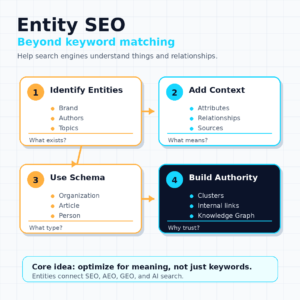
Start with an entity map. List your core entities:
- Brand.
- Founders or authors.
- Products or services.
- Categories.
- Topics.
- Locations.
- Methodologies.
- Related tools.
- Competitors or alternatives where relevant.
Then assign each entity a role. Some entities deserve dedicated pages. Some belong in schema. Some belong in internal links. Some need external confirmation. Some only need consistent naming.
A practical entity SEO workflow looks like this:
- Identify the main entity for each important page.
- Add supporting entities that clarify context.
- Link related pages into topic clusters.
- Add schema markup that matches visible content.
- Use consistent names, URLs, logos, and sameAs links.
- Cite authoritative sources where needed.
- Keep author and organization details consistent.
- Review pages in Triomize before publishing.
Triomize helps by checking content across SEO, AEO, and GEO signals, which makes entity clarity easier to manage inside WordPress.
How Do You Build Topical Authority with Entities?
You build topical authority with entities by creating a cluster of related pages that explain a subject from multiple angles. One page rarely proves expertise. A connected body of content does.
For example, an AI search website might build pages around these entities:
- Generative Engine Optimization.
- Answer Engine Optimization.
- Google AI Overviews.
- ChatGPT Search.
- Perplexity AI.
- AI crawler monitoring.
- Schema markup for AI search.
- Entity SEO.
Each page should link to the others where relevant. This helps users explore the topic and helps search engines understand the relationship between pages. Internal linking turns isolated content into a semantic network.
This is why Triomize content clusters link guides such as Google AI Overviews, ChatGPT Search, Schema Markup for AI Search, and AI Crawler Monitoring.
How Do You Use Structured Data for Entity SEO?
You use structured data for Entity SEO by describing the entities on your page in a machine-readable format. Schema markup helps search engines understand the page type, publisher, author, topic, breadcrumbs, and related entities.
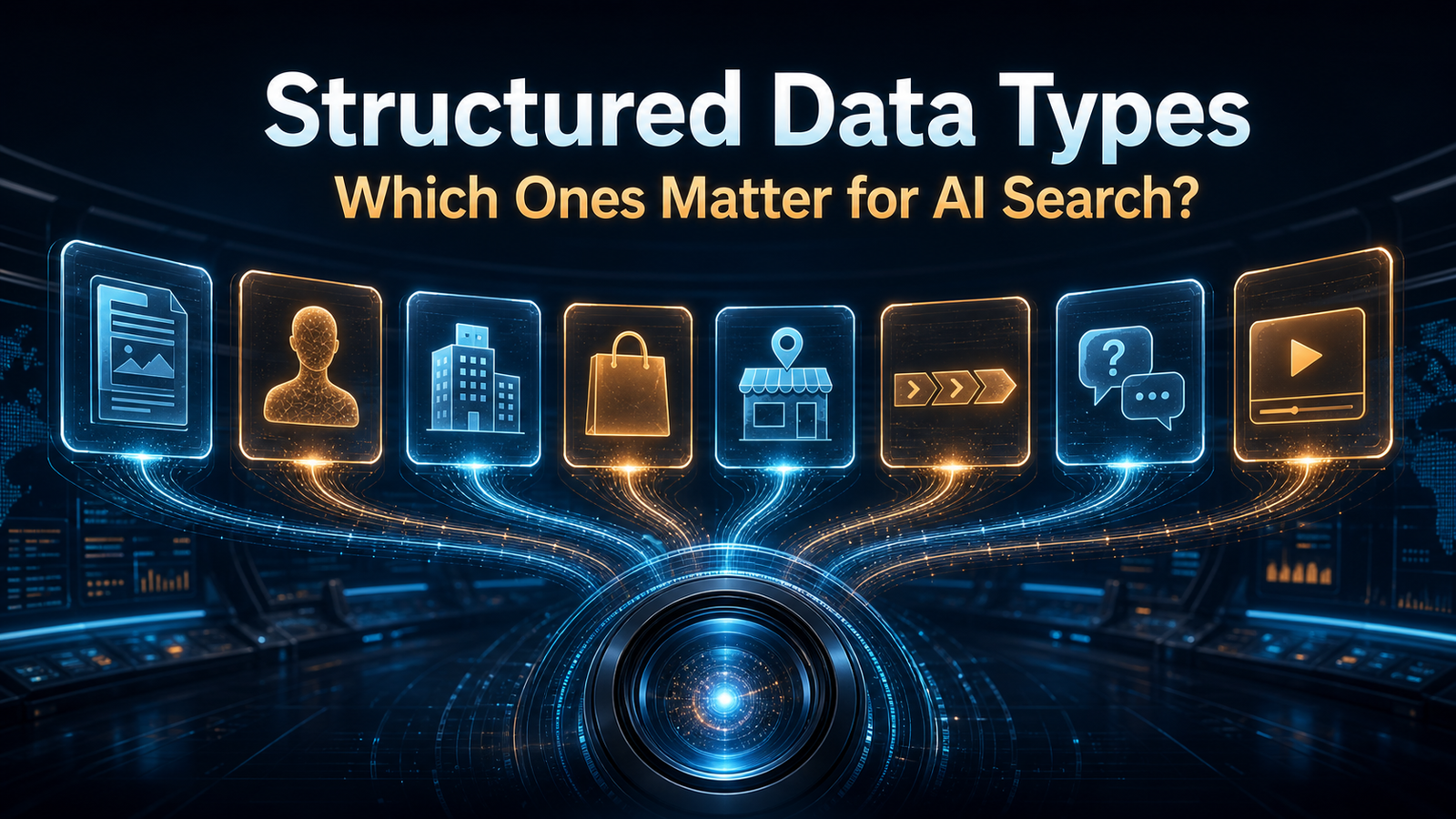
Useful schema types include:
| Schema type | Entity role |
|---|---|
| Organization | Clarifies the brand or publisher |
| Person | Clarifies authors, experts, and founders |
| Article | Clarifies article identity, dates, author, and publisher |
| BreadcrumbList | Clarifies site hierarchy and topic placement |
| FAQPage | Clarifies question and answer pairs |
| Product | Clarifies product details when relevant |
| LocalBusiness | Clarifies local business identity and location |
Use JSON-LD where possible. Google recommends JSON-LD because it is usually easiest to implement and maintain at scale. For a deeper walkthrough, see Schema Markup for AI Search.
How Do You Create Strong Internal Links for Entities?
You create strong internal links for entities by linking related pages with descriptive anchor text. Internal links tell search engines which pages define important entities and how those entities connect.
Good internal links use natural, specific anchors:
- “Generative Engine Optimization” instead of “click here.”
- “Entity SEO” instead of “read more.”
- “Google AI Overviews” instead of “this feature.”
Internal links should point from supporting pages to core entity pages and back again. This creates a two-way structure. A page about schema can link to Entity SEO, and a page about Entity SEO can link back to schema markup.
Avoid random linking. Link when the relationship helps the reader or clarifies the topic map.
How Do You Build Author Authority as an Entity?
You build author authority as an entity by making the author’s identity consistent, visible, and connected to relevant expertise. Search engines need to understand who created the content and why they are credible.
Useful author entity signals include:
- A consistent author name.
- A clear author profile page.
- Article schema that identifies the author.
- SameAs links to professional profiles where appropriate.
- A bio that explains topical expertise.
- A history of content on related subjects.
- References or citations from trusted sources.
The user-facing content still matters most. Author schema cannot make weak content authoritative. It can, however, reduce ambiguity when a real expert consistently publishes around a topic.
How Do You Improve Context Around Entities?
You improve context around entities by surrounding them with relevant facts, related terms, source references, and internal links. Search engines use context to disambiguate meaning.
For example, the entity “Perplexity” may refer to a general state of confusion or the AI search company. A page that also mentions PerplexityBot, citations, AI search, source links, and retrieval makes the intended entity clearer.
Context can come from:
- Nearby headings.
- Related entities.
- Schema properties.
- Internal links.
- External citations.
- Page category.
- Breadcrumbs.
- Author expertise.
Context is the difference between mentioning an entity and owning a topic around that entity.
What Are Common Entity SEO Mistakes?
Common Entity SEO mistakes usually come from treating entities like keywords. Entities need clarity, relationships, and consistency, not repetition.
Avoid these mistakes:
- Keyword stuffing entity names. Repeating a name does not prove understanding.
- Using inconsistent brand names. Pick one primary name and use it consistently.
- Ignoring schema markup. Structured data helps machines identify key entities.
- Publishing isolated pages. Build clusters, not disconnected articles.
- Using vague author profiles. Make author identity and expertise clear.
- Failing to link related concepts. Internal links create entity relationships.
- Forgetting external validation. Trusted citations help confirm facts.
- Mixing unrelated intents. One page should have a clear main entity and purpose.
The best approach is systematic. Define entities, connect them, describe them, validate them, and keep them consistent.
How Can Triomize Help with Entity SEO?
Triomize can help with Entity SEO by making entity clarity part of the publishing workflow. Instead of checking only keywords, Triomize helps WordPress users think across SEO, AEO, and GEO signals.
For entity-based optimization, the workflow matters:
- SEO checks help confirm the page is crawlable, internally linked, and focused.
- AEO checks help structure definitions, answers, headings, tables, and FAQs.
- GEO checks help strengthen citations, brand mentions, original statistics, and trust signals.
- Schema tools help generate structured data such as FAQ Schema, with more schema capabilities planned.
- Crawler monitoring helps show whether AI platforms can access the content.
Triomize does not replace strategy. It gives WordPress teams a clearer system for applying entity SEO consistently across posts, pages, and topic clusters.
As AI-powered search continues to grow, the goal is simple: help website owners make their content easier for search engines and AI systems to understand, trust, and surface.
What Should You Remember About Entity SEO?
The future of search is becoming less about matching exact keywords and more about understanding meaning. Entities allow search engines and AI systems to recognize real-world concepts and the relationships between them.
Keywords still play an important role, but they are only one piece of the puzzle. Websites that combine high-quality content, structured data, topical authority, and clear entity relationships are better positioned to succeed in modern search.
As AI-powered search continues to grow, understanding and optimizing for entities will become an increasingly valuable part of every SEO strategy.
Frequently Asked Questions
What is Entity SEO?
How is Entity SEO different from keyword SEO?
Does structured data help Entity SEO?
Why does Entity SEO matter for AI search?
How can I start with Entity SEO?