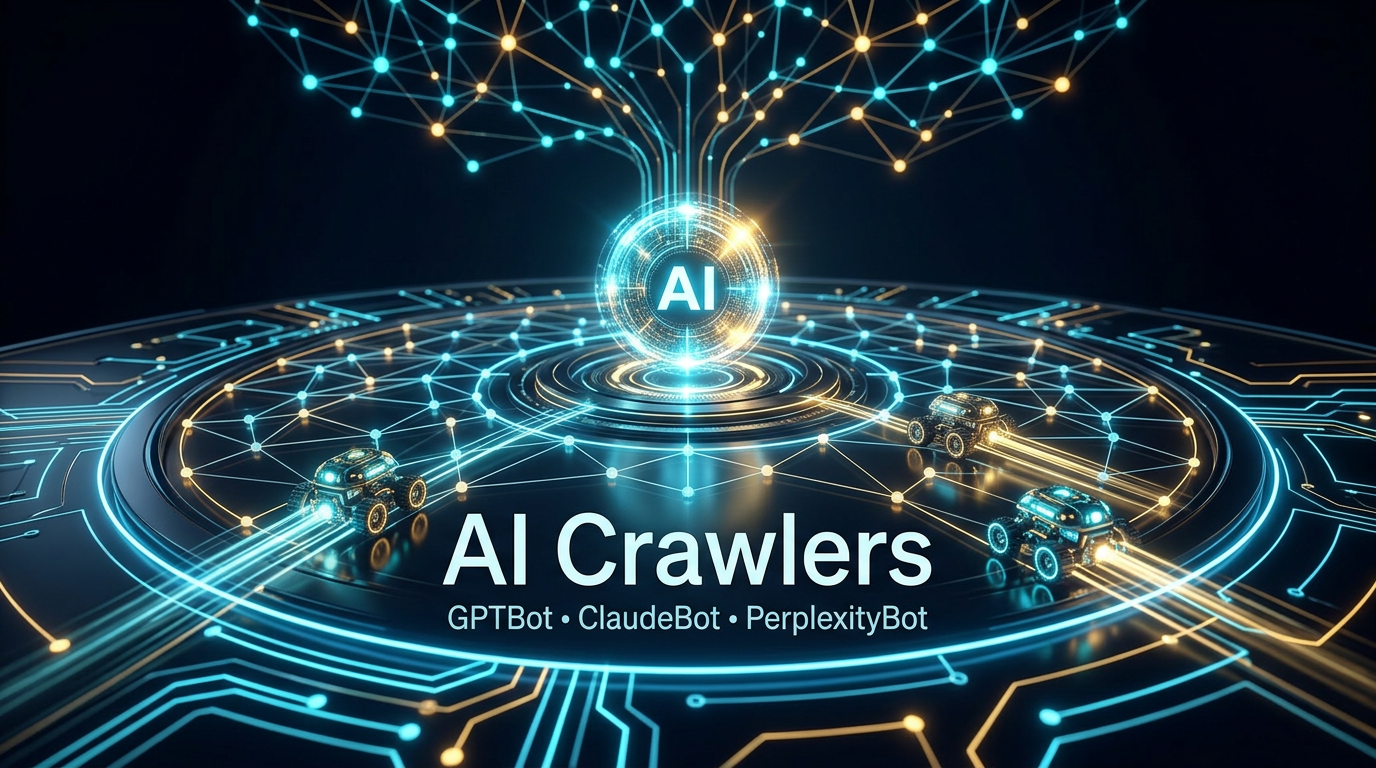
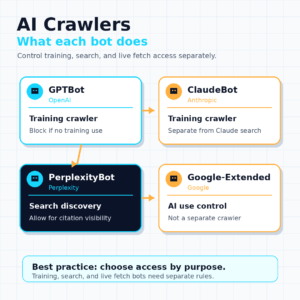
AI Crawlers is the term for automated bots used by AI companies to discover, retrieve, index, or train on public web content. They are not all the same. GPTBot supports OpenAI model training, OAI-SearchBot supports ChatGPT Search, ClaudeBot supports Anthropic training, Claude-SearchBot supports Claude search, and PerplexityBot helps surface websites in Perplexity. Website owners should understand each crawler before allowing or restricting access. Triomize recommends managing AI crawlers through robots.txt, server logs, WAF rules, and GEO-friendly content structure.
Table of Contents
What Are AI Crawlers?
AI Crawlers is the term for web robots that AI platforms use to access public websites for model training, search retrieval, user-triggered browsing, or answer citation. They work like traditional crawlers in some ways, but their business purpose is different.
Googlebot crawls the web so Google Search can index pages and rank results. AI web crawlers may collect training data, build retrieval indexes, fetch pages for live user questions, or support AI-generated summaries. That is why one company may operate several bots with separate names and separate robots.txt controls.
For example, OpenAI documents four crawler or fetcher roles: GPTBot, OAI-SearchBot, OAI-AdsBot, and ChatGPT-User. Anthropic documents three main Claude bots: ClaudeBot, Claude-User, and Claude-SearchBot. Perplexity documents two agents: PerplexityBot and Perplexity-User. Google documents Google-Extended as a control token, not a separate HTTP user agent.
This creates a practical SEO question. Should you allow these crawlers because they may help AI discoverability, or block them because they may use your content in ways you do not want? The answer depends on purpose. Triomize treats AI crawler access as a GEO infrastructure signal because AI systems cannot cite content they cannot access, understand, or verify.
How Do AI Crawlers Work?
AI crawlers work by requesting URLs, reading allowed content, following access rules, and sending retrieved information into a search, training, or answer system. Most reputable AI crawlers identify themselves with a user-agent string and document how site owners can control access.
The basic process looks like this:
- Discovery: The crawler finds a URL through links, sitemaps, search indexes, user prompts, or known web datasets.
- Permission check: The crawler requests
/robots.txtand checks the user-agent rules that apply to it. - Fetching: If allowed, it downloads HTML, media, or other public resources.
- Parsing: It extracts visible text, links, metadata, headings, schema, and page structure.
- Use case routing: The content may support training, search indexing, live answer retrieval, or citation selection.
- Logging: The request appears in server logs with a user agent, status code, path, IP address, and timestamp.
The key phrase is use case routing. GPTBot and OAI-SearchBot are both OpenAI agents, but they do different jobs. ClaudeBot and Claude-SearchBot are both Anthropic agents, but blocking one does not automatically block the other. A simple all-or-nothing robots.txt policy can accidentally remove your content from AI search while trying to block model training.
Cloudflare data shows why this matters. In its AI crawler analysis, Cloudflare reported that overall crawling rose 32% year-over-year in April 2025. It also reported that GPTBot’s share of AI-only crawler traffic rose from 11.9% in July 2024 to 28.1% in July 2025, while ClaudeBot rose from 15% to 23.3% over the same period. AI crawler management is now a real technical SEO task, not a fringe issue.
What Is GPTBot?
GPTBot is OpenAI’s web crawler for content that may be used to improve generative AI foundation models. OpenAI says disallowing GPTBot signals that a site’s content should not be used for training those models.
OpenAI’s official crawler documentation separates GPTBot from search and user-fetch agents. That distinction is important:
| OpenAI agent | Main purpose | Practical control |
|---|---|---|
GPTBot |
Model training | Block if you do not want content used for training |
OAI-SearchBot |
ChatGPT Search results and source surfacing | Allow if you want ChatGPT Search visibility |
ChatGPT-User |
User-triggered fetches in ChatGPT and Custom GPTs | Understand that robots.txt may not apply the same way |
OAI-AdsBot |
Ad landing page review | Relevant only for submitted ad pages |
A common mistake is blocking GPTBot and assuming that blocks ChatGPT Search. It does not. OpenAI says sites opted out of OAI-SearchBot will not be shown in ChatGPT search answers, though they may still appear as navigational links. If your goal is to block training but allow discovery, you need separate directives.
Example policy:
User-agent: GPTBot
Disallow: /

User-agent: OAI-SearchBot
Allow: /
That policy says no to training access but yes to ChatGPT Search discovery. It is a cleaner approach than blocking every OpenAI agent. For more strategy, read our guide on How to Optimize for ChatGPT Search.
What Is ClaudeBot?
ClaudeBot is Anthropic’s crawler for collecting web content that may contribute to Claude model training. Anthropic also documents separate bots for user-triggered retrieval and search result quality.
According to Anthropic’s help center, the three main Claude bots are:
| Anthropic bot | Use | What blocking can affect |
|---|---|---|
ClaudeBot |
Training data collection | Future materials excluded from training datasets |
Claude-User |
User-directed web access | May reduce visibility for user-directed web search |
Claude-SearchBot |
Search result quality and indexing | May reduce visibility and accuracy in user search results |
Anthropic states that its bots honor standard robots.txt directives and respect anti-circumvention technologies like CAPTCHAs. It also supports the non-standard Crawl-delay extension. That is useful for large sites worried about crawl load.
Example full block:
User-agent: ClaudeBot
Disallow: /
Example crawl rate control:
User-agent: ClaudeBot
Crawl-delay: 1
Anthropic also warns that IP blocking may not work reliably as an opt-out method because it can prevent bots from reading robots.txt. That means the robots file remains the primary policy layer for most publishers.
What Is PerplexityBot?
PerplexityBot is Perplexity’s crawler for surfacing and linking websites in Perplexity search results. Perplexity says it is not used to crawl content for AI foundation model training.
Perplexity documents two agents:
| Perplexity agent | Main purpose | Important note |
|---|---|---|
PerplexityBot |
Surface and link websites in Perplexity results | Perplexity recommends allowing it for search visibility |
Perplexity-User |
User-triggered page visits for answers | It generally ignores robots.txt because a user requested the fetch |
Perplexity also publishes IP address JSON endpoints for both agents and recommends WAF rules that combine user-agent checks with IP verification. This matters because fake bots can spoof user-agent names. If you use Cloudflare, AWS WAF, or another firewall, verify the crawler before whitelisting it.
Example allow rule:
User-agent: PerplexityBot
Allow: /
Perplexity SEO depends on this access layer. In our Perplexity SEO guide, we explain how crawlability, clear answers, entity schema, and cited evidence work together to increase citation eligibility.
What Is Google-Extended?
Google-Extended is a robots.txt product token that lets publishers manage whether Google-crawled content may be used for Gemini model training and Gemini grounding. It is not a separate crawler that appears as its own HTTP user agent.
Google’s documentation says crawling is done with existing Google user agents, while Google-Extended works as a control token in robots.txt. Google also states that Google-Extended does not affect inclusion in Google Search and is not used as a ranking signal in Google Search.
Example policy:
User-agent: Google-Extended
Disallow: /
That rule tells Google not to use the content for covered Gemini use cases. It does not remove the page from Google Search. To remove a page from Google Search, you need tools like noindex, access restriction, or removal workflows. Google specifically warns that robots.txt is not a security tool and not a reliable way to hide pages from search results if other pages link to them.
This is why Google-Extended is often misunderstood. It is an AI policy control, not a standard SEO crawler and not a privacy mechanism.
How Do AI Crawlers Compare With Googlebot?
AI crawlers compare with Googlebot in access mechanics, but they differ in purpose, output, and business impact. Both request URLs and read robots.txt. They do not always use the content for the same end product.
| Attribute | Traditional Googlebot | AI Crawlers |
|---|---|---|
| Primary purpose | Build Google Search indexes | Train models, build AI search indexes, fetch answers, support citations |
| Main output | Ranked search results | AI answers, source citations, model improvements, retrieval results |
| Control method | robots.txt, noindex, Search Console, canonical tags | robots.txt, per-agent rules, WAF rules, logs, published IP checks |
| User value exchange | Search referral traffic | AI visibility, citation traffic, possible training use |
| Crawl identity | Mostly stable Googlebot tokens | Many separate agents by vendor and use case |
| Blocking risk | Loss of classic search visibility | Loss of AI search visibility or training access, depending on agent |
Cloudflare’s late-2025 analysis found that Googlebot reached 11.6% of unique web pages in a sample of successful HTML requests, compared with 3.6% for GPTBot and 0.06% for PerplexityBot. It also reported that user-action crawling volume increased more than 15 times from January through early December 2025.
That gap explains the challenge. Googlebot still dominates crawl coverage, but AI-specific fetchers are growing fast. Triomize therefore treats AI crawler policy as part of a broader search infrastructure stack rather than a replacement for classic SEO.
Should You Block AI Crawlers?
You should block AI crawlers only after deciding what you want to allow: training, search visibility, user-triggered retrieval, or none of the above. A blanket block is simple, but it can reduce AI discoverability.
Here is a practical decision table:
| Goal | Suggested approach |
|---|---|
| Allow AI search citations | Allow search-focused bots like OAI-SearchBot, PerplexityBot, and Claude-SearchBot |
| Block model training only | Block training-focused bots like GPTBot, ClaudeBot, and Google-Extended |
| Reduce crawler load | Use crawl-delay where supported, WAF rate limits, and log monitoring |
| Protect private content | Use authentication, not robots.txt alone |
| Avoid all AI access | Block each documented agent separately and enforce server-side controls |
The safest policy for many publishers is selective access. Allow AI search and citation agents for public educational content. Block training agents if your legal or content policy requires it. Protect private content with authentication. Monitor logs for unexpected patterns.
Robots.txt is useful, but it is not security. The Robots Exclusion Protocol was formalized as RFC 9309 in 2022, but it remains an instruction system for cooperative crawlers. Bad bots can ignore it. Sensitive pages need real access controls.
How Do You Optimize Your Website for AI Crawlers?
Optimizing your website for AI crawlers means making public content accessible, structured, verifiable, and easy to cite while controlling crawler permissions intentionally. This is both a technical SEO task and a GEO task.
Start with access. Audit /robots.txt, XML sitemaps, server status codes, canonical tags, WAF rules, and CDN bot settings. Confirm that allowed crawlers receive 200 responses for public pages. Check logs for blocked requests, 403 responses, 429 rate limits, and unexpected user agents.
Then improve content extraction. AI crawlers and retrieval systems favor clean HTML, direct definitions, short paragraphs, structured headings, tables, lists, and schema markup. Use Article, Organization, BreadcrumbList, and FAQPage schema where relevant.
Finally, build authority. Link to credible sources, publish original data, keep pages current, and connect related topics with internal links. This post naturally supports guides on SEO vs AEO vs GEO, What Is GEO?, What Is llms.txt?, Google AI Overviews Explained, ChatGPT Search Optimization, and Perplexity SEO.
Use this checklist before publishing:
- Define which AI crawlers you allow for training, search, and user fetches.
- Add separate robots.txt rules for GPTBot, OAI-SearchBot, ClaudeBot, Claude-SearchBot, PerplexityBot, and Google-Extended.
- Verify official IP ranges where vendors publish them.
- Keep public pages fast, indexable, canonicalized, and internally linked.
- Use semantic headings, lists, tables, and schema markup.
- Add credible external references and original statistics.
- Monitor AI crawler requests in server logs monthly.
- Run the page through Triomize to check SEO, AEO, and GEO gaps before publishing. Triomize also helps confirm whether the post includes enough crawler, schema, and citation signals for AI search.
Frequently Asked Questions
What are AI crawlers?
Do AI crawlers respect robots.txt?
Should I allow GPTBot on my website?
Is Google-Extended the same as Googlebot?
Can AI crawlers help my GEO visibility?