AI Search Optimization is the practice of preparing a website to be found, understood, cited, and trusted by AI-powered search systems such as ChatGPT Search, Google AI Overviews, Gemini, Claude, and Perplexity. It builds on traditional SEO but adds answer-first structure, entity clarity, source trust, AI crawler access, and citation readiness. For website owners, AI Search Optimization is not a replacement for SEO. It is a broader framework that combines SEO, AEO, and GEO into one search visibility strategy.
Table of Contents
- What Is AI Search Optimization?
- Why Is AI Search Changing SEO?
- Is SEO Enough for AI Search?
- What Is the Difference Between SEO, AEO, and GEO?
- How Do ChatGPT and Google AI Find Websites?
- How Does AI Search Optimization Differ by Platform?
- Can AI Cite a Page That Is Not Indexed?
- What Are the Main AI Search Optimization Ranking Factors?
- How Can Businesses Prepare for AI Search?
- How Should WordPress Websites Prioritize AI Search Optimization?
- How Do You Optimize a Website for AI Search?
- What Are Common AI Search Optimization Mistakes?
- What Tools Help Optimize for AI Search?
- What Is the AI Search Optimization Checklist?
- What Should You Remember About AI Search Optimization?
What Is AI Search Optimization?
AI Search Optimization is the process of improving your website so AI-powered search systems can discover your pages, understand your content, and use your site as a trusted source in generated answers. It includes classic search engine optimization, answer formatting, structured data, topical authority, crawler access, and credibility signals.
Traditional search results usually show a ranked list of pages. AI search results often synthesize an answer first, then include citations, links, cards, or follow-up prompts. This means the goal is no longer only to rank. The goal is also to be retrieved, summarized, and cited.
AI Search Optimization matters because search behavior is changing across multiple platforms. Google now shows AI Overviews and AI Mode for certain queries. OpenAI runs ChatGPT Search. Perplexity is built around cited answers. Anthropic documents Claude bots for training, user-directed retrieval, and search quality. Microsoft Bing states that SEO fundamentals also support Copilot and grounding experiences.
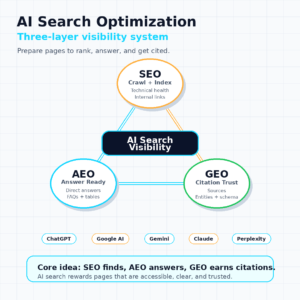
A useful way to understand AI Search Optimization is as a stack:
| Layer | Purpose | Main outcome |
|---|---|---|
| SEO | Make pages crawlable, indexable, relevant, and fast | Rankings and organic visibility |
| AEO | Make answers clear, direct, and extractable | Snippets, answers, and AI summaries |
| GEO | Make sources credible, citable, and entity-rich | AI citations and brand mentions |
The strongest websites use all three. AI Search Optimization fails when one layer is missing. A technically blocked page cannot be cited. A vague answer is hard to extract. A source with no trust signals is risky to reference.
Why Is AI Search Changing SEO?
AI Search Optimization changes SEO because users are getting more answers before they click. Search engines and answer engines now retrieve information, synthesize summaries, and display supporting links in the same experience.
Google’s AI features documentation explains that AI Overviews and AI Mode surface relevant links to help users explore information. It also says the same foundational SEO best practices still apply. That is important. AI Search Optimization does not remove the need for crawlable pages, helpful content, internal links, or technical SEO.
The shift is in the success metric. In classic SEO, a top ranking and click-through rate were the main goals. In AI-powered search, visibility can also mean being cited in an answer, appearing as a source card, being mentioned as a brand, or being retrieved as supporting context.
Data shows why this matters. Pew Research Center analyzed 68,879 Google searches and found that users clicked a traditional result 8% of the time when an AI summary appeared, compared with 15% when no AI summary appeared. That is a major behavioral shift. AI Search Optimization helps websites adapt by improving the signals that make content useful inside answer-led experiences.
This does not mean every site should chase every AI platform at once. It means your content should be technically accessible, answer-ready, entity-clear, and trustworthy enough to perform across multiple discovery systems.
Is SEO Enough for AI Search?
SEO is necessary for AI Search Optimization, but SEO alone is not enough. Classic SEO makes your pages discoverable and indexable. AI Search Optimization also asks whether those pages are structured, credible, and useful enough for answer engines.
A page can rank in Google but still be weak for AI search if it has:
- Long introductions with no direct answer.
- Poor entity clarity.
- No schema markup.
- Weak internal links.
- No cited sources.
- Thin topical coverage.
- Blocked AI crawlers.
- Outdated statistics.
- Generic author information.
At the same time, a page can be beautifully structured for AI but fail if it is blocked from crawling or buried with no internal links. That is why AI Search Optimization starts with SEO and then expands.
Think of it this way:
- SEO makes the page findable.
- AEO makes the answer extractable.
- GEO makes the source citable.
- Technical SEO keeps the system working.
- EEAT and topical authority build trust.
If your website already has strong SEO, AI Search Optimization is the next layer. If your SEO foundation is weak, fix that first.
What Is the Difference Between SEO, AEO, and GEO?
SEO, AEO, and GEO are three connected disciplines inside AI Search Optimization. They overlap, but they optimize for different outcomes.
SEO means Search Engine Optimization. It focuses on rankings, crawlability, relevance, internal links, page speed, mobile usability, indexation, and content quality.
AEO means Answer Engine Optimization. It focuses on direct answers, question-led headings, concise definitions, tables, FAQ sections, and content that answer engines can extract.
GEO means Generative Engine Optimization. It focuses on citations, entity clarity, trusted sources, original data, author credibility, brand mentions, AI crawler access, and content that generative systems can reference.
| Discipline | Primary goal | Example signals |
|---|---|---|
| SEO | Rank in search results | Crawlability, links, content quality, Core Web Vitals |
| AEO | Be extracted as an answer | Direct answers, FAQs, tables, short sections |
| GEO | Be cited by AI systems | Statistics, sources, entities, authors, schema, trust |
For a deeper breakdown, read SEO vs AEO vs GEO, What is AEO, and What is GEO.
AI Search Optimization combines these disciplines because AI search engines do not operate like one old search results page. They retrieve, synthesize, cite, and respond.
How Do ChatGPT and Google AI Find Websites?
AI Search Optimization depends on discovery. ChatGPT, Google AI, Gemini, Claude, Bing, and Perplexity need some way to find and access pages before they can surface them.
OpenAI documents separate crawlers and agents. OAI-SearchBot is used for ChatGPT Search visibility, while GPTBot is related to training. OpenAI states that each setting is independent, so a webmaster can allow OAI-SearchBot for search while disallowing GPTBot for training.
Anthropic documents three Claude agents: ClaudeBot, Claude-User, and Claude-SearchBot. ClaudeBot supports model training, Claude-User supports user-directed access, and Claude-SearchBot supports search quality. Anthropic says its bots honor robots.txt and also support crawl-delay.
Google says AI Overviews and AI Mode use Google Search systems. Its AI features guidance says there are no additional technical requirements beyond being indexed and eligible to appear in Google Search with a snippet.
Bing’s webmaster guidelines state that Bing and Copilot search experiences rely on the same core crawling, indexing, and ranking foundation as traditional search. They also mention IndexNow, XML sitemaps, internal links, structured content, and entity clarity.
This creates a clear rule for AI Search Optimization: if the page cannot be found, crawled, rendered, indexed, or retrieved, it cannot reliably appear in AI search results.
How Does AI Search Optimization Differ by Platform?
AI Search Optimization differs by platform because each AI search engine has its own discovery layer, crawler policy, answer format, and citation behavior. The same website foundation helps everywhere, but platform details still matter.
| Platform | What to focus on | Useful preparation |
|---|---|---|
| ChatGPT Search | OAI-SearchBot access, direct answers, source clarity | Allow search crawling, cite sources, build answer-ready pages |
| Google AI Overviews | Google indexing, helpful content, Search eligibility | Follow Google Search fundamentals and keep pages indexable |
| Gemini | Google ecosystem visibility and entity clarity | Strengthen schema, topical authority, and Google Search quality |
| Claude | Claude bot access, trustworthy content, user fetch support | Review ClaudeBot, Claude-User, and Claude-SearchBot policies |
| Perplexity | Cited answers, PerplexityBot access, source usefulness | Build citation-worthy pages and monitor AI crawler activity |
| Bing and Copilot | Bing indexing, IndexNow, grounding eligibility | Use Bing Webmaster Tools, sitemaps, internal links, and IndexNow |
This is why a single tactic rarely works everywhere. Blocking GPTBot does not mean blocking ChatGPT Search. Google-Extended does not remove a page from Google Search. PerplexityBot is not the same as Perplexity-User. ClaudeBot is not the same as Claude-SearchBot.
AI Search Optimization works best when teams separate platform policy from content quality. First, decide which crawlers should access public content. Then make the pages useful enough to be selected. Finally, measure whether AI referrals, citations, and source mentions improve over time.
For Perplexity-specific preparation, use our Perplexity SEO guide and How to Get Cited by Perplexity AI. For Google, use the Google AI Overviews guide. For crawler rules, start with AI Crawler Monitoring.
Can AI Cite a Page That Is Not Indexed?
AI Search Optimization should assume that indexed, accessible pages have the best chance of being used. Some AI systems can fetch pages live when a user asks. However, relying on live fetching alone is risky.
Google’s AI Overviews require pages to be indexed and eligible for Google Search with a snippet. ChatGPT Search uses OAI-SearchBot and web retrieval systems. Perplexity documents PerplexityBot for surfacing and linking websites. Claude documents search and user agents. Bing and Copilot depend on crawl, indexing, and grounding eligibility.
So the practical answer is simple. Do not plan around unindexed pages being cited. Make important pages crawlable, indexable, internally linked, and technically clean.
Use this rule:
- Public informational pages should be crawlable and indexable.
- Private or paid pages should be protected with authentication.
- Thin or duplicate pages should be improved, consolidated, or noindexed.
- Important pages should appear in XML sitemaps.
- Canonical tags should point to the correct version.
- AI crawler access should match your business policy.
AI Search Optimization is strongest when the same page is eligible for traditional search and AI retrieval.
What Are the Main AI Search Optimization Ranking Factors?
AI Search Optimization ranking factors are best understood as visibility factors, not a single published algorithm. No major AI platform has released a universal AI search ranking formula. Still, the strongest signals are consistent across search and answer systems.
The most important factors include:
- Crawlability. Bots and retrieval systems must access the page.
- Indexability. Search-connected systems need the page in the index.
- Answer clarity. The page should answer the query directly.
- Content depth. The article should cover the topic fully.
- Topical authority. Related pages should support the subject.
- Entity clarity. People, brands, products, and concepts should be obvious.
- Structured data. Schema helps machines understand relationships.
- Source evidence. Statistics, citations, and references improve trust.
- Freshness. Fast-changing topics need current details.
- User experience. Fast, mobile-friendly pages are easier to use and crawl.
- Author trust. Clear author or publisher information supports EEAT.
- Internal links. Connected pages build semantic depth.
The GEO research from Princeton University, Georgia Tech, Allen Institute, and IIT Delhi tested optimization tactics across 10,000 queries and nine datasets. It found that adding citations, statistics, and authoritative language improved position-adjusted word count by 30% to 40% and subjective impression by 15% to 30%.
That research does not define every AI search ranking factor. It does reinforce one point: AI Search Optimization improves when your content is clearer, more evidence-backed, and more authoritative.
How Can Businesses Prepare for AI Search?
Businesses can prepare for AI search by building a website that is technically accessible, semantically clear, and trustworthy. AI Search Optimization is not a one-time plugin setup. It is an operating system for content and technical quality.
Start with this preparation plan:
- Audit your technical SEO. Fix crawlability, indexing, canonicals, sitemaps, speed, and status codes.
- Create topic clusters. Build connected content around the subjects you want to own.
- Write direct answers. Put clear definitions and answers near the top of pages.
- Add structured data. Use Article, Organization, BreadcrumbList, FAQPage, and relevant schema types.
- Clarify entities. Make authors, products, services, categories, and brands consistent.
- Improve EEAT. Show experience, expertise, authority, and trust.
- Cite primary sources. Link to documentation, research, standards, and official sources.
- Monitor AI crawlers. Track OpenAI, Anthropic, Perplexity, Google, and Bing-related activity.
- Update content regularly. Keep fast-changing topics fresh.
- Measure AI referrals. Watch traffic from ChatGPT, Perplexity, Gemini, Copilot, Claude, and other sources.
AI Search Optimization is especially important for SaaS, agencies, ecommerce, finance, health, education, local services, and B2B companies. These users often ask AI tools for comparisons, recommendations, definitions, and implementation guidance.
If your business is not part of those answers, a competitor may be.
How Should WordPress Websites Prioritize AI Search Optimization?
WordPress websites should prioritize AI Search Optimization by fixing the foundation first, then improving content structure and trust. Many teams start with advanced AI tactics while basic WordPress issues still block visibility.
A practical WordPress priority order looks like this:
- Technical health. Check indexing, robots.txt, XML sitemaps, canonicals, redirects, and Core Web Vitals.
- Content quality. Improve thin pages, outdated posts, duplicate intent, and weak introductions.
- Answer formatting. Add direct answers, question-led headings, lists, tables, and FAQ sections.
- Structured data. Add Article, Organization, BreadcrumbList, and FAQPage schema where relevant.
- Topic clusters. Connect related content around core entities and user problems.
- Crawler access. Review AI crawlers, Bingbot, Googlebot, OAI-SearchBot, Claude agents, and PerplexityBot.
- Trust signals. Add author clarity, sources, examples, update dates, and transparent policies.
- Measurement. Track Google Search Console, Bing Webmaster Tools, analytics, AI referrals, and bot logs.
This order matters because AI Search Optimization depends on compounding signals. A site with great schema but poor indexing will struggle. A site with strong content but no internal links may look shallow. A site with good SEO but no direct answers may be harder for answer engines to extract.
WordPress adds another challenge: plugins can help or hurt. SEO plugins, schema plugins, caching plugins, security plugins, and page builders can all affect crawlability, performance, structured data, and redirects. Review plugin output after major updates, not only when traffic drops.
Triomize is designed for this kind of workflow. It helps connect page-level SEO, AEO, and GEO checks so a WordPress team can see whether a post is findable, answer-ready, and citation-ready before it goes live.
How Do You Optimize a Website for AI Search?
To optimize a website for AI search, build a unified workflow that combines technical SEO, answer formatting, entity optimization, schema, and trust signals. AI Search Optimization works best when every new page follows the same process.
Use this step-by-step workflow:
- Pick one clear search intent.
- Map the main entity and supporting entities.
- Write a direct answer in the first 100 words.
- Use question-based H2s and H3s.
- Add a table, checklist, or comparison block.
- Include citations for factual claims.
- Add schema markup where appropriate.
- Link to related internal pages.
- Check robots.txt and crawl access.
- Test indexing and canonical tags.
- Improve page speed and mobile usability.
- Add FAQ answers at the end.
- Review EEAT signals.
- Refresh content within 12 months.
- Track rankings, AI citations, and referral traffic.
This is where AI Search Optimization differs from old keyword-only SEO. You are not only placing a keyword in a title. You are making the page machine-readable, answer-ready, entity-clear, and trustworthy.
For supporting tactics, read the llms.txt guide, Schema Guide, and AI Crawler Monitoring.
What Are Common AI Search Optimization Mistakes?
Common AI Search Optimization mistakes happen when teams chase AI visibility without fixing the fundamentals. AI search is new, but many of the failures are old technical and content problems.
Avoid these mistakes:
- Assuming SEO is dead. AI search still depends on crawlable, useful web content.
- Blocking useful crawlers. Check OAI-SearchBot, PerplexityBot, Claude-SearchBot, Bingbot, and Googlebot policies.
- Writing vague introductions. AI systems need direct answers.
- Publishing isolated pages. Build topical authority with clusters.
- Ignoring schema. Structured data helps clarify entities and relationships.
- Skipping citations. Unsupported claims are weaker than sourced claims.
- Overusing AI-generated text. Generic content without experience is easy to ignore.
- Forgetting Bing. Bing and Copilot are part of AI search discovery.
- Using llms.txt as a magic fix. It can help documentation, but it does not replace crawlability or content quality.
- Not measuring AI traffic. Watch referrals and source mentions, not only rankings.
The biggest mistake is treating AI Search Optimization as a trick. It is a quality and accessibility discipline.
What Tools Help Optimize for AI Search?
Tools help optimize for AI search by identifying technical, content, and trust gaps. No tool can guarantee AI citations. A good tool helps you find the issues that make citations less likely.
Useful tool categories include:
- Google Search Console for indexing, performance, Core Web Vitals, and query data.
- Bing Webmaster Tools for Bing visibility, IndexNow, and Copilot-related discovery basics.
- Schema validators for structured data checks.
- Server logs for crawler activity.
- Analytics tools for referral traffic from AI platforms.
- Content optimization tools for topical coverage and internal links.
- AI crawler monitors for bot visibility.
- SEO audit tools for technical health.
Triomize analyzes your website across SEO, AEO, and GEO, helping you identify the gaps that impact both traditional search engines and AI-powered search platforms from a single dashboard. It helps WordPress users check SEO Score, AEO Score, GEO Score, schema opportunities, AI crawler access, internal links, and content quality signals.
AI Search Optimization becomes easier when you can see all three layers together. You do not want one tool for SEO, another for AEO, and another for GEO if your publishing team cannot connect the work.
What Is the AI Search Optimization Checklist?
An AI Search Optimization checklist helps website owners prepare content before publishing. Use this list for every important page.
| Area | Check |
|---|---|
| Crawlability | Page is accessible to relevant crawlers |
| Indexing | Page is indexable and canonicalized correctly |
| Search intent | Page answers one clear user need |
| Direct answer | First 100 words answer the main question |
| Headings | H2s and H3s match real user questions |
| Structured data | Article, Organization, Breadcrumb, FAQ where relevant |
| Entities | Brand, author, product, topic, and category are clear |
| Internal links | Page connects to related cluster content |
| External sources | Factual claims cite reliable sources |
| EEAT | Author, publisher, evidence, and trust signals are visible |
| AI crawlers | Access policy matches business goals |
| Freshness | Page has current examples and updated data |
| Performance | Core Web Vitals and mobile usability are acceptable |
| Measurement | Analytics and Search Console are monitored |
| AI referrals | ChatGPT, Perplexity, Gemini, Copilot, and Claude traffic are reviewed |
This checklist is the practical heart of AI Search Optimization. If one row is weak, fix it before expecting AI search visibility.
What Should You Remember About AI Search Optimization?
AI Search Optimization is not a replacement for SEO. It is the next stage of search visibility. It combines technical SEO, answer-first content, entity clarity, schema markup, topical authority, crawler access, and trust signals.
Google says AI features still rely on foundational SEO best practices. OpenAI, Anthropic, Perplexity, and Bing all document crawler or discovery systems that depend on access and content clarity. That means the future of AI search is not separate from your website. It is built on how well your website can be discovered, understood, and trusted.
Website owners should start now. Audit technical SEO. Build content clusters. Add schema. Improve EEAT. Monitor AI crawlers. Track AI referrals. Use tools like Triomize to connect the work across SEO, AEO, and GEO.
The sites that win in AI-powered search will not be the sites chasing shortcuts. They will be the sites that provide clear, useful, trustworthy content in a format both humans and machines can understand.
Frequently Asked Questions
What is AI Search Optimization?
Is SEO enough for AI search?
Can AI cite a page that is not indexed?
How do I optimize a website for AI search?
What tools help with AI Search Optimization?