
Google AI Overviews is the name of Google’s AI-generated search summary experience that answers complex queries above or within standard results while linking to supporting web sources. For website owners, AI Overviews are not a replacement for SEO. They are an evolution of Google Search. The practical goal is to make your content crawlable, helpful, structured, and trusted enough to be understood by Google systems. Triomize recommends combining strong SEO with AEO and GEO best practices so your pages can rank, answer, and earn citations in AI-powered search.
Table of Contents
What Are Google AI Overviews?
Google AI Overviews is the name of a Google Search feature that generates concise AI answers for selected queries and includes links to sources that support the response. It appears when Google believes an AI summary can help users understand a topic faster than standard results alone.
An AI Overview usually pulls together facts from multiple pages. It may show a short answer, follow-up prompts, product context, images, or citation links. The user still searches on Google, but the first interaction is more answer-led.
This does not mean classic SEO is dead. Google says its AI features use the same broad Search systems that help users find relevant, reliable links. Its official AI features and your website guidance states that SEO best practices remain relevant and that there are no special requirements to appear in AI Overviews or AI Mode.
That point matters. There is no guaranteed AI Overview ranking hack. The better strategy is to build pages that are easy to crawl, easy to understand, and worthy of being cited. This is why Triomize scores SEO, Answer Engine Optimization, and Generative Engine Optimization as separate engines inside one WordPress workflow.
How Do Google AI Overviews Work?
Google AI Overviews work by using Google’s search systems and generative AI to synthesize a helpful answer from relevant web results. The system evaluates the query, decides whether an AI summary adds value, then builds an answer with supporting links.
In its May 2024 AI Overviews announcement, Google positioned the feature as a way to help users handle more complex searches, planning tasks, and follow-up exploration. The feature is most common on informational queries, especially long-tail questions and research-heavy topics.
Independent studies show why this matters for publishers and brands. Pew Research Center analyzed 68,879 Google searches from March 2025 and found that roughly one in five searches produced an AI summary. When an AI summary appeared, users clicked a traditional result 8% of the time, compared with 15% when no summary appeared. Pew also found that users clicked a source inside the summary on only about 1% of visits.
Semrush research summarized by Search Engine Land across more than 10 million keywords reported that AI Overviews appeared for 6.49% of tracked queries in January 2025 and rose above 13% on desktop searches by mid-2025. Other trackers report higher rates in informational keyword sets, which is why every site should inspect its own search results instead of relying on one global number.
The lesson is simple. If Google answers more queries on the results page, your content must do more than rank. It must also be citation-ready.
How Google Selects Sources for Google AI Overviews?
Google AI Overviews select sources from pages that Google can crawl, index, understand, and trust. The source list is not a separate directory. It is connected to the same web ecosystem that powers traditional Search.
Google’s public guidance points site owners back to Search fundamentals. That means helpful content, accessible pages, meaningful snippets, and clear signals about authorship, organization, and topic. The Google Search Essentials documentation still applies.
In practice, sources tend to share several traits:
- Strong topical relevance. The page directly answers the query and covers related subtopics.
- Crawlable technical setup. Googlebot can access the page, render key content, and follow internal links.
- Clear answer structure. Definitions, lists, tables, and short paragraphs make extraction easier.
- Trusted evidence. Claims are supported by cited research, official documentation, or first-party data.
- Entity clarity. Schema markup and consistent brand signals help Google understand who published the page.
- Freshness. Current topics need current examples, current dates, and updated statistics.
This is where AEO and GEO support SEO. AEO helps Google extract a direct answer. GEO helps AI systems connect your brand to verified facts, entities, and citations. Triomize brings these layers into the editor so teams can fix weak signals before publishing.
Google AI Overviews vs Featured Snippets
Google AI Overviews and featured snippets both answer search queries inside Google results, but they are not the same feature. A featured snippet usually extracts a direct passage from one page. An AI Overview can synthesize a response from several sources.
| Attribute | Featured Snippets | Google AI Overviews |
|---|---|---|
| Answer style | Usually one extracted passage | Generated summary from multiple sources |
| Source model | Often one primary cited URL | Several supporting links or cards |
| Best query fit | Simple definitions, steps, and facts | Complex questions, comparisons, and research tasks |
| Optimization focus | Concise answer blocks and schema | Helpful content, topical authority, source trust, and structure |
| SEO dependency | Strong traditional ranking overlap | Built on Google Search systems and eligibility |
| Main risk | Losing click share to the snippet | Losing visibility if your brand is not cited |
Featured snippet optimization still matters. Many of the same practices help AI Overviews. Write clean definitions. Use question-based headings. Add tables for comparisons. Keep paragraphs short. Cite sources. Maintain schema markup.
The difference is scope. Featured snippets reward extractable passages. AI Overviews reward extractable passages plus broader authority. That is why the best strategy combines SEO, AEO, and GEO instead of treating them as separate campaigns.
How to Optimize for Google AI Overviews?
Optimizing for Google AI Overviews means improving your eligibility to be understood, trusted, and cited by Google Search’s AI features. You are not optimizing for a hidden AI algorithm. You are improving the same foundation that already supports organic rankings, then making the content easier for AI systems to summarize.
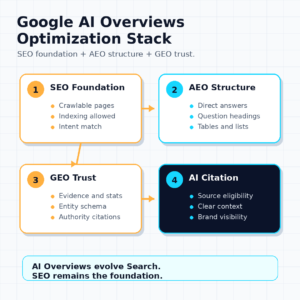
Start with crawlability. Confirm your important pages are indexable, internally linked, mobile friendly, and included in XML sitemaps. Use Search Console to monitor impressions, indexed pages, query changes, and crawling issues.
Next, improve answer extraction. Put a direct answer in the first 100 words. Add question-based H2s and H3s. Use ordered lists for processes. Use comparison tables for choice-based queries. Keep sentences short. Make every section useful on its own.
Then build trust signals. Cite official sources like Google Search Central, research bodies, and recognized industry studies. Add Organization, Article, BreadcrumbList, and FAQPage schema where appropriate. Clarify the brand entity across your website, author schema, social profiles, and about page.
Finally, strengthen topical authority. Create clusters around related searches. For example, this article should link to SEO vs AEO vs GEO, AEO vs SEO, GEO vs SEO, What is llms.txt?, and How to Optimize for ChatGPT Search. If your site has dedicated guides for What is AEO and What is GEO, link those too.
Use Triomize as a final pre-publish check. A page that passes SEO but fails AEO may rank without being extracted. A page that passes AEO but fails GEO may answer well without building enough entity trust.
What are the Common AI Overview SEO Mistakes?
Common AI Overview SEO mistakes usually come from chasing shortcuts instead of improving the page. Google has not published a special AI Overview checklist that overrides standard SEO.
Avoid these errors:
- Promising guaranteed placement. No tool or tactic can guarantee inclusion in AI Overviews.
- Publishing vague answers. AI systems need precise facts, not fluffy introductions.
- Ignoring traditional SEO. If a page is not crawlable or indexable, it cannot become a reliable source.
- Forgetting evidence. Unsupported claims are weaker than sourced claims with clear context.
- Overusing schema without substance. Schema clarifies content. It does not make thin content authoritative.
- Blocking snippets by accident.
nosnippet, restrictivemax-snippet, or hidden key content can reduce eligibility. - Writing only for bots. Human usefulness remains the core quality signal.
Google’s Search Quality Rater Guidelines also reinforce experience, expertise, authoritativeness, and trust concepts. These are not direct ranking buttons. They are useful quality lenses for content teams reviewing sensitive, financial, medical, or high-impact topics.
Google AI Overviews Checklist
Use this checklist before publishing or updating content for AI-powered Google Search:
- Put the focus keyword in the H1, URL slug, SEO title, meta description, first paragraph, and at least one H2.
- Open the article with a direct definition or answer within the first 100 words.
- Match search intent before adding advanced AI optimization tactics.
- Make the page crawlable, indexable, fast, and mobile friendly.
- Add short answer blocks under important question headings.
- Include at least one table, checklist, or ordered list.
- Cite official documentation, research studies, and credible data sources.
- Add Article, Organization, BreadcrumbList, and FAQPage schema where relevant.
- Build internal links to closely related topical cluster pages.
- Review Search Console data after publication and update the page within 12 months.
- Test the draft with Triomize before publishing in WordPress.
Frequently Asked Questions
What are Google AI Overviews?
How do I rank in Google AI Overviews?
Does schema markup help Google AI Overviews?
Are Google AI Overviews replacing SEO?
Why is my website not appearing in AI Overviews?