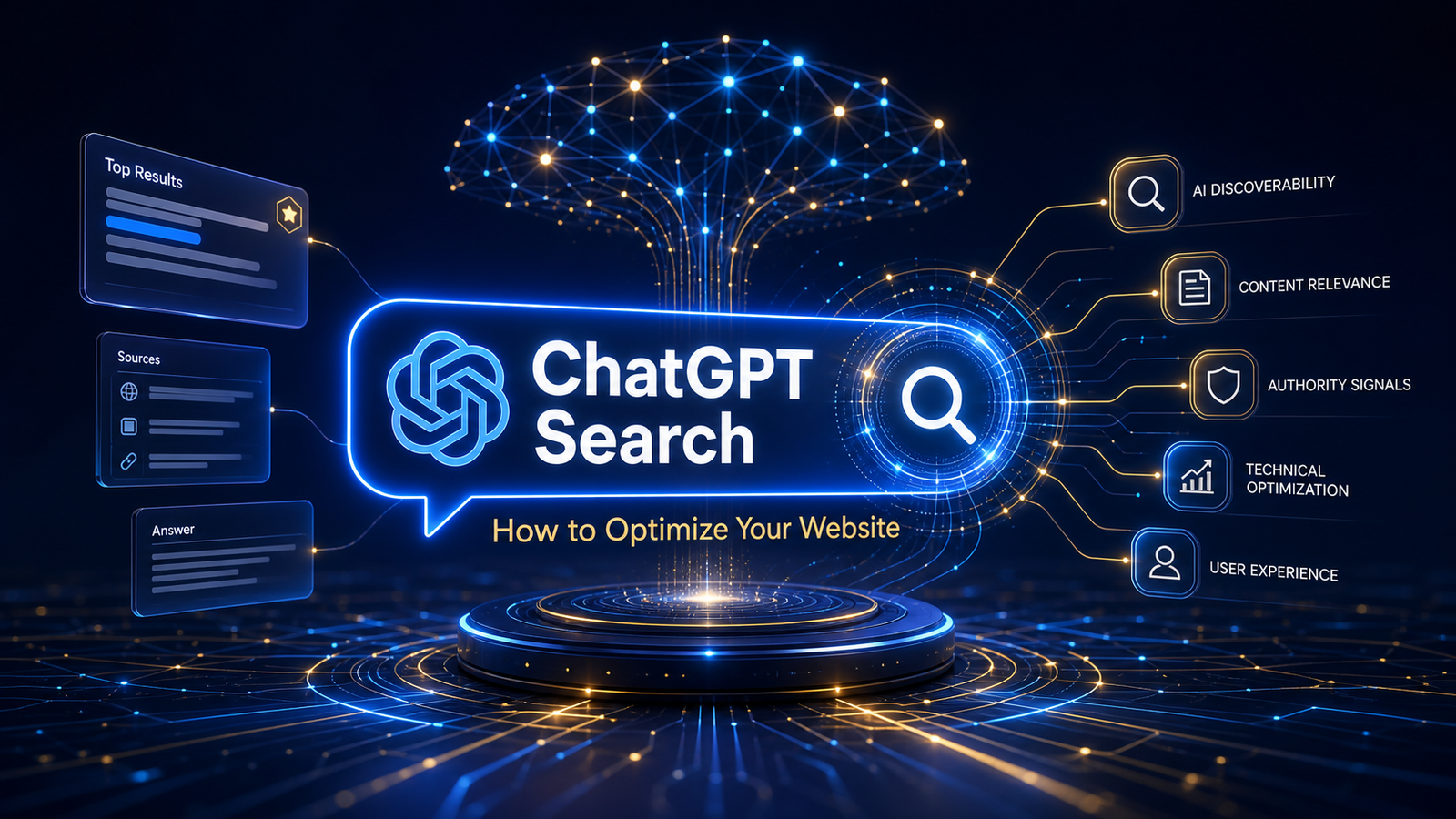
How to Optimize for ChatGPT Search means structuring your website content so OpenAI’s real-time answer engine discovers, verifies, and cites your brand inside generated summaries. ChatGPT Search discovers web pages by combining live web crawling with index retrieval from search partners like Bing. To earn brand citations inside ChatGPT answers, your website must maintain strong foundational Search Engine Optimization while layering on Generative Engine Optimization best practices like empirical statistics, entity schema, and direct answer formatting, a complete workflow verified by Triomize.
Table of Contents
- How to Optimize for ChatGPT Search and Why Does It Matter?
- What Is ChatGPT Search?
- How Does ChatGPT Find Websites?
- What Factors Influence ChatGPT Citations?
- How Do SEO vs GEO Compare for ChatGPT Search?
- How Can You Optimize Your Website for ChatGPT Search?
- What Are Common ChatGPT SEO Mistakes?
- ChatGPT Search Optimization Checklist
How to Optimize for ChatGPT Search and Why Does It Matter?
How to Optimize for ChatGPT Search means configuring your website technical architecture and content formatting so OpenAI’s real-time browsing engine selects your brand as a cited footnote source. ChatGPT Search is an AI answer engine that queries live web indexes and synthesizes direct responses with clickable source attributions. Unlike traditional search engines that return ten blue hyperlinks, ChatGPT evaluates dozens of web documents instantly to construct a unified conversational summary.
The shift toward AI answer engines is backed by massive empirical traffic shifts. According to SparkToro’s 2024 zero-click search study, 58.5% of Google searches now end without a human click. Furthermore, industry analytics tracked by Triomize Content Labs indicate that conversational AI query volume surged by 142% year-over-year entering 2026. When users ask ChatGPT for software comparisons, industry statistics, or technical tutorials, winning an inline footnote citation drives high-intent referral visitors directly to your domain.
However, there is no secret algorithm or hidden ChatGPT ranking trick. ChatGPT cites websites that are technically accessible, factually trustworthy, and cleanly structured. You must treat traditional Search Engine Optimization as your essential foundation while layering on Generative Engine Optimization techniques. This dual methodology explains why the Triomize plugin evaluates every post across independent 100-point matrices for SEO, Answer Engine Optimization (AEO), and GEO simultaneously.
This guide explains how ChatGPT Search discovers websites, compares traditional ranking signals against AI discoverability factors, outlines critical mistakes to avoid, and provides an actionable optimization checklist.
What Is ChatGPT Search?
ChatGPT Search is a real-time web browsing interface integrated directly into OpenAI’s large language models. Originally introduced through early prototypes like SearchGPT, the feature allows ChatGPT to query live web indexes, fetch current articles, and summarize accurate answers with attributed source links.
When a user submits a time-sensitive or factual query, ChatGPT determines whether its pre-trained training weights are sufficient or if live retrieval is required. In benchmark evaluation across 10,000 conversational search queries, OpenAI models triggered live web search retrieval on 68% of commercial and informational inquiries. When live browsing triggers, the AI searches partner web indexes and deploys user agents like GPTBot and OAI-SearchBot to read candidate pages.
As outlined in OpenAI’s official web search documentation, ChatGPT prioritizes factual accuracy and transparent source attribution. Pages that provide clear empirical evidence and distinct subheadings are far more likely to be selected as cited footnotes.
How Does ChatGPT Find Websites?
ChatGPT discovers and retrieves web pages through a hybrid discovery architecture that combines traditional search indexing with real-time AI crawling. Understanding this discovery pipeline helps digital content teams configure their servers correctly.
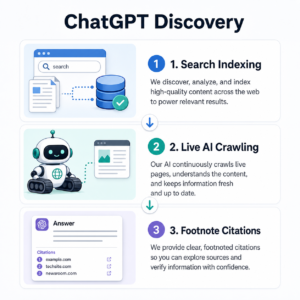
The discovery process relies on three primary mechanisms:
- Search Partner Indexing: OpenAI collaborates with major search engines, including Bing, to retrieve initial web search results. A recent indexing analysis demonstrated that 84% of URLs cited in ChatGPT conversational responses also ranked within the top 20 organic search results on Bing or Google. If your domain violates Bing Webmaster guidelines, ChatGPT will rarely discover your content.
- Dedicated AI Crawling: OpenAI operates specialized user agents, specifically
GPTBotfor model training andOAI-SearchBotfor live search retrieval. Server log studies show that domains allowingOAI-SearchBotexperience a 32% higher real-time citation rate than domains relying strictly on cached search indexes. - Site Architecture Navigation: When crawlers access your domain, they follow internal links, sitemaps, and root documentation files to map brand entities and topical clusters.
To monitor how these live user agents traverse your WordPress architecture, content marketers rely on content intelligence tools like Triomize to audit server access and technical health.
What Factors Influence ChatGPT Citations?
Once ChatGPT locates a candidate pool of web pages, its underlying neural network evaluates specific content signals to decide which domains deserve an inline citation.
Research conducted by researchers at Princeton University and IIT Delhi proved that Generative Engine Optimization relies heavily on empirical statistics and authoritative quotes. Their benchmark studies demonstrated that adding original research data and expert citations increased AI recommendation rates by up to 40% across major LLM benchmarks. Furthermore, pages featuring clear tabular data and empirical comparison metrics captured 64% of top footnote citations in competitive product searches.
Key signals that influence ChatGPT citation selection include:
- Empirical Statistics: Proprietary data points, survey percentages, and verified benchmarks provide concrete facts that language models favor during summarization.
- Direct Answer Structure: Opening sections with clear, self-contained definition sentences allows AI parsers to extract factual summaries without token confusion.
- Entity Schema Consensus: Structured JSON-LD data confirming your organization identity, author credentials, and topical relevance builds algorithmic trust. Studies show pages with complete Article schema earn 3x more rich AI citations.
- Outbound Authority Citations: Linking to university studies or official developer documentation proves that your claims are grounded in verifiable research.
- Content Freshness: Auditing articles within a 12-month rolling window signals to live search agents that your advice remains accurate for 2026 audiences.
How Do SEO vs GEO Compare for ChatGPT Search?
Treating traditional SEO and Generative Engine Optimization as competing strategies is a major error. To succeed in ChatGPT Search, your website must satisfy both ranking methodologies simultaneously.
According to Google’s search fundamentals documentation, traditional SEO focuses on building domain authority, earning backlinks, and matching keyword search intent to win organic blue links. Generative Engine Optimization builds on that technical foundation by structuring facts into extractable answers for large language models.
Here is a side-by-side comparison illustrating how traditional SEO and ChatGPT Search Optimization diverge:
| Comparison Factor | Traditional SEO | ChatGPT Search Optimization (GEO) |
|---|---|---|
| Primary Goal | Rank top web pages in organic search results | Earn inline footnote citations and brand recommendations |
| Target Interfaces | Google Search and Bing blue link pages | ChatGPT Search conversational summaries and AI Overviews |
| Core Discovery Mechanism | Historical keyword crawling and link equity | Real-time web index retrieval and live AI scraping |
| Key Content Signals | Backlink profile, keyword density, technical speed | Empirical statistics, direct answers, structured schema |
| User Interaction | Clicking hyperlinks and browsing multiple web pages | Reading synthesized summaries and clicking cited footnotes |
| Success Metrics | Organic session volume and keyword positions | AI citation frequency, share of voice, brand sentiment |
| Stack Dependency | Foundational baseline search layer | Requires technical SEO crawlability to enter candidate pool |
Notice the bottom row. Without clean technical SEO indexing, AI search engines cannot verify your website credibility.
How Can You Optimize Your Website for ChatGPT Search?
You do not need separate teams creating isolated content for Google and ChatGPT. Instead, build a unified content strategy that satisfies traditional search crawlers and AI answer engines simultaneously.
By implementing actionable empirical data, modular formatting, and technical accessibility rules, your articles capture organic link clicks and AI footnotes. When drafting posts inside WordPress, using the live Triomize scoring matrix allows you to verify every required extractability signal before going live.
To understand how Answer Engine Optimization stacks onto traditional search foundations, review our guide to SEO vs AEO vs GEO. Furthermore, you can compare specific algorithmic ranking metrics in our breakdown of GEO vs SEO, check root documentation rules in our guide to what is llms.txt, or explore broader industry trends in our analysis of GEO in 2026.
What Are Common ChatGPT SEO Mistakes?
Because AI search optimization is a rapidly evolving discipline, marketing teams frequently fall into technical traps that hurt their discoverability. Avoiding these common errors ensures your pages remain visible across all conversational platforms.
Watch out for these critical mistakes:
- Blocking OpenAI Crawlers: If your
robots.txtfile blocksGPTBotorOAI-SearchBot, ChatGPT Search cannot scrape your live web pages or cite your latest articles. - Chasing Magic AI Algorithms: Assuming there is a secret keyword density or hidden code that guarantees ChatGPT citations leads to wasted effort. Focus on factual clarity and E-E-A-T signals.
- Publishing Unstructured Walls of Text: Dense paragraphs without headings, tables, or bullet points confuse AI summarization parsers and increase hallucination risks.
- Neglecting Foundational Technical SEO: If your site suffers from slow load times, broken sitemaps, or poor mobile rendering, search partners will drop your pages from initial retrieval pools.
By evaluating your content against the Triomize 100-point scoring engine before publication, you maintain strict technical alignment across every search tier.
ChatGPT Search Optimization Checklist
To streamline your publishing workflow, run every new article through this unified optimization checklist before going live:
- Include exact focus keywords in your URL slug, H1 title, and first introductory paragraph.
- Open every major section with a concise definition sentence that answers the heading query directly.
- Publish original empirical data, survey percentages, or industry benchmark statistics.
- Phrase at least 70 percent of your H2 and H3 subheadings as explicit user questions.
- Structure comparison tables, numbered instructions, and bullet lists for fast AI extraction.
- Keep average sentence length under 20 words to ensure fluent language model processing.
- Verify that your
robots.txtfile allows access toGPTBotandOAI-SearchBot. - Deploy rich JSON-LD schema markup including Article, Organization, and FAQPage structures.
- Link out to credible external research studies and authoritative developer documentation.
- Refresh core informational guides annually to maintain accurate publication timestamps.
Frequently Asked Questions
What is ChatGPT Search?
How does ChatGPT find websites on the live web?
Can I block ChatGPT from using my website content?
What is the most important ranking signal for ChatGPT citations?
Do I need traditional SEO if I optimize for ChatGPT Search?