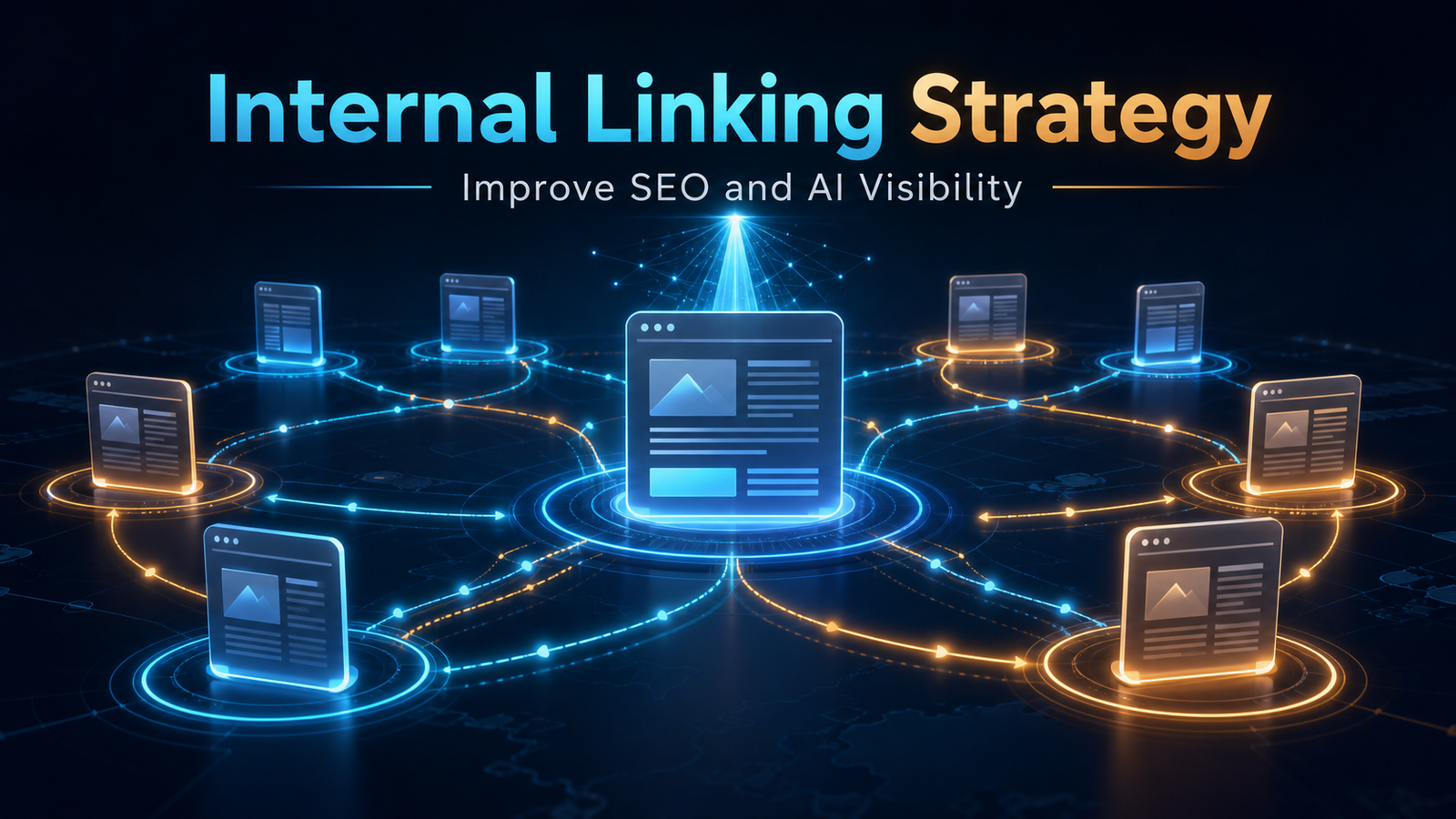
Internal linking strategy is the planned use of links between pages on the same website to help users, search engines, and AI systems discover important content and understand how topics connect. A strong internal linking structure supports crawlability, distributes authority, reduces orphan pages, strengthens topical relevance, and helps important pages sit closer to the site’s core architecture. It does not replace backlinks, but it makes your existing content easier to find, interpret, and trust.
Table of Contents
- What Is an Internal Linking Strategy?
- How Does Internal Linking Improve SEO?
- Why Is Internal Linking Important for SEO?
- How Do Internal Links Help Search Engines Discover Pages?
- How Do Internal Links Distribute Authority?
- How Do Internal Links Establish Topical Relationships?
- How Does Internal Linking Help AI Search?
- What Is a Good Internal Linking Strategy?
- Step 1: How Do You Identify Core Topics?
- Step 2: How Do You Create Pillar Pages?
- Step 3: How Do You Create Supporting Content?
- Step 4: How Do You Connect Related Pages?
- Step 5: How Do You Link Back to the Pillar?
- Step 6: How Do You Keep Important Pages Close to the Site Structure?
- How Many Internal Links Should a Page Have?
- What Makes a Good Internal Link?
- What Is a Relevant Destination?
- What Is Descriptive Anchor Text?
- Why Does Context Matter?
- What Is a Logical Relationship?
- What Are Common Internal Linking Mistakes?
- What Are Orphan Pages and Why Do They Matter?
- How Do Internal Links Compare with Backlinks?
- How Does Internal Linking Support Topical Authority?
- How Do You Audit Internal Links?
- Does Internal Linking Help AI Citations?
- How Can Triomize Help with Internal Linking Strategy?
What Is an Internal Linking Strategy?
An internal linking strategy is a planned system for connecting related pages within the same website. It helps users move between useful resources and helps search engines understand which pages are connected, important, and relevant to a topic.
An internal link points from one page on your domain to another page on the same domain. An external link points from your website to another website, or from another website to yours.
For example:
SEO Guide → Technical SEO → Core Web VitalsThat simple path shows a topic relationship. The broad SEO guide introduces the larger topic. The technical SEO page narrows the context. The Core Web Vitals page answers a specific performance question.
Internal links can appear in several places:
- Navigation menus.
- Breadcrumbs.
- Footer links.
- Related post blocks.
- Category pages.
- Contextual links inside paragraphs.
- Table of contents links.
Contextual internal links are especially useful because they appear near relevant text. A sentence about page speed can link to a Core Web Vitals guide. A paragraph about content clusters can link to Topical Authority.
A good internal linking strategy is not random. It connects pages because the destination genuinely helps the reader.
How Does Internal Linking Improve SEO?
Internal linking improves SEO by connecting related pages within a website, helping search engines discover content, understand topical relationships, and distribute link authority across important pages. A strong internal linking structure can also reduce orphan pages, improve navigation, and help search engines identify which pages are most important within a topic.
The main SEO benefits are:
- Better page discovery.
- Clearer site architecture.
- Stronger topical relevance.
- Better distribution of internal authority.
- Improved user navigation.
- Fewer orphan pages.
- Better support for pillar pages and content clusters.
According to Google’s link best practices, Google uses links to find new pages and to determine page relevancy. Google also says every page you care about should have a link from at least one other page on your site.
Industry research supports the same direction. According to a Seobility summary of internal link studies, the Zyppy dataset analyzed about 23 million internal links across 1,800 websites, while the AuthorityHacker dataset analyzed about 1 million internal links across 10,000 first-page ranking pages. These studies found strong relationships between internal link patterns, anchor text variety, and search performance.
This does not mean every internal link passes identical value. It means internal linking is a controllable architecture signal. Unlike backlinks, you can improve it today.
Why Is Internal Linking Important for SEO?
Internal linking is important for SEO because it helps search engines discover pages, interpret relationships, and understand which content matters most. It also helps users continue their journey.
How Do Internal Links Help Search Engines Discover Pages?
Search engines discover many pages by following links from pages they already know. If an important page has no internal links pointing to it, crawlers may only find it through a sitemap, backlink, or direct URL history.
A page without internal links can still exist, but it is structurally isolated. That weakens discovery and makes the page look less important within your site architecture.
Use internal links to connect:
- New posts from existing relevant posts.
- Supporting articles to pillar pages.
- Pillar pages to supporting articles.
- Product pages to relevant guides.
- Old articles to newer resources.
How Do Internal Links Distribute Authority?
Internal links help distribute authority and importance across a website. A high-value page can point users and crawlers toward another important page. This can help the destination page gain visibility within the site’s structure.
Avoid the oversimplified idea that every internal link passes the same amount of link value. The context, location, relevance, anchor text, and page importance all matter.
The practical rule is simple. Link from relevant pages to pages that deserve more visibility.
How Do Internal Links Establish Topical Relationships?
Internal links establish topical relationships by showing how pages fit together. This is where an internal linking strategy becomes more than navigation.
For example:
AI Search
↓
AI Search Optimization
↓
Google AI Overviews
↓
ChatGPT Search
↓
AI Crawlers
↓
AI Citations
This creates a content cluster. Each page supports the broader topic. Search engines and AI systems can see that the website covers the subject from multiple angles.
This is why internal links are central to Topical Authority.
How Does Internal Linking Help AI Search?
Internal linking helps AI search indirectly by improving discoverability and contextual understanding. It does not guarantee that ChatGPT, Perplexity, Gemini, or Google AI Overviews will cite a page. It helps make related content easier to find and interpret.
AI-oriented discovery depends on several layers:
- Crawlers need to find the page.
- Retrieval systems need to understand the topic.
- AI systems need context about related pages.
- Content needs clear answers and trust signals.
- The site needs enough topical depth to look credible.
Internal links contribute to that foundation. They show:
- Which pages are related.
- Which topics the website covers.
- How concepts connect.
- Which pages are important.
- Where deeper information can be found.
For example, a post about schema markup can link to Entity SEO, AI Search Optimization, and Technical SEO Audit Checklist. Those links help humans and machines understand that schema is part of a broader technical and semantic search system.
Do not claim that AI engines rank websites only because of internal links. That would be too simplistic. Internal linking contributes to the discovery and context layer. AI citation decisions also depend on content quality, sources, entities, freshness, EEAT, schema, and platform-specific retrieval systems.
What Is a Good Internal Linking Strategy?
A good internal linking strategy connects important pages by topic, intent, and user need. It should make the website easier to navigate and easier to understand.
Step 1: How Do You Identify Core Topics?
Start by listing the topics your website wants to own. For Triomize, core topics include SEO, AEO, GEO, AI search, technical SEO, schema, entity SEO, and WordPress optimization.
Your core topics should match:
- Your business expertise.
- User search demand.
- Product or service relevance.
- Existing content strengths.
- Future content plans.
Step 2: How Do You Create Pillar Pages?
A pillar page covers a broad topic and links to supporting pages. It should act as the main resource for that topic.
Examples:
- AI Search Optimization.
- Technical SEO Audit Checklist.
- Topical Authority.
- Entity SEO.
Pillar pages should be comprehensive, well-structured, and regularly updated.
Step 3: How Do You Create Supporting Content?
Supporting content answers narrower questions. It gives depth to the pillar topic.
For example, a technical SEO pillar can link to supporting pages on Core Web Vitals, Robots.txt, internal linking, crawl health, schema, and sitemaps.
Each supporting article should link back to the pillar when relevant.
Step 4: How Do You Connect Related Pages?
Connect related pages using contextual internal links. The link should appear where the reader naturally needs more information.
Good examples:
- Link a paragraph about AI discoverability to AI Visibility.
- Link a section about technical audits to Technical SEO Audit Checklist.
- Link a discussion of site performance to Core Web Vitals.
Step 5: How Do You Link Back to the Pillar?
Supporting pages should link back to the main pillar page. This helps define the cluster structure.
For example, an article about Core Web Vitals can link back to a technical SEO audit guide. An article about AI citations can link back to AI Search Ranking Factors.
This creates a hub-and-spoke structure.
Step 6: How Do You Keep Important Pages Close to the Site Structure?
Important pages should not be buried too deep. If a user needs six clicks to reach a key article, crawlers may also treat it as less central.
A practical rule is to keep important pages reachable from category hubs, pillar pages, menus, or related articles. Do not rely only on XML sitemaps.
How Many Internal Links Should a Page Have?
There is no universal ideal number of internal links for every page. The right number depends on content length, topic complexity, number of relevant pages, website architecture, and user needs. Link whenever the destination genuinely helps the reader understand or continue the topic.
Avoid rigid rules like “every article needs exactly 10 internal links.” A 700-word post may need only a few. A 3,000-word guide may need many more.
Use these questions instead:
- Does the link help the reader?
- Is the destination closely related?
- Does the anchor text describe the page accurately?
- Does the page link to its pillar or hub?
- Are important pages receiving enough contextual links?
- Are you linking only because you want to force authority flow?
Google advises writing anchor text naturally and avoiding forced keyword stuffing. That same principle applies to link quantity. Too many irrelevant links can dilute clarity and frustrate users.
The goal is not more links. The goal is better connections.
What Makes a Good Internal Link?
A good internal link points to a relevant page, uses descriptive anchor text, appears in useful context, and creates a logical relationship between two pages. It should help the reader and clarify the site structure.
What Is a Relevant Destination?
The linked page should expand the topic. If a paragraph mentions technical audits, a link to a technical SEO audit page is useful. If it links to a random product page, it feels forced.
What Is Descriptive Anchor Text?
Descriptive anchor text tells users and search engines what the destination page covers.
Poor anchor text:
Click here
Read more
This article
Better anchor text:
technical SEO audit checklist
AI Search Optimization guide
Topical Authority strategy
Why Does Context Matter?
The surrounding sentence helps explain why the link exists. A link placed naturally inside a relevant paragraph is stronger than a random link list.
What Is a Logical Relationship?
A logical relationship means the two pages belong together. A page about internal links naturally connects to crawlability, technical SEO, topical authority, content clusters, and AI visibility.
What Are Common Internal Linking Mistakes?
Common internal linking mistakes weaken site architecture and make important pages harder to discover.
Avoid these mistakes:
- Linking unrelated pages. Relevance matters.
- Using the same anchor text everywhere. Vary anchors naturally.
- Creating orphan pages. Important pages need incoming internal links.
- Overloading pages with unnecessary links. More is not always better.
- Linking only to the homepage. Deep pages need links too.
- Ignoring older content. Old posts can support new pages.
- Using generic anchor text. Avoid “click here” and “read more.”
- Creating excessive navigation links. Navigation should be useful, not bloated.
- Forgetting commercial pages. Important service and product pages need support.
- Leaving valuable pages buried deep. Key content should be easy to reach.
The best internal linking strategy is intentional. Every link should have a reason.
What Are Orphan Pages and Why Do They Matter?
Orphan pages are pages that have no internal links pointing to them. They may exist in a sitemap or receive external traffic, but users and crawlers cannot reach them through normal site navigation.
The problem looks like this:
Published page → no internal links → difficult discoveryOrphan pages matter because they sit outside the website’s internal structure. They are harder for search engines to discover, harder for users to find, and harder to connect to a topic cluster.
Common causes include:
- Publishing pages without linking to them.
- Removing category links.
- Deleting related posts.
- Website migrations.
- Changing navigation.
- Creating landing pages outside the normal structure.
- Forgetting to update old content.
An orphan page is not always bad. Some campaign pages are intentionally isolated. But if the page should rank, earn traffic, or support topical authority, it needs internal links.
This is why site-wide crawling and structural analysis matter. A manual review can miss orphan pages. A crawler or SEO tool can compare known URLs, sitemap URLs, analytics URLs, and internal link data.
How Do Internal Links Compare with Backlinks?
Internal links and backlinks solve different problems. Internal links come from your own website. Backlinks come from other websites.
| Internal Links | Backlinks |
|---|---|
| Come from your own website | Come from external websites |
| You control them | You do not fully control them |
| Help site architecture | Can provide external authority |
| Help crawlers discover related content | Can introduce new authority and referral traffic |
| Build topical relationships | Build external credibility |
| Improve navigation | Improve reputation signals |
Internal links do not replace backlinks. Backlinks can show external trust and reputation. Internal links show structure, priority, and topic relationships.
A strong SEO strategy uses both. Backlinks help prove that other sites trust you. Internal links help your own site explain what matters.
For more on citations and authority, read Do Backlinks Still Matter for AI Citations?.
How Does Internal Linking Support Topical Authority?
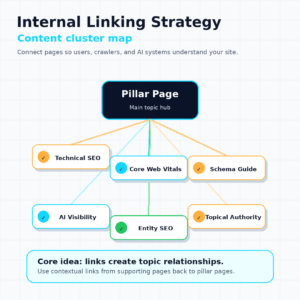
Internal linking supports topical authority by connecting a topic, pillar page, supporting pages, and contextual links into one clear structure.
The model looks like this:
Topic → Pillar → Supporting pages → Contextual links → Stronger topic structureFor example, a website that wants to build authority around AI search should connect:
- AI Search Optimization.
- AI Visibility.
- AI Search Ranking Factors.
- AI Crawler Monitoring.
- Schema Markup for AI Search.
- Entity SEO.
- EEAT for AI Search.
- Topical Authority.
When these pages link to each other naturally, the site becomes easier to understand. Users can explore the topic. Search engines can see the content cluster. AI systems get more context about the website’s expertise.
This is why Topical Authority should be the most prominent internal link from this article. Internal linking is one of the practical ways topical authority is built.
How Do You Audit Internal Links?
You audit internal links by checking whether important pages are discoverable, properly linked, and connected to relevant topic clusters. The goal is to find broken, weak, excessive, or missing links.
Use this checklist:
- Find orphan pages.
- Identify pages with very few internal links.
- Find broken internal links.
- Review anchor text.
- Identify pages receiving excessive links.
- Check that important pages are internally linked.
- Review crawl depth.
- Check links to redirected URLs.
- Identify pages with no contextual links.
- Check old articles for opportunities to link to new pages.
- Confirm supporting pages link back to pillar pages.
- Confirm pillar pages link to the best supporting resources.
A good audit should combine crawl data, sitemap data, Search Console data, analytics data, and manual review.
For a broader workflow, use the Technical SEO Audit Checklist.
Does Internal Linking Help AI Citations?
Internal linking does not guarantee that an AI system will cite a page. However, a well-connected website makes it easier for crawlers and retrieval systems to discover related content and understand the relationships between pages. Strong internal architecture therefore supports the broader discoverability foundation needed for AI search.
This is the key distinction. Internal links are not a magic AI citation factor. They support:
- Discovery.
- Context.
- Topical depth.
- Entity relationships.
- Crawl paths.
- User navigation.
- Content clusters.
AI citations also depend on direct answers, structured data, trust signals, source quality, freshness, and platform-specific retrieval systems.
For AI search, internal linking is part of the foundation. It helps the site communicate what it covers and which pages matter. It works best when paired with AI Search Optimization and AI Visibility.
How Can Triomize Help with Internal Linking Strategy?
Triomize can help with internal linking strategy by making internal links part of the SEO, AEO, and GEO workflow. Internal links affect crawlability, topical relevance, content clusters, and AI search discoverability.
Triomize helps WordPress teams identify optimization gaps across:
- SEO foundations.
- Content structure.
- Internal link opportunities.
- Orphan page risks.
- Topic cluster strength.
- Schema opportunities.
- AEO answer quality.
- GEO citation readiness.
A page may have strong content but weak internal support. Triomize helps teams see when a post should link to a pillar page, related guide, technical resource, or AI search article.
This fits the broader Triomize philosophy: SEO is the foundation, AEO makes answers extractable, and GEO makes content more citable. Internal linking supports all three by helping users, crawlers, and AI systems understand the structure of your website.
Frequently Asked Questions
Does internal linking improve SEO?
How many internal links should a page have?
What is a good internal linking strategy?
Do internal links help Google discover pages?
Does internal linking help AI search?
What are orphan pages?
Do internal links improve topical authority?
Are internal links better than backlinks?