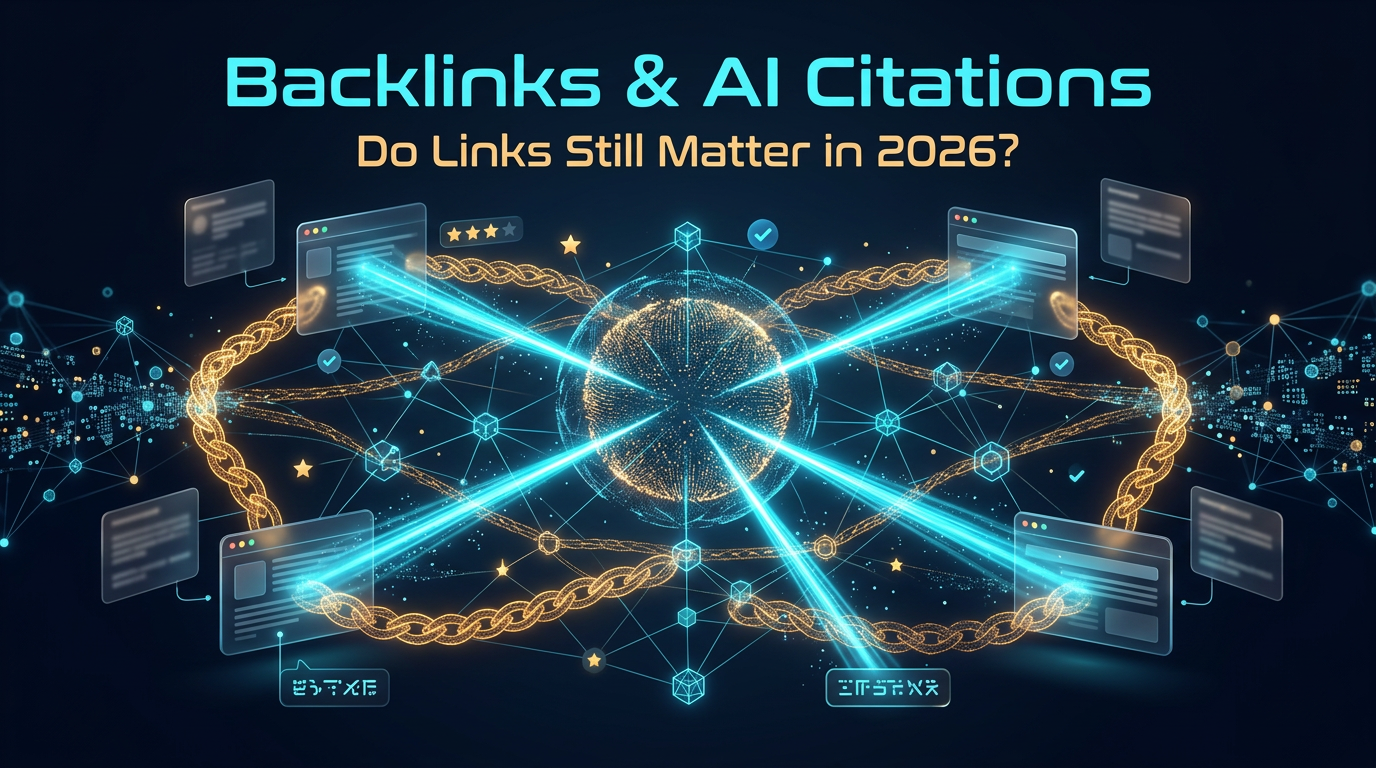
AI Citations are source references that AI search engines use to support generated answers, and backlinks still matter for them, but not like traditional SEO. ChatGPT Search, Perplexity, and Google AI Overviews may treat backlinks as one trust signal among many. In 2026, topical authority, entity recognition, factual accuracy, structured data, direct answers, and content quality often influence AI citations more than backlink quantity alone.
Table of Contents
- What Are AI Citations?
- Do AI Search Engines Use Backlinks?
- How Does Google Use Backlinks?
- How Does ChatGPT Search Use Trust Signals?
- How Does Perplexity Select Sources?
- Are Backlinks Still Important for AI Citations?
- What Matters More Than Backlinks for AI Citations?
- How Can You Earn AI Citations Without Thousands of Links?
- How Do You Use Original Research?
- How Do You Add Statistics?
- How Do Expert Quotes Help?
- How Do Clear Answers Help?
- How Do FAQs Help?
- How Does Schema Help?
- How Does Internal Linking Help?
- How Does Updating Content Help?
- How Does AI Crawler Accessibility Help?
- What Are Common Myths About Backlinks and AI Citations?
- Does ChatGPT Count Backlinks?
- Can You Rank in AI Search Without Backlinks?
- Are Backlinks Becoming Obsolete?
- Do Nofollow Links Matter for AI Citations?
- How Should You Balance Link Building and AI Citation Strategy?
- How Can Triomize Help Improve AI Citation Readiness?
What Are AI Citations?
AI Citations are source references that appear inside or alongside AI-generated answers. They may show as footnotes, source cards, inline links, supporting links, or cited pages in tools like Perplexity, ChatGPT Search, Google AI Overviews, Gemini, Claude, or Bing Copilot.
A traditional search result asks the user to choose a page from a list. An AI citation means the AI system has already selected a source to support part of its answer. That is a major shift. The website is not only competing for a ranking. It is competing to be trusted enough to support the answer.
AI citations can support several outcomes:
- Referral traffic from AI platforms.
- Brand visibility inside answers.
- Source credibility.
- Assisted conversions.
- More branded searches.
- Higher trust with users researching a topic.
For example, if Perplexity cites your guide in a comparison answer, the user sees your brand as one of the sources behind the answer. If ChatGPT Search references your page, your content may shape the response. If Google AI Overviews includes your page as a supporting link, your site may gain visibility even when the query is partially answered on the results page.
This is why AI Visibility, Perplexity SEO, and AI Search Optimization all matter. AI citations are one of the measurable outcomes of those strategies.
Do AI Search Engines Use Backlinks?
AI search engines may use backlinks directly, indirectly, or through search indexes that already rely on link signals. However, backlinks are not the only factor behind AI citations.
Traditional Google Search has long used links to discover pages and evaluate authority. Google’s own link guidance says links help Google discover pages, understand relationships, and make sense of a site. Industry research has also shown strong correlation between links and rankings. A Backlinko and Ahrefs study of 11.8 million Google search results reported that the number one result had 3.8x more backlinks than results in positions two through ten.
AI search works differently. It may use a search index, live web retrieval, crawling, embeddings, entity recognition, source selection, and answer synthesis. A page with strong backlinks may look authoritative, but an AI system also needs to decide whether the page directly answers the question, whether its claims are factual, and whether the page is safe to cite.
The difference looks like this:
| Search model | Main path | What backlinks do |
|---|---|---|
| Traditional Google | Crawl → link graph → authority → ranking | Strong authority and discovery signal |
| AI search | Retrieve → understand → verify → synthesize → cite | One trust signal among many |
| Perplexity-style answer engines | Retrieve sources → generate cited answer | May value authority, freshness, structure, and source fit |
| ChatGPT Search | Search retrieval → answer synthesis → source links | Needs access, relevance, authority, and clarity |
So yes, backlinks still matter. But a page with thousands of weak links and poor content may lose to a page with fewer links, stronger topical relevance, clear answers, current facts, and better entity signals.
How Does Google Use Backlinks?
Google uses links as part of its broader system for discovering and evaluating web pages. Links are not the whole algorithm, but they remain part of how Google understands the web.
Backlinks can help Google understand:
- Which pages other sites reference.
- Which sources are considered useful.
- How pages relate to each other.
- Which domains have earned authority over time.
- Which pages deserve crawling and discovery attention.
Google’s public guidance also warns against manipulative link schemes. That means the quality, context, and legitimacy of links matter more than raw backlink volume.
For AI citations, Google matters because Google AI Overviews are built on Google Search systems. Google’s AI features documentation says AI Overviews and AI Mode use relevant links and require pages to be indexed and eligible for Google Search with a snippet. That means classic SEO signals, including links, still contribute to the foundation.
However, Google AI Overviews are not just a backlink contest. A page also needs to be helpful, clear, current, and relevant to the user’s query. Backlinks may help a page enter the candidate pool, but they do not guarantee inclusion as a supporting source.
How Does ChatGPT Search Use Trust Signals?
ChatGPT Search uses trust signals through retrieval, crawler access, content relevance, and source selection. OpenAI has not published a public ranking formula for ChatGPT citations, but its crawler documentation shows that access and search visibility are managed through specific agents.
OpenAI documents separate crawlers and user agents. OAI-SearchBot is used to surface websites in ChatGPT Search. GPTBot is related to training. ChatGPT-User is used for certain user-triggered actions.
For ChatGPT Search, backlinks may matter indirectly if the retrieval system uses search indexes or authority signals influenced by links. But ChatGPT also needs content that is easy to summarize and cite.
Strong ChatGPT citation signals include:
- OAI-SearchBot access.
- Crawlable public content.
- Direct answers.
- Clear headings.
- Current information.
- Structured data.
- Credible citations.
- Topical authority.
- Brand and entity clarity.
- Strong internal links.
A page with strong backlinks but no clear answer may be less useful than a page with a concise explanation, updated statistics, and credible sources. This is why ChatGPT Search optimization must combine SEO, AEO, and GEO.
How Does Perplexity Select Sources?
Perplexity selects sources that help support cited answers. It is built around source-backed responses, so citation quality is central to the user experience.
Perplexity documents PerplexityBot as a crawler designed to surface and link websites in Perplexity results. It also documents Perplexity-User for user-triggered actions when someone asks a question.
Perplexity source selection appears to depend on more than backlinks. Practical patterns suggest that cited sources often have:
- Clear answers.
- Relevant content.
- Fresh facts.
- Source citations.
- Good page structure.
- Entity clarity.
- Topical depth.
- Accessible pages.
- Strong authority signals.
Backlinks can contribute to authority and discovery, but Perplexity still needs a page that fits the answer. If a page is broad, outdated, or vague, it may not be selected even if the domain has authority.
This is why How to Get Cited by Perplexity AI focuses on access, direct answers, trust signals, and entity clarity, not only link building.
Are Backlinks Still Important for AI Citations?
Backlinks are still important for AI citations because they can influence authority, reputation, discovery, trust, and brand recognition. They are especially useful when links come from relevant, credible sources.
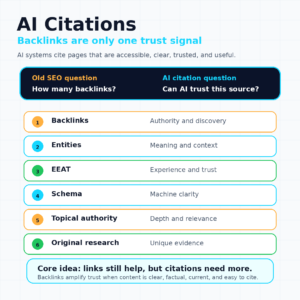
Backlinks can help in five ways:
- Authority. High-quality backlinks can signal that other websites trust your content.
- Reputation. Mentions from respected sources can strengthen brand credibility.
- Discovery. Links help crawlers find pages.
- Trust. A link from a trusted source may reinforce that your page is worth evaluating.
- Brand recognition. Repeated mentions can help search systems associate your brand with a topic.
But backlink quantity alone is weaker than it used to be. A page with many irrelevant links can still fail to earn AI citations if it lacks clear answers, factual accuracy, current data, or topical authority.
Think of backlinks as a trust amplifier. They help most when the content already deserves trust. They do not replace content quality.
A strong link from an expert source to a well-structured, evidence-backed guide can improve AI citation potential. A batch of low-quality links to a thin article probably will not.
What Matters More Than Backlinks for AI Citations?
Several signals can matter as much as backlinks, and sometimes more, when AI systems choose sources to cite. The key difference is that AI citations require a page to be useful inside a generated answer.
| Signal | Traditional SEO | AI Citations |
|---|---|---|
| Backlinks | ⭐⭐⭐⭐⭐ | ⭐⭐⭐ |
| Entities | ⭐⭐⭐ | ⭐⭐⭐⭐⭐ |
| EEAT | ⭐⭐⭐⭐ | ⭐⭐⭐⭐⭐ |
| Schema | ⭐⭐⭐ | ⭐⭐⭐⭐ |
| Topical Authority | ⭐⭐⭐⭐ | ⭐⭐⭐⭐⭐ |
| Direct Answers | ⭐⭐⭐ | ⭐⭐⭐⭐⭐ |
| Original Research | ⭐⭐⭐⭐ | ⭐⭐⭐⭐⭐ |
| Freshness | ⭐⭐⭐ | ⭐⭐⭐⭐ |
| Citation Quality | ⭐⭐⭐ | ⭐⭐⭐⭐⭐ |
| AI Crawler Access | ⭐⭐ | ⭐⭐⭐⭐⭐ |
This table is not a universal formula. It is a strategic comparison. Traditional SEO still benefits from backlinks. AI citations often depend more on whether the page is easy to understand, verify, and quote.
The GEO study from Princeton University, Georgia Tech, Allen Institute, and IIT Delhi supports this direction. The researchers tested optimization tactics across 10,000 queries and nine datasets. They found that adding citations, statistics, and authoritative language improved position-adjusted word count by 30% to 40% and subjective impression by 15% to 30%.
That does not mean backlinks are irrelevant. It means evidence, clarity, and source authority are central to generative visibility.
How Can You Earn AI Citations Without Thousands of Links?
You can earn AI citations without thousands of backlinks by creating content that is clearly useful, verifiable, and easy to cite. Smaller websites can compete when they publish focused, high-quality resources around specific topics.
Use these tactics:
How Do You Use Original Research?
Original research gives AI systems something unique to cite. This may include surveys, benchmarks, experiments, case studies, data tables, or industry analysis.
Examples:
- A study of AI crawler visits across WordPress sites.
- A benchmark of schema errors in plugin pages.
- A survey of how agencies use AI search tools.
- A comparison of AI citation rates before and after content updates.
Original research can earn links too, but its value for AI citations is the factual uniqueness.
How Do You Add Statistics?
Statistics make content more quotable. Use current, sourced numbers and explain what they mean. Avoid vague statements like “AI search is growing fast” when you can cite specific figures.
Good statistics should include:
- Source.
- Date.
- Method or sample where available.
- Clear interpretation.
- Relevance to the article.
How Do Expert Quotes Help?
Expert quotes add perspective and credibility. AI systems can use quoted experts as context when summarizing a topic. Users also trust content more when real experts explain tradeoffs.
Use quotes from:
- Developers.
- SEO specialists.
- Researchers.
- Product leaders.
- Industry practitioners.
- Customers with firsthand experience.
How Do Clear Answers Help?
Clear answers help AI systems extract content accurately. Put direct answers near the top of sections. Use question-based headings and concise paragraphs.
A clear answer should be:
- Direct.
- Specific.
- Self-contained.
- Free of unnecessary setup.
- Supported by detail below.
How Do FAQs Help?
FAQs help answer engines map common questions to concise answers. They also help users who scan the page quickly.
A strong FAQ section should include real questions, not keyword-stuffed headings. Keep answers useful and concise.
How Does Schema Help?
Schema markup helps machines understand page type, author, organization, breadcrumbs, and FAQs. It does not guarantee AI citations, but it improves clarity.
Read Schema Markup for AI Search for the full workflow.
How Does Internal Linking Help?
Internal linking helps search systems understand topical relationships. Link your AI citation content to related pages like AI Search Ranking Factors, Entity SEO, EEAT for AI Search, and AI Crawler Monitoring.
How Does Updating Content Help?
AI search moves quickly. Update content when tools, crawlers, policies, or data change. Freshness can matter when the query involves current behavior.
How Does AI Crawler Accessibility Help?
AI systems need access to public pages. Review robots.txt, WAF rules, and AI crawler monitoring. If OAI-SearchBot, PerplexityBot, Claude-SearchBot, Googlebot, or Bingbot cannot access the page, citation potential may drop.
What Are Common Myths About Backlinks and AI Citations?
Common myths about backlinks and AI citations usually come from applying old SEO assumptions to new AI search behavior.
Does ChatGPT Count Backlinks?
OpenAI has not published a public statement saying ChatGPT counts backlinks as a direct ranking factor. However, ChatGPT Search can use web retrieval systems, and those systems may be influenced by source authority, search indexes, and link-based trust indirectly.
The practical answer is: backlinks may help authority, but they are not enough.
Can You Rank in AI Search Without Backlinks?
Yes, a page can gain AI visibility without thousands of backlinks if it is highly relevant, crawlable, current, structured, and source-backed. Smaller sites can win citations for niche questions when they provide the clearest answer.
Backlinks help, but they are not the only path.
Are Backlinks Becoming Obsolete?
No. Backlinks are not obsolete. They still support authority, discovery, and reputation. What changed is that AI citations depend on more signals than link count alone.
Backlinks are now one part of a larger trust system.
Do Nofollow Links Matter for AI Citations?
Nofollow links may not pass traditional ranking signals in the same way as followed links, but they can still create discovery, referral traffic, brand mentions, and entity confirmation. For AI citations, unlinked mentions and nofollow references may still support brand recognition.
Do not ignore nofollow links if they come from relevant, trusted sources.
How Should You Balance Link Building and AI Citation Strategy?
You should balance link building and AI citation strategy by earning links through useful assets instead of chasing links as a standalone goal. The best AI citation strategy often creates link-worthy content naturally.
A balanced approach looks like this:
- Publish original research.
- Build topic clusters.
- Add direct answers.
- Cite credible sources.
- Use schema markup.
- Improve author and organization trust.
- Monitor AI crawlers.
- Earn mentions from relevant sources.
- Promote useful data to journalists and developers.
- Update high-value pages regularly.
This approach helps both traditional SEO and AI citations. You earn backlinks because the content is useful. You earn AI citations because the content is clear and trustworthy.
If your link building does not improve source quality, it may not help AI visibility much.
How Can Triomize Help Improve AI Citation Readiness?
Triomize can help improve AI citation readiness by analyzing website content across SEO, AEO, and GEO. AI citations depend on more than backlinks, so teams need a workflow that checks technical access, answer structure, entity clarity, trust signals, and content quality together.
Triomize helps WordPress teams review:
- SEO foundations.
- Answer-first structure.
- FAQ quality.
- Schema opportunities.
- Internal links.
- Brand mentions.
- GEO trust signals.
- AI crawler access.
- Citation readiness.
- Content freshness.
The goal is not to guarantee AI citations. No tool can do that. The goal is to improve the signals that make citations more likely.
Backlinks still matter, but they are only one part of the picture. Triomize helps you see the rest of the picture across SEO, AEO, and GEO.
Frequently Asked Questions
Do backlinks still matter for AI citations?
Does ChatGPT count backlinks?
Can you get AI citations without backlinks?
Are backlinks becoming obsolete?
Do nofollow links matter for AI citations?
What matters more than backlinks for AI search?