
Perplexity SEO is the practice of making your website discoverable, understandable, and trustworthy enough to be cited inside Perplexity AI answers. Perplexity does not simply rank websites like a classic search engine. It retrieves sources, evaluates relevance, synthesizes an answer, and displays citations that users can click. Strong SEO remains the base layer, while GEO practices like structured content, clear entities, fresh data, and source citations improve your chance of being referenced. Triomize helps WordPress teams check all three layers before publishing.
Table of Contents
What Is Perplexity SEO and Why Does It Matter?
Perplexity SEO is the process of optimizing pages so Perplexity AI can find them, understand them, verify their claims, and cite them inside AI-generated answers. Perplexity AI is a conversational answer engine. It combines web search, retrieval, and language models to produce direct answers with linked sources.
This makes Perplexity different from a traditional search results page. A user does not always scan ten blue links. They ask a question, read a synthesized answer, and choose which cited source deserves a click. That creates a new visibility layer for brands that publish research, guides, comparisons, and technical explanations.
The opportunity is measurable. StatCounter reported that Perplexity held 7.73% of global AI chatbot referral share in April 2026, while ChatGPT held 76.85%, Gemini held 9.0%, Copilot held 3.76%, and Claude held 2.66%. Business Insider reported that Perplexity passed $150 million in annual recurring revenue by mid-2025, more than four times its roughly $35 million ARR a year earlier. Public usage estimates also place Perplexity at about 22 million monthly active users, 100 million weekly queries, 13.9 million app downloads, and roughly 780 million monthly queries in May 2025.
Those figures do not mean every page can get cited. Perplexity has not published a complete ranking algorithm. The right strategy is to focus on observable and documented signals: crawlability, source access, entity clarity, topical authority, direct answers, and evidence. This is why the Triomize plugin scores SEO, AEO, and GEO separately instead of treating AI visibility as one vague metric.
What Is Perplexity AI?
Perplexity AI is an AI-powered answer engine that responds to user questions with concise answers and inline citations. It is built for research-style queries where users want sources, context, and follow-up exploration.
Perplexity is popular because it makes citations central to the answer experience. A typical response includes linked references near the claims it makes. That design changes how content earns visibility. Your page does not need to be the only result. It needs to be one of the most relevant, accessible, and credible sources for a specific part of the answer.
For marketers, this shifts the goal from ranking alone to being cited accurately. A page can attract value even when users do not begin with Google. They may ask Perplexity for vendor comparisons, legal definitions, SaaS alternatives, research summaries, market statistics, or implementation checklists.
That is where Perplexity AI SEO overlaps with Generative Engine Optimization. SEO gets the page into the web discovery layer. GEO makes the page easier to trust and cite once an AI system evaluates candidate sources.
How Does Perplexity AI Find Websites?
Perplexity AI finds websites through a mix of its own crawlers, user-triggered fetching, and web retrieval systems. Site owners should understand the official crawler distinction because it affects access controls.
Perplexity’s official crawler documentation lists two important user agents:
- PerplexityBot. Perplexity says
PerplexityBotis designed to surface and link websites in search results on Perplexity. It is not used to crawl content for AI foundation models. Perplexity recommends allowing this bot inrobots.txtand permitting requests from its published IP ranges. - Perplexity-User. Perplexity says
Perplexity-Usersupports user actions when someone asks a question. It may visit a web page to help provide an accurate answer and include a link in the response. Perplexity states this fetcher is not used for training, and since it is user requested, it generally ignoresrobots.txtrules.
That difference is important. Perplexity documents two separate agents, two published IP-range JSON endpoints, and WAF configuration guidance for Cloudflare and AWS. Blocking every non-Google bot can reduce your AI discoverability. At the same time, you should verify user agents and IP ranges so fake crawlers cannot abuse your server.
A practical Perplexity setup includes:
- Allowing
PerplexityBotto crawl public content. - Reviewing WAF and CDN rules that may block Perplexity requests.
- Keeping XML sitemaps current and accessible.
- Returning fast
200responses for public pages. - Protecting private, paid, or sensitive areas with authentication and
noindexwhere needed.
If you have already read our guide to what is llms.txt, use it as supporting documentation, not a magic ranking file. Perplexity visibility still depends more on crawlability, clear content, and authority signals.
How Does Perplexity Choose Sources?
Perplexity chooses sources by retrieving candidate documents and selecting the pages that best support a useful, cited answer. The exact weighting is not public, so any Perplexity SEO guide should separate official documentation from practical inference.
Officially documented facts include crawler access, user agents, published IP ranges, and source-link behavior. Practical inference comes from repeated testing across research queries. The same patterns appear often.
Pages that earn citations tend to have:
- Direct relevance. The page answers the exact user question, not just a broad topic.
- Clear structure. H2s, lists, tables, and short paragraphs make answer extraction easier.
- Verifiable claims. Statistics, named sources, and outbound references reduce ambiguity.
- Entity consistency. Schema markup, organization details, and author context help machines map the source.
- Freshness. Current topics need updated dates, recent examples, and current numbers.
- Topical authority. A cluster of related pages can signal deeper expertise than one isolated post.
Research on Generative Engine Optimization supports this pattern. The Princeton University, Georgia Tech, Allen Institute, and IIT Delhi study on GEO tested optimization tactics across 10,000 queries and nine datasets. It found that methods like adding statistics, citing sources, and adding quotations improved position-adjusted word count by 30% to 40% and subjective impression by 15% to 30%. That does not prove a Perplexity-specific ranking factor, but it supports the broader principle. AI answer engines favor content that is easy to verify and cite.
Use Triomize to make this repeatable. A writer can add a direct answer. An editor can check source quality. A technical SEO can confirm crawler access. The combined score is stronger than any single tactic.
How Do SEO vs GEO Compare for Perplexity?
SEO and GEO for Perplexity are not competing strategies. SEO makes your content discoverable. GEO makes your content citable inside AI answers.
Traditional SEO still matters because Perplexity needs accessible web documents. Google Search Central’s guidance on helpful content, crawlability, structured data, and page quality remains relevant. Bing Webmaster guidance also matters because many AI search experiences rely on web indexes, backlinks, and accessible pages in some part of retrieval.
GEO adds a second layer. It focuses on how a language model interprets your page once it has retrieved it. That includes concise definitions, source-backed claims, topical entities, and clear passages that can be cited without confusion.
| Comparison Factor | Traditional SEO | Perplexity SEO and GEO |
|---|---|---|
| Primary goal | Rank pages in search results | Earn cited references in AI answers |
| Discovery layer | Googlebot, Bingbot, sitemaps, links | PerplexityBot, web retrieval, user-triggered fetching |
| Content target | Search intent and organic clicks | Answer usefulness and citation support |
| Strong signals | Crawlability, relevance, links, content quality | Evidence, structure, entities, topical authority |
| Best formats | Guides, category pages, landing pages | Definitions, comparisons, tables, research pages |
| Measurement | Rankings, impressions, clicks | Citation frequency, AI referrals, brand mentions |
| Dependency | Foundation layer | Requires SEO to work well |
The bottom row is the key. You cannot skip SEO. Perplexity cannot reliably cite a page that is slow, blocked, thin, confusing, or hard to access.
How to Optimize Your Website for Perplexity
Optimizing your website for Perplexity means improving access, structure, trust, and topical depth. You are not trying to manipulate a secret Perplexity algorithm. You are making your best pages easier for an answer engine to use responsibly.
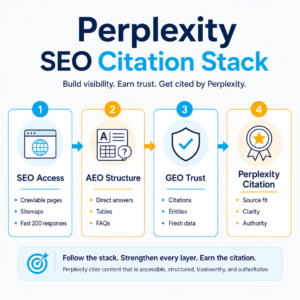
Start with technical access. Review robots.txt, WAF rules, CDN bot settings, XML sitemaps, canonical tags, and server logs. Confirm that legitimate Perplexity requests can reach your public content. Also confirm that private content remains protected.
Next, make content extractable. Open each article with a direct answer. Use question-led headings. Keep paragraphs short. Add comparison tables for decision queries. Add numbered steps for processes. Use FAQ sections only when the questions match real user intent.
Then strengthen trust. Link to official documentation, original studies, government data, or credible industry research. Add Article, Organization, BreadcrumbList, and FAQPage schema using Schema.org vocabulary where appropriate. Make your brand entity consistent across your About page, author schema, social profiles, and footer.
Finally, build a search and AI visibility cluster. Link this article to SEO vs AEO vs GEO, GEO vs SEO, What is GEO?, How to Optimize for ChatGPT Search, Google AI Overviews Explained, and What is llms.txt?. Add an AI Crawlers Explained link when that post is published.
Triomize is useful here because it catches gaps before publication. A post may look polished but still miss the first-100-word answer, schema clarity, internal links, outbound citations, or visible brand consistency.
What Are Common Perplexity SEO Mistakes?
Common Perplexity SEO mistakes come from treating AI search like either magic or classic SEO alone. Both views are incomplete.
Avoid these mistakes:
- Claiming guaranteed citations. Perplexity has not published a guarantee-based ranking formula.
- Blocking useful crawler access. Check
PerplexityBot, WAF rules, rate limits, and IP verification. - Writing vague introductions. Perplexity needs clear answers, not five paragraphs of setup.
- Publishing unsupported claims. Cite statistics, official docs, and primary sources when possible.
- Ignoring entity SEO. Inconsistent author, organization, and topic signals make trust harder to verify.
- Relying only on llms.txt. A documentation file cannot replace structured pages and strong architecture.
- Forgetting human readers. If a cited visitor lands on your page, the content still needs to convert.
The strongest Perplexity AI SEO strategy is boring in the best way. Make the page accessible. Answer the query. Prove the answer. Keep it current. Build authority around the topic.
What Belongs on a Perplexity SEO Checklist?
Use this checklist before publishing or updating content for Perplexity AI visibility:
- Use the focus keyword in the H1, URL slug, SEO title, meta description, first paragraph, and at least one H2.
- Confirm that public pages are crawlable, indexable, fast, and mobile friendly.
- Allow
PerplexityBotfor public content unless you have a policy reason not to. - Verify Perplexity user agents against official IP ranges before whitelisting at the WAF level.
- Add a direct answer within the first 100 words.
- Use clear H2s, H3s, tables, lists, and FAQ answers for extraction.
- Add original data, statistics, or named examples when possible.
- Link out to credible sources and official documentation.
- Add Article, Organization, BreadcrumbList, and FAQPage schema where relevant.
- Build internal links to related SEO, AEO, GEO, and AI crawler guides.
- Monitor analytics for Perplexity referrals and landing page behavior.
- Recheck the post in Triomize after every major edit.
Frequently Asked Questions
What is Perplexity SEO?
How does Perplexity AI find websites?
Can I guarantee that Perplexity will cite my website?
Does schema markup help Perplexity SEO?
Is Perplexity SEO different from Google SEO?