
Featured snippet optimization is the process of structuring content so Google can extract a clear answer and display it above standard organic results. Featured snippets still matter in 2026 because the same practices that win snippets also support answer engine optimization and AI search visibility. Short answers, question-based headings, tables, lists, schema markup, EEAT, and fresh content help websites compete for position zero while preparing for Google AI Overviews and other answer-led search experiences.
Table of Contents
- What Is Featured Snippet Optimization?
- What Are Featured Snippets?
- Why Do Featured Snippets Still Matter in 2026?
- How Do Featured Snippets Improve Visibility?
- How Do Featured Snippets Build Authority?
- Why Is Position Zero Valuable?
- How Do Featured Snippets Overlap with AI Search?
- How Does Google Choose Featured Snippets?
- What Are Featured Snippet Optimization Best Practices?
- How Do Question-Based Headings Help?
- Why Should Answers Be 40 to 60 Words?
- How Do Lists Help Featured Snippets?
- How Do Tables Help Featured Snippets?
- How Do Bullet Points Help?
- Do Images Help Featured Snippets?
- Does Schema Markup Help Featured Snippets?
- How Do Internal Links Help?
- Why Does EEAT Matter?
- Why Does Content Freshness Matter?
- What Are Common Types of Featured Snippets?
- What Is a Paragraph Featured Snippet?
- What Is a List Featured Snippet?
- What Is a Table Featured Snippet?
- What Is a Video Featured Snippet?
- What Mistakes Prevent Featured Snippets?
- How Do Featured Snippets Compare with AI Overviews?
- How Can Triomize Help with Featured Snippet Optimization?
- What Should You Remember About Featured Snippet Optimization?
What Is Featured Snippet Optimization?
Featured snippet optimization is the practice of formatting a page so Google can identify a concise, useful answer to a search query and display it as a featured snippet. A featured snippet is often called position zero because it appears above the normal organic results.
A featured snippet usually includes:
- A short answer pulled from a web page.
- The source page title.
- The source URL.
- A paragraph, list, table, or video format.
- Sometimes an image or jump link to the answer section.
Google’s featured snippets documentation explains that featured snippets display the descriptive snippet first in search results. It also says that clicking a featured snippet may take the user directly to the relevant section of the source page when Google can identify that section.
Featured snippet optimization is part of Answer Engine Optimization, or AEO. It helps search engines extract an answer without making the user dig through a long article. It also supports broader AI Search Optimization because AI search systems also need direct, structured, trustworthy answers.
What Are Featured Snippets?
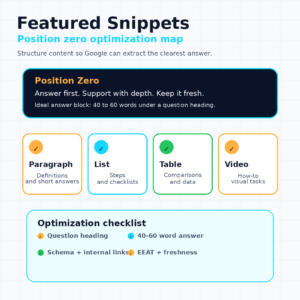
Featured snippets are special Google search results that show a direct answer above standard organic listings. Google pulls the answer from a ranking page and highlights it in a box.
Common examples include:
- A definition for “what is topical authority.”
- A numbered list for “how to optimize for featured snippets.”
- A table for “SEO vs AEO vs GEO.”
- A video result for a how-to query.
Featured snippets usually appear when Google believes a direct answer helps the searcher. They are common for informational searches, how-to queries, comparison queries, and definition-style questions.
Ahrefs studied about 112 million U.S. keywords and found that nearly 14 million had featured snippets, equal to about 12.29% of queries in its database. Ahrefs also found that 99.58% of featured snippets came from pages already ranking in Google’s top 10 results. This means featured snippet optimization works best after a page is already strong enough to reach page one.
That is why snippets are not a shortcut around SEO. They are an extraction opportunity built on top of SEO.
Why Do Featured Snippets Still Matter in 2026?
Featured snippets still matter in 2026 because they create visibility, authority, and answer ownership even as AI search grows. They are one of the oldest forms of answer-led search.
Featured snippets matter for four reasons.
How Do Featured Snippets Improve Visibility?
Featured snippets can place your answer above the standard organic results. This can help users see your brand before they scan other links.
Ahrefs found the featured snippet itself captured about 8.6% of clicks on average, while the page below it captured about 19.6%. A normal number one ranking with no featured snippet above it captured about 26% of clicks. This shows that featured snippets can reduce total clicks in some cases, but they still create major visibility.
How Do Featured Snippets Build Authority?
A featured snippet suggests that Google considers your page useful for the query. Users may treat your answer as authoritative because Google has elevated it.
That authority can support brand recall, assisted conversions, and later branded searches. Even when users do not click immediately, the brand gets exposure.
Why Is Position Zero Valuable?
Position zero is valuable because it gives a page a prominent search result above the normal rankings. Ahrefs found that only 30.9% of featured snippets come from the number one organic result. This means a page ranking lower on page one can sometimes jump above competitors by better formatting the answer.
How Do Featured Snippets Overlap with AI Search?
Featured snippets overlap with AI search because both reward clear answers. Google AI Overviews, ChatGPT Search, and Perplexity all need source content that is easy to retrieve, understand, summarize, and cite.
Pew Research Center analyzed 68,879 Google searches and found that users clicked traditional results 8% of the time when an AI summary appeared, compared with 15% when no AI summary appeared. This makes answer visibility more important. If clicks are harder to earn, winning the visible answer becomes more valuable.
For the zero-click context, read Zero Click Search.
How Does Google Choose Featured Snippets?
Google chooses featured snippets by identifying pages that contain a relevant answer and displaying the answer when it believes that format helps the user. Google does not provide a guaranteed formula, but practical patterns are clear.
Important featured snippet factors include:
- Direct answers. The page should answer the query clearly and early.
- Clear headings. Headings should match user questions or search intent.
- Structured formatting. Lists, tables, and short paragraphs help extraction.
- Search intent alignment. The answer should match what the query asks.
- Authority. The page should be credible and strong enough to rank.
- Freshness. Current topics need current answers.
- Top 10 ranking. Most featured snippets come from pages already on page one.
- Readable HTML. Important text should not be hidden in images or scripts.
Featured snippet optimization usually begins with finding queries where you already rank on page one but do not own the snippet. Then you improve the page section most likely to answer that query.
A simple model looks like this:
Search intent → Question heading → 40 to 60 word answer → Supporting details → Table or list → FAQThis model works because it gives Google a clean passage to extract and gives users the deeper context they need after the direct answer.
What Are Featured Snippet Optimization Best Practices?
Featured snippet optimization best practices focus on making answers clear, concise, structured, and trustworthy. These practices also support AEO and AI search visibility.
How Do Question-Based Headings Help?
Question-based headings help because they match how users search. A heading like “What is featured snippet optimization?” is easier for Google to map to a query than a vague heading like “Overview.”
Use headings that match real questions:
- What are featured snippets?
- How do you optimize for featured snippets?
- Does schema help featured snippets?
- Are featured snippets still useful after AI Overviews?
This structure also helps readers scan the page quickly.
Why Should Answers Be 40 to 60 Words?
Short answers help featured snippet optimization because Google often needs a compact passage. A 40 to 60 word answer is long enough to explain the concept but short enough to display.
Example answer format:
Featured snippets are short answers Google displays above standard organic results. They are pulled from ranking pages and can appear as paragraphs, lists, tables, or videos. To win them, structure content with question headings, concise answers, and supporting details.Do not stop at the short answer. Add depth below it so users have a reason to click.
How Do Lists Help Featured Snippets?
Lists help when the query asks for steps, examples, tools, reasons, or best practices. Google can extract ordered or unordered lists from clear HTML.
Use lists for:
- How-to steps.
- Checklist items.
- Ranking factors.
- Types of snippets.
- Common mistakes.
A list should be complete enough to satisfy the query but not padded with filler.
How Do Tables Help Featured Snippets?
Tables help comparison and data queries. Google can extract rows and columns when the table is simple and relevant.
Use tables for:
- Before and after comparisons.
- SEO vs AEO vs GEO.
- Snippet types.
- Tool comparisons.
- Feature comparisons.
Keep tables simple. Avoid very wide tables that are hard to read on mobile.
How Do Bullet Points Help?
Bullet points help when the answer involves related items without a strict order. They are easier to scan than dense paragraphs.
Use bullet points for features, benefits, signals, and mistakes. Each bullet should be short and specific.
Do Images Help Featured Snippets?
Images can support a snippet when they clarify the answer. Use descriptive file names, alt text, and captions. Do not put the only answer inside the image. Google and AI systems need readable text.
Does Schema Markup Help Featured Snippets?
Schema markup can help machines understand your content, but it does not guarantee featured snippets. FAQPage, Article, Organization, BreadcrumbList, and HowTo schema can support clarity when they match visible content.
For broader structured data guidance, read Schema Markup for AI Search.
How Do Internal Links Help?
Internal links help Google find related content and understand topical relationships. Link snippet-focused pages to relevant cluster pages.
For example, this article naturally connects to AEO vs SEO, Google AI Overviews Explained, AI Search Ranking Factors, and Topical Authority.
Why Does EEAT Matter?
EEAT matters because featured snippets should come from helpful, reliable sources. Clear authorship, source citations, accurate facts, and updated content support trust.
For a trust workflow, read EEAT for AI Search.
Why Does Content Freshness Matter?
Freshness matters when the answer changes over time. Featured snippet optimization for topics like AI search, Google AI Overviews, and schema markup requires updates as platforms change.
Update dates honestly. Do not change dates without improving content.
What Are Common Types of Featured Snippets?
Common types of featured snippets include paragraph snippets, list snippets, table snippets, and video snippets. Each format fits a different type of search intent.
| Snippet type | Best for | Example query |
|---|---|---|
| Paragraph | Definitions and short explanations | What is zero-click search? |
| List | Steps, methods, examples, rankings | How to optimize for featured snippets |
| Table | Comparisons and structured data | Featured snippets vs AI Overviews |
| Video | Visual how-to tasks | How to set up WordPress permalinks |
What Is a Paragraph Featured Snippet?
A paragraph featured snippet is a short text answer. It works well for definitions, explanations, and direct questions.
To optimize for it, write a concise answer immediately under a question-based heading.
What Is a List Featured Snippet?
A list featured snippet shows ordered or unordered steps. It works well for how-to queries and checklists.
To optimize for it, use clean HTML lists and avoid burying steps in long paragraphs.
What Is a Table Featured Snippet?
A table featured snippet shows rows and columns. It works well for comparisons.
To optimize for it, use simple tables with clear headings and relevant data.
What Is a Video Featured Snippet?
A video featured snippet shows a video result, often for visual tasks. YouTube videos may appear for how-to queries.
To optimize for it, use clear titles, descriptions, captions, chapters, and transcripts.
What Mistakes Prevent Featured Snippets?
Common mistakes prevent featured snippets by making content hard to extract, hard to trust, or poorly matched to the query.
Avoid these mistakes:
- Long introductions. Put the answer before the long setup.
- Poor heading hierarchy. Use logical H2s and H3s.
- Thin content. A short answer needs supporting depth.
- Keyword stuffing. Repetition does not create a better answer.
- No concise answer. Google needs a clean passage to extract.
- Outdated information. Old facts lose trust.
- Unclear intent. Match the query exactly.
- Overcomplicated tables. Keep tables simple.
- Hidden content. Do not hide key answers behind scripts or images.
- Weak authority. Trust and topical relevance still matter.
The most common problem is writing around the answer instead of answering. Featured snippet optimization rewards clarity.
How Do Featured Snippets Compare with AI Overviews?
Featured snippets and AI Overviews both answer questions inside search results, but they work differently. A featured snippet usually quotes or extracts from one source. An AI Overview synthesizes information from multiple sources.
| Factor | Featured Snippets | AI Overviews |
|---|---|---|
| Answer source | Usually one page | Multiple sources |
| Format | Extracted paragraph, list, table, or video | Generated summary with supporting links |
| Visibility | Position zero above standard results | AI answer area above or within results |
| Click behavior | Can drive or reduce clicks depending on query | Pew found very low citation clicks in AI summaries |
| Optimization | Concise answers and structured HTML | SEO fundamentals, source trust, entities, and citations |
| Similarity | Rewards clear answers | Also rewards clear, trusted answers |
Featured snippets are more predictable than AI Overviews because they usually pull a visible passage from one page. AI Overviews are more complex because they combine information.
Still, the optimization overlap is strong. Clear answers, structured formatting, topical authority, schema, and trust signals help both. This is why featured snippet optimization remains relevant in the AI search era.
How Can Triomize Help with Featured Snippet Optimization?
Triomize can help with featured snippet optimization by checking whether your content is structured for SEO, AEO, and GEO. Featured snippets sit closest to the AEO layer because they reward direct answers and extractable formatting.
Triomize helps WordPress users review:
- Focus keyword placement.
- Question-based headings.
- Direct answers near the top.
- FAQ structure.
- Tables and lists.
- Schema opportunities.
- Internal links.
- Content freshness.
- SEO, AEO, and GEO gaps.
Want to know if your content is optimized for featured snippets and AI search? Triomize analyzes your pages across SEO, AEO, and GEO, highlighting opportunities to improve structure, answer quality, and overall search visibility.
Featured snippets remain valuable because the same practices that win them also support broader AI search visibility.
What Should You Remember About Featured Snippet Optimization?
Featured snippet optimization remains valuable because search is still moving toward direct answers. Google featured snippets, AI Overviews, ChatGPT Search, Perplexity, and Gemini all reward content that is clear, structured, and trustworthy.
The best strategy is simple. Answer the question directly. Format the answer clearly. Add useful depth. Use tables and lists where helpful. Support claims with sources. Keep content fresh. Build topical authority. Make the page easy for search engines and AI systems to understand.
Featured snippets do not guarantee traffic. But they can increase visibility, build authority, support zero-click search, and strengthen your broader AEO and GEO strategy.
Frequently Asked Questions
How long does it take to get a featured snippet?
Can a new website earn featured snippets?
Do featured snippets improve SEO?
Are featured snippets still important after AI Overviews?
Does schema markup help featured snippets?