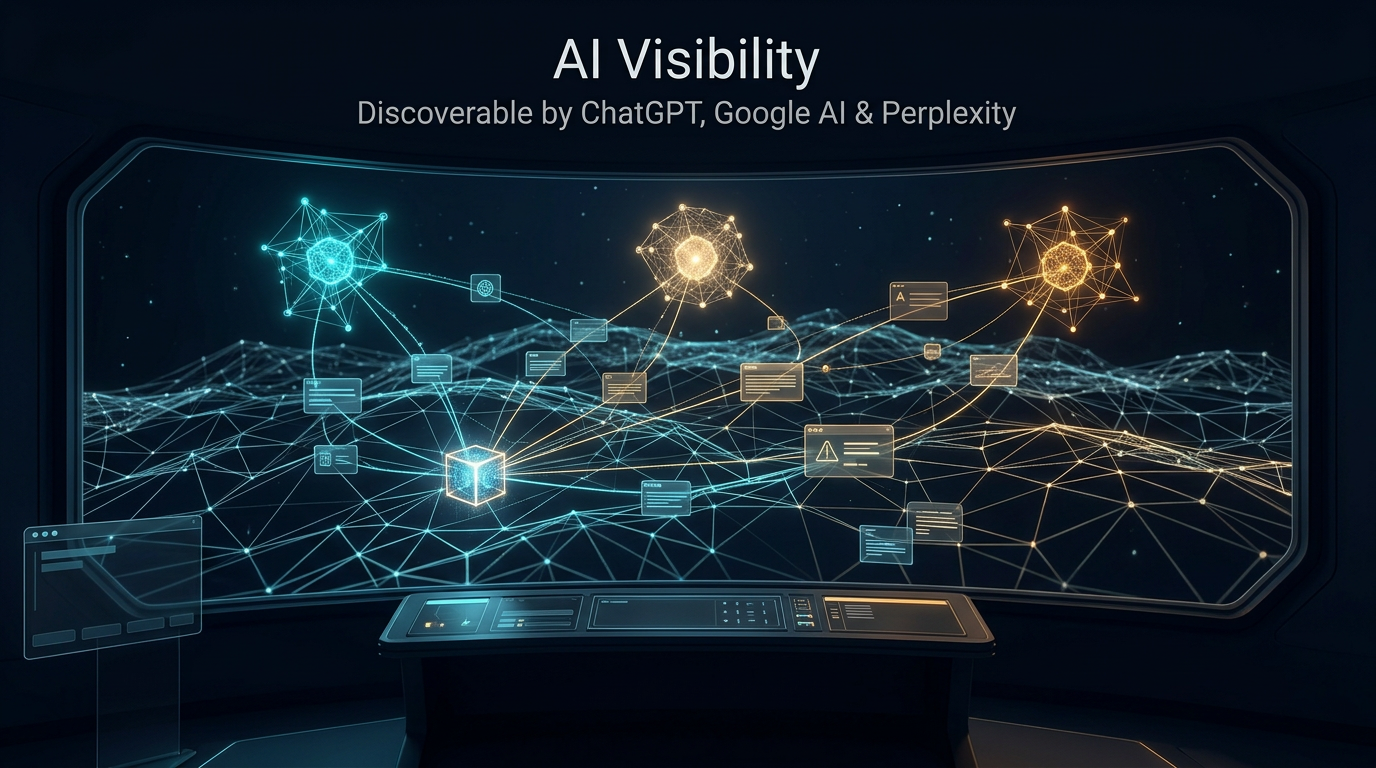
AI Visibility is the ability of your website, brand, content, and entities to be discovered, understood, cited, or recommended by AI-powered search systems such as ChatGPT Search, Google AI Overviews, Gemini, Claude, and Perplexity. It builds on SEO, but it also depends on AI discoverability, structured content, entity clarity, trust signals, crawler access, and citation readiness. Triomize helps WordPress teams improve AI Visibility by checking SEO, AEO, and GEO signals together.
Table of Contents
- What Is AI Visibility?
- Why Does AI Visibility Matter in 2026?
- How Is AI Visibility Different from SEO?
- How Do ChatGPT, Google AI, and Perplexity Discover Websites?
- What Signals Improve AI Visibility?
- How Do You Improve AI Discoverability?
- How Does Schema Markup Help AI Visibility?
- How Do Entity SEO and Topical Authority Support AI Visibility?
- How Do EEAT Signals Affect AI Visibility?
- How Can You Measure AI Visibility?
- What Are Common AI Visibility Mistakes?
- How Can You Build an AI Ready Website?
- How Can Triomize Help Improve AI Visibility?
- What Should You Remember About AI Visibility?
What Is AI Visibility?
AI Visibility is the measure of how easily AI-powered search systems can find, interpret, and surface your website in generated answers, citations, recommendations, or source links. It is broader than ranking for one keyword.
In traditional SEO, visibility often means appearing in Google search results. In AI search, visibility can mean several things:
- Your website is cited by Perplexity.
- Your page appears as a source in ChatGPT Search.
- Your article supports a Google AI Overview.
- Your brand is mentioned in an AI answer.
- Your content is retrieved by an AI crawler.
- Your entity is understood as part of a topic cluster.
- Your page is selected as a supporting link in AI-powered search.
This is why AI Visibility is becoming a central concept. Website owners are no longer optimizing only for blue links. They are optimizing for discovery across answer engines, generative engines, and traditional search engines.
AI Visibility does not replace SEO. It extends it. A page still needs technical SEO, crawlability, indexability, helpful content, and internal links. But it also needs answer-first formatting, schema markup, topical authority, EEAT signals, entity clarity, and AI crawler access.
Why Does AI Visibility Matter in 2026?
AI Visibility matters in 2026 because users increasingly get answers from AI-powered interfaces before they click a traditional result. If your website is not discoverable by those systems, your brand may be absent from the answer journey.
Google’s AI features documentation says AI Overviews and AI Mode surface relevant links and can use query fan-out to display a wider and more diverse set of helpful links. That means AI search can create new source opportunities, but only for pages that are accessible, useful, and eligible.
User behavior is changing too. Pew Research Center analyzed 68,879 Google searches and found that when an AI summary appeared, users clicked a traditional result 8% of the time, compared with 15% when no AI summary appeared. The same study found users clicked a link inside the AI summary on only about 1% of visits.
This does not mean websites are doomed. It means the value of visibility is shifting. A brand may earn value through citation, mention, trust, and discovery, not only through a classic organic click.
For businesses, AI Visibility can influence:
- Brand awareness.
- Referral traffic.
- Trust and credibility.
- Product comparisons.
- Lead quality.
- Share of voice in AI answers.
- Long-term search resilience.
If AI systems cannot find or trust your content, they are more likely to cite someone else.
How Is AI Visibility Different from SEO?
AI Visibility and SEO overlap, but they are not identical. SEO focuses on ranking and organic traffic from search engines. AI Visibility focuses on being discovered, cited, mentioned, or recommended by AI-powered search systems.
| Comparison Factor | Traditional SEO | AI Visibility |
|---|---|---|
| Primary goal | Rank in search results | Be discovered, cited, and trusted by AI systems |
| Main surfaces | Google, Bing, classic SERPs | ChatGPT, Google AI Overviews, Perplexity, Gemini, Claude |
| Core signals | Crawlability, relevance, links, content quality | SEO plus entities, answers, schema, trust, citations |
| Content format | Search intent pages | Answer-ready, source-backed, structured pages |
| Measurement | Rankings, clicks, impressions | Citations, mentions, AI referrals, source visibility |
| Risk | Losing rankings | Being invisible inside generated answers |
SEO remains the base layer. AI systems still need web documents they can access and understand. Bing Webmaster Guidelines state that Bing and Copilot rely on the same core crawling, indexing, and ranking foundation as traditional search, and that SEO practices also support eligibility for AI-generated experiences and grounding results.
The difference is that AI Visibility adds new success conditions. A page should not only rank. It should answer clearly, prove claims, clarify entities, and be trusted enough to cite.
How Do ChatGPT, Google AI, and Perplexity Discover Websites?
ChatGPT, Google AI, and Perplexity discover websites through a mix of search indexes, crawlers, user-triggered fetches, sitemaps, links, and retrieval systems. Each platform has its own discovery layer.
OpenAI documents multiple agents. OAI-SearchBot is used for ChatGPT Search, while GPTBot is related to training. OpenAI says these controls are independent, so a site can allow OAI-SearchBot for search visibility while disallowing GPTBot for training.
Perplexity documents PerplexityBot and Perplexity-User. PerplexityBot is designed to surface and link websites in Perplexity results. Perplexity-User supports user actions when a person asks a question.
Anthropic documents three Claude bots: ClaudeBot, Claude-User, and Claude-SearchBot. These support model training, user-directed access, and search result quality.
Google AI Overviews and AI Mode are connected to Google Search systems. Google says pages must be indexed and eligible to be shown in Google Search with a snippet to appear as supporting links in AI features.
The practical lesson is simple. AI Visibility starts with access. If important content is blocked, uncrawlable, unindexed, or hidden behind scripts, AI systems may not use it.
What Signals Improve AI Visibility?
AI Visibility improves when a website sends clear signals that its content is accessible, useful, trustworthy, and easy to interpret. No platform has published one universal AI visibility formula, but the strongest signals are consistent.
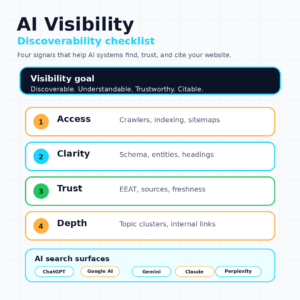
Important signals include:
- Crawlability. AI and search crawlers can access public pages.
- Indexability. Important pages are eligible for Google and Bing indexes.
- Answer structure. Pages open with direct answers and use clear headings.
- Entity clarity. Brands, products, authors, and topics are easy to identify.
- Structured data. Schema markup clarifies page type and relationships.
- Topical authority. Related pages prove depth across a subject.
- EEAT signals. Experience, expertise, authority, and trust are visible.
- Source evidence. Claims use credible citations and current statistics.
- Internal links. Pages connect into logical clusters.
- Freshness. Content reflects current platform behavior and policies.
- Performance. Pages load quickly and work well on mobile.
- Security. HTTPS and safe site delivery support trust.
The GEO study from Princeton University, Georgia Tech, Allen Institute, and IIT Delhi tested optimization tactics across 10,000 queries and nine datasets. It found that adding citations, statistics, and authoritative language improved position-adjusted word count by 30% to 40% and subjective impression by 15% to 30%.
This supports a key idea: AI Visibility is not only about crawler access. It is also about being specific, verifiable, and authoritative.
How Do You Improve AI Discoverability?
You improve AI discoverability by making your website easy for AI search systems to find and parse. This is the technical side of AI Visibility.
Start with these checks:
- Keep important pages crawlable.
- Submit clean XML sitemaps.
- Use crawlable internal links.
- Fix accidental noindex tags.
- Set correct canonical URLs.
- Avoid hiding main content behind heavy JavaScript.
- Monitor AI crawler visits.
- Review robots.txt rules for Googlebot, Bingbot, OAI-SearchBot, PerplexityBot, Claude agents, and other relevant bots.
- Keep public educational content accessible when visibility is the goal.
This is where AI Crawler Monitoring becomes important. You need to know which bots visit your site, which pages they request, and whether your server returns clean status codes.
You can also support AI discoverability with documentation files such as llms.txt. However, llms.txt is not a magic visibility file. The foundation is still crawlability, structured content, internal links, and trust.
How Does Schema Markup Help AI Visibility?
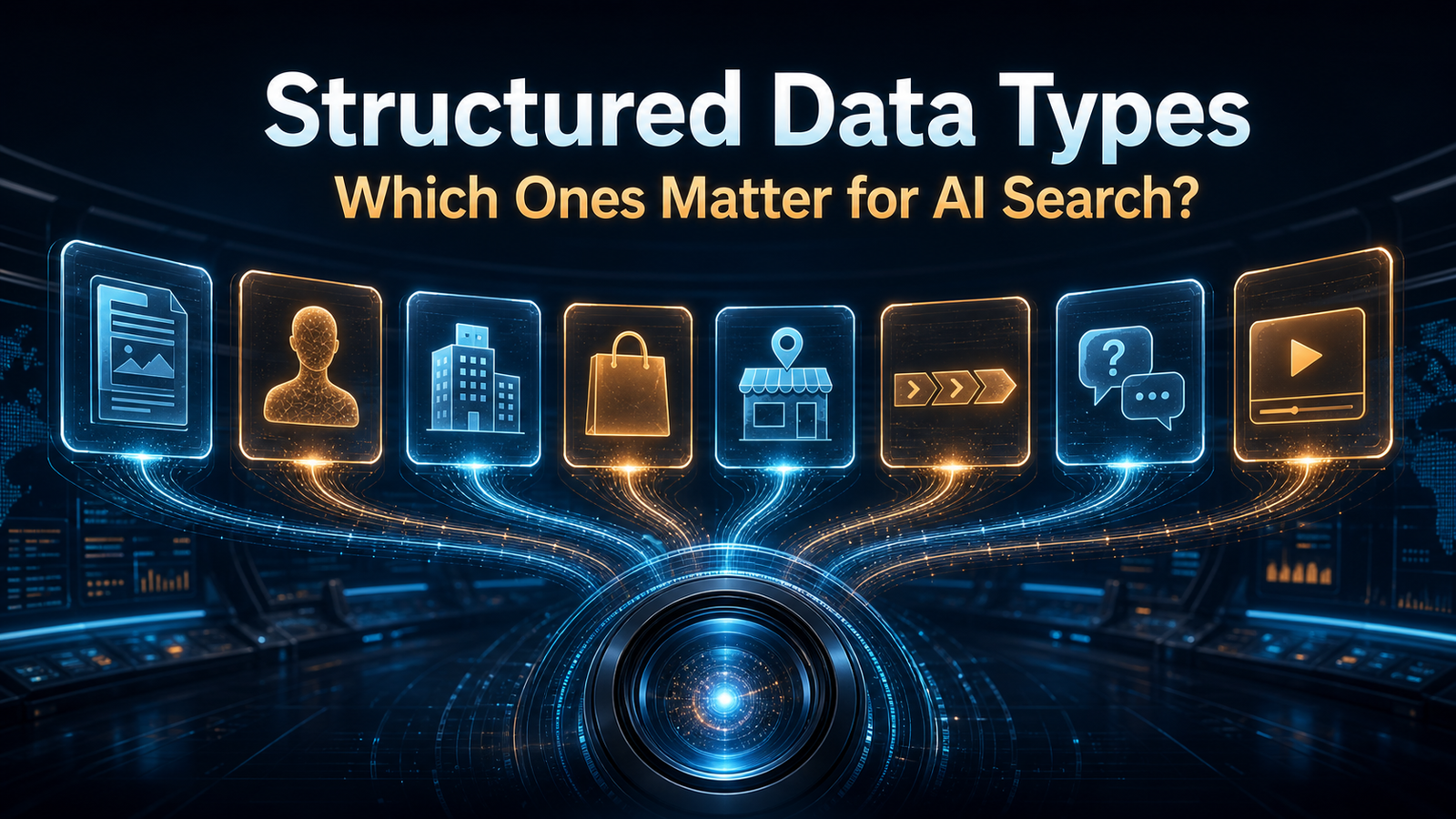
Schema markup helps AI Visibility by giving machines structured information about your page, organization, author, breadcrumbs, FAQs, products, and entities. It does not guarantee AI citations, but it reduces ambiguity.
Useful schema types include:
| Schema type | Why it helps AI Visibility |
|---|---|
| Article | Clarifies headline, author, publisher, and dates |
| Organization | Clarifies the brand or website entity |
| Person or Author | Clarifies who created or reviewed the content |
| BreadcrumbList | Clarifies site hierarchy and topic placement |
| FAQPage | Clarifies question-answer pairs |
| Product | Clarifies offers, reviews, and product details where valid |
| LocalBusiness | Clarifies location, services, and contact details |
Structured data adoption is already common. The 2024 HTTP Archive Web Almanac found JSON-LD on 41% of pages, up from 34% in 2022. WebDataCommons reported structured data in 1.7 billion HTML pages out of 3.4 billion pages in its October 2023 crawl, equal to 50.60% of the crawl.
For a full workflow, read Schema Markup for AI Search.
How Do Entity SEO and Topical Authority Support AI Visibility?
Entity SEO and topical authority support AI Visibility by helping AI systems understand who you are, what you cover, and why your site is relevant. AI search needs meaning, not only keywords.
Entity SEO clarifies real-world things like brands, authors, products, services, concepts, and locations. It helps search engines connect your content to a Knowledge Graph.
Topical Authority proves that your site covers a subject deeply. Instead of one isolated post, you build a cluster of related pages that answer multiple user questions.
Together, they help AI systems answer these questions:
- What is this website about?
- Who publishes it?
- Which topics does it understand deeply?
- Which pages define the core concepts?
- Which pages support the cluster?
- Which sources confirm the claims?
Google said in 2020 that its Knowledge Graph had amassed over 500 billion facts about 5 billion entities. That scale shows why entity understanding matters. AI systems need to map real-world concepts and relationships, not only match words.
How Do EEAT Signals Affect AI Visibility?
EEAT signals affect AI Visibility because AI systems need trustworthy sources before they can summarize or cite content safely. EEAT stands for Experience, Expertise, Authoritativeness, and Trustworthiness.
Trust signals include:
- Clear author identity.
- Real experience or examples.
- Reliable citations.
- Transparent business information.
- Accurate dates and updates.
- Editorial standards.
- Secure website delivery.
- Consistent brand and entity signals.
Google’s helpful content documentation says its systems identify factors that help determine whether content demonstrates experience, expertise, authoritativeness, and trustworthiness. It also says trust is the most important part of E-E-A-T.
For AI Visibility, trust is practical. An AI system that cites weak, unsupported, or outdated content risks giving bad answers. A source with clear authors, citations, current facts, and topical depth is easier to trust.
For deeper guidance, read EEAT for AI Search.
How Can You Measure AI Visibility?
You can measure AI Visibility by tracking how often your brand, URLs, or content appear in AI-powered search experiences. This is still an emerging measurement area, so use several signals together.
Track these metrics:
- AI referral traffic from ChatGPT, Perplexity, Gemini, Claude, Copilot, and other platforms.
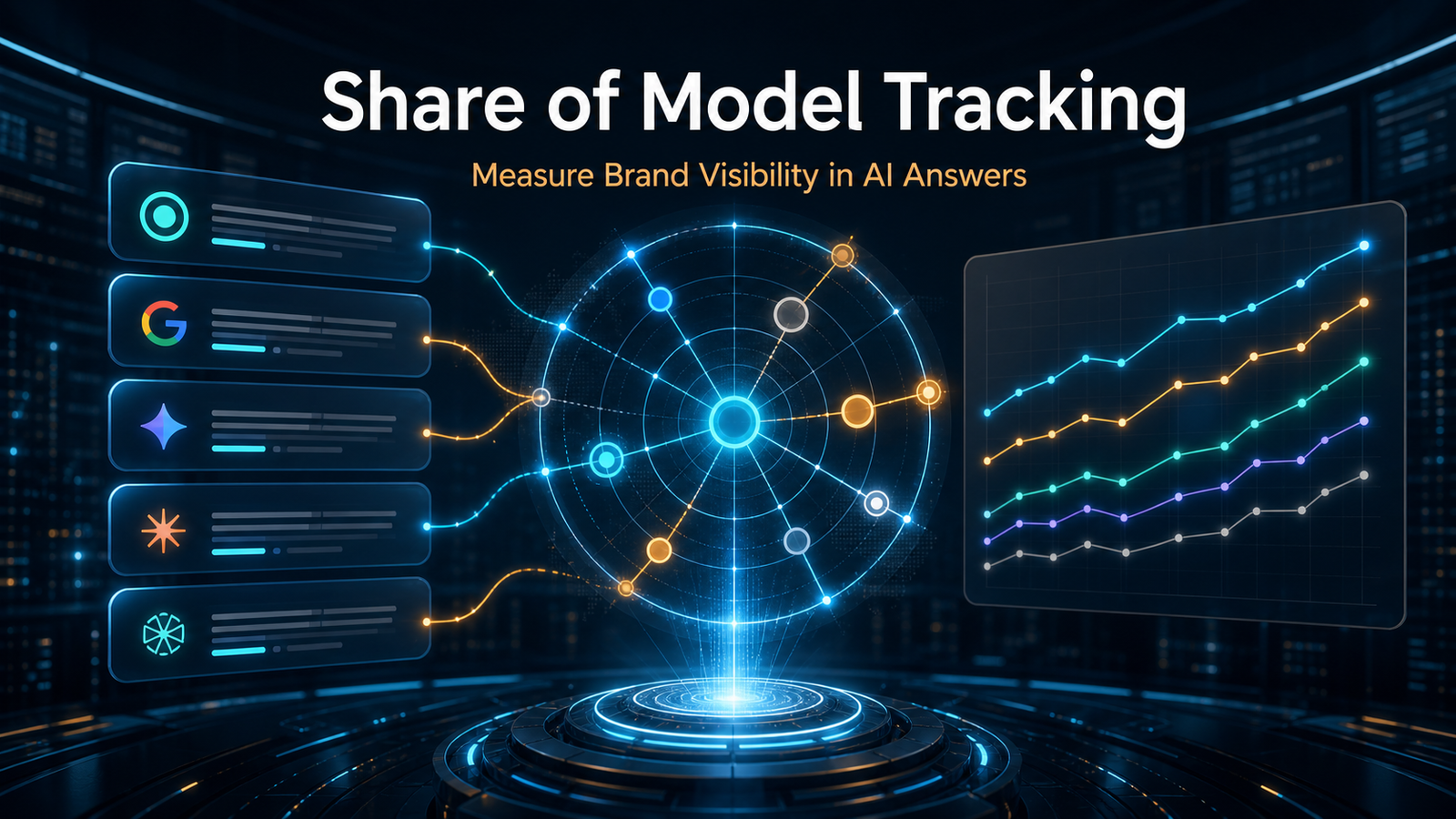
- Mentions of your brand in AI-generated answers.
- Citations or source links in Perplexity and ChatGPT Search.
- Inclusion in Google AI Overviews where visible.
- AI crawler visits in server logs.
- Google Search Console query growth for AI-related topics.
- Bing Webmaster Tools performance.
- Rankings for topics that trigger AI summaries.
- Growth of topic cluster impressions.
- Branded search growth after AI visibility campaigns.
Do not rely on one metric. AI Visibility is multi-surface. A page may gain fewer clicks from one query but more brand exposure through citations and mentions.
Build a simple monthly dashboard with four groups: search visibility, AI referrals, crawler activity, and content cluster growth.
What Are Common AI Visibility Mistakes?
Common AI Visibility mistakes happen when websites chase AI mentions without fixing the foundations. AI search is new, but most visibility failures come from familiar SEO and content problems.
Avoid these mistakes:
- Blocking useful AI crawlers. Review crawler policies before blocking everything.
- Publishing generic content. AI systems have little reason to cite shallow summaries.
- Ignoring SEO basics. Crawlability, indexing, canonicals, and internal links still matter.
- Skipping schema. Structured data helps clarify meaning.
- Weak entity signals. Inconsistent brand, author, and product names create ambiguity.
- No topical depth. One article rarely proves expertise.
- No citations. Unsupported claims are weak candidates for AI answers.
- Outdated content. AI search topics change quickly.
- Measuring only rankings. AI visibility includes citations, mentions, and referrals.
The biggest mistake is treating AI Visibility as a trick. It is a long-term visibility system built on access, clarity, trust, and usefulness.
How Can You Build an AI Ready Website?
You build an AI ready website by combining technical SEO, answer-first content, entity clarity, schema markup, topical authority, and trust signals. This makes your content easier for humans and machines to understand.
Use this workflow:
- Audit crawlability and indexing.
- Improve Core Web Vitals and mobile usability.
- Create topic clusters around key subjects.
- Add direct definitions near the top of important pages.
- Use question-led headings.
- Add tables, lists, and FAQs.
- Implement schema markup.
- Clarify authors, organization, and product entities.
- Cite credible sources.
- Keep content updated.
- Monitor AI crawlers.
- Track AI referrals and citations.
- Review SEO, AEO, and GEO gaps before publishing.
This is where AI Search Optimization becomes the broader framework. AI Visibility is the outcome. AI Search Optimization is the work that improves it.
How Can Triomize Help Improve AI Visibility?
Triomize can help improve AI Visibility by analyzing website content across SEO, AEO, and GEO from a single WordPress workflow. That matters because AI visibility is not one signal. It is the combination of technical access, answer clarity, structured data, entity trust, topical authority, and citation readiness.
Triomize helps website owners find gaps that may affect traditional search and AI-powered discovery. It can support content analysis, schema workflows, internal linking improvements, AI crawler monitoring, and optimization checks that make content easier for search engines and AI systems to understand.
A practical Triomize workflow can help teams ask:
- Is the page crawlable and indexable?
- Does the page answer the main question quickly?
- Are headings structured for answer extraction?
- Are internal links supporting the topic cluster?
- Are schema and entity signals clear?
- Are GEO trust signals strong enough?
- Are AI crawlers able to access public content?
The goal is not to guarantee citations. No tool can do that. The goal is to improve the signals that make AI visibility more likely.
What Should You Remember About AI Visibility?
AI Visibility is becoming one of the most important concepts in the AI search space. It describes whether your website can be discovered, understood, cited, or recommended by AI-powered search systems.
The path to stronger AI Visibility is not a shortcut. It requires strong technical SEO, clear answers, schema markup, entity SEO, topical authority, EEAT, credible sources, and crawler monitoring.
Websites that build these signals now will be better prepared for ChatGPT Search, Google AI Overviews, Gemini, Claude, Perplexity, Bing Copilot, and future AI search engines. The future of search will reward websites that are accessible, clear, trustworthy, and useful.
Frequently Asked Questions
What is AI Visibility?
How is AI Visibility different from SEO?
How do I improve AI Visibility?
Does schema markup improve AI Visibility?
Can Triomize help with AI Visibility?