
AI crawler monitoring is the practice of tracking which AI bots visit your website, what they request, and how your server responds. It helps website owners separate traditional search crawlers from AI bots used for training, AI search, citations, product features, and user-triggered browsing. As AI-powered search grows, monitoring these visits is becoming part of technical SEO and GEO. Triomize helps WordPress teams identify AI crawlers, understand their purpose, and prepare content for the next phase of search visibility.
Table of Contents
- What Is AI Crawler Monitoring?
- How Does AI Crawler Monitoring Differ from Search Crawler Monitoring?
- Which AI Bots Should You Monitor?
- What Is GPTBot?
- What Is ChatGPT-User?
- What Is ClaudeBot?
- What Is Claude-User?
- What Is Google-Extended?
- What Is GoogleOther?
- What Is PerplexityBot?
- What Is Bingbot?
- Should AI Crawler Monitoring Change What You Block?
- How Can You Monitor AI Crawlers on Your Website?
- How Does AI Crawler Monitoring Affect SEO?
- How Does AI Crawler Monitoring Affect GEO?
- How Can Triomize Help with AI Crawler Monitoring?
What Is AI Crawler Monitoring?
AI crawler monitoring is the process of tracking AI bots that visit your website, identifying their purpose, and reviewing how they interact with your public content. It helps you understand whether AI platforms can access your pages for search, retrieval, citations, training, or user-triggered browsing.
A traditional crawler like Googlebot mainly helps build a search index. An AI crawler may support model training, AI search results, live answer generation, citation discovery, ad review, or user-requested page fetching. That is why the same company may operate several crawler names with different purposes.
For example, OpenAI documents separate agents for GPTBot, OAI-SearchBot, OAI-AdsBot, and ChatGPT-User. Anthropic documents separate bots for ClaudeBot, Claude-User, and Claude-SearchBot. Perplexity documents PerplexityBot and Perplexity-User. Google documents Google-Extended as a control token, not a separate visible crawler user agent.
This matters because crawler policy now affects more than classic SEO. It can affect AI discoverability, AI citations, training consent, and visibility in answer engines. AI crawler monitoring gives site owners the evidence they need before changing robots.txt or firewall rules. Triomize treats crawler access as part of the larger GEO infrastructure layer.
How Does AI Crawler Monitoring Differ from Search Crawler Monitoring?
AI crawler monitoring differs from search crawler monitoring because AI bots vary by purpose, output, and control. Search engine crawlers usually build indexes for ranked search results. AI crawlers may feed answer systems, training pipelines, retrieval indexes, or user-triggered browsing sessions.
| Attribute | Search Engine Crawlers | AI Crawlers |
|---|---|---|
| Common examples | Googlebot, Bingbot | GPTBot, ClaudeBot, PerplexityBot, Google-Extended |
| Main purpose | Build search indexes | Support training, AI search, answers, and citations |
| User output | Ranked search results | AI answers, citations, summaries, and model improvements |
| Control layer | robots.txt, noindex, Search Console | robots.txt, per-agent rules, WAF logs, IP verification |
| Business question | Do I want search visibility? | Do I want search, training, live fetch, or citation access? |
| Measurement | Crawls, impressions, clicks | Bot visits, AI referrals, citations, source mentions |
The difference is not always clean. Bingbot still matters for search. Googlebot still matters for Google Search. Google-Extended controls covered Gemini uses but does not remove your site from Google Search. OAI-SearchBot supports ChatGPT Search, while GPTBot supports OpenAI model training.
This is why website owners should avoid blanket assumptions. One crawler may be useful for visibility. Another may relate to model training. A third may fetch content only when a user asks an AI assistant to read a page.
Which AI Bots Should You Monitor?
AI bots you should monitor include OpenAI, Anthropic, Google, Perplexity, and Microsoft agents. Each one has a different purpose and should be managed separately.
| Bot or token | Company | Primary purpose | Notes |
|---|---|---|---|
GPTBot |
OpenAI | Model training | Block if you do not want content used for OpenAI training |
ChatGPT-User |
OpenAI | User-triggered fetching | Used when a user asks ChatGPT or a Custom GPT to access a page |
OAI-SearchBot |
OpenAI | ChatGPT Search | Allow if you want ChatGPT Search visibility |
ClaudeBot |
Anthropic | Model training | Anthropic says it respects robots.txt |
Claude-User |
Anthropic | User-directed fetching | May affect visibility for user-directed Claude web search |
Claude-SearchBot |
Anthropic | Search quality and indexing | Blocking may reduce Claude search visibility |
Google-Extended |
Gemini AI use control | It is a robots.txt token, not a separate HTTP user agent | |
GoogleOther |
Generic product fetching | Used by various Google product teams for public content | |
PerplexityBot |
Perplexity | Surface and link websites | Perplexity recommends allowing it for search visibility |
Perplexity-User |
Perplexity | User-triggered fetching | Generally ignores robots.txt because a user requested the fetch |
Bingbot |
Microsoft | Bing Search crawling | Still important because many AI search systems depend on web indexes |
Cloudflare data shows the scale of the shift. In its AI crawler analysis, Cloudflare reported that overall crawling rose 32% year-over-year in April 2025. It also reported that GPTBot’s share of AI-only crawler traffic rose from 11.9% in July 2024 to 28.1% in July 2025, while ClaudeBot rose from 15% to 23.3% over the same period.
Those figures explain why AI crawler monitoring is becoming a technical SEO task. You need to know who is visiting, why they are visiting, and whether your rules match your business policy.
What Is GPTBot?
GPTBot is OpenAI’s crawler for content that may be used to improve generative AI foundation models. OpenAI says disallowing GPTBot indicates that your site’s content should not be used for training those models.
A simple block looks like this:
User-agent: GPTBot
Disallow: /
Important point: blocking GPTBot does not automatically block ChatGPT Search. OpenAI separates GPTBot from OAI-SearchBot, which supports search results in ChatGPT. If you want search visibility but not training access, manage those agents separately.
What Is ChatGPT-User?
ChatGPT-User is an OpenAI fetcher used for certain user actions in ChatGPT and Custom GPTs. It may visit a page when a user asks ChatGPT to access a URL or when a GPT action needs external content.
OpenAI says ChatGPT-User is not used for automatic web crawling and is not used to determine whether content appears in Search. Because these actions are user initiated, robots.txt rules may not apply the same way they apply to automatic crawlers.
This makes ChatGPT-User different from GPTBot. GPTBot is about training. OAI-SearchBot is about ChatGPT Search. ChatGPT-User is about user-triggered access.
What Is ClaudeBot?
ClaudeBot is Anthropic’s crawler for collecting web content that may contribute to Claude model training. Anthropic says its bots honor industry-standard robots.txt directives and respect anti-circumvention technologies like CAPTCHAs.
A simple block looks like this:
User-agent: ClaudeBot
Disallow: /
Anthropic also supports the non-standard Crawl-delay extension. That can help large sites manage crawl load when they do not want to block the crawler completely.
What Is Claude-User?
Claude-User is Anthropic’s user-directed fetcher. When someone asks Claude a question, Claude may access websites through the Claude-User agent.
Anthropic says disabling Claude-User can prevent its system from retrieving your content in response to a user query. That may reduce your site’s visibility for user-directed web search. This is a different decision from blocking ClaudeBot for model training.
If you want Claude users to access public content while avoiding training use, you need a selective policy. Do not treat every Claude bot as the same thing.
What Is Google-Extended?
Google-Extended is a robots.txt product token that lets publishers manage whether Google-crawled content may be used for Gemini model training and Gemini grounding. It is not a separate HTTP user agent.
Google’s crawler documentation says crawling is done with existing Google user agents, while Google-Extended works as a control token in robots.txt. Google also says Google-Extended does not affect inclusion in Google Search and is not used as a ranking signal in Google Search.
Example:
User-agent: Google-Extended
Disallow: /
That rule controls covered Gemini uses. It does not remove a page from Google Search.
What Is GoogleOther?
GoogleOther is a generic Google crawler used by various Google product teams for fetching publicly accessible content. Google says crawl preferences addressed to GoogleOther do not affect any specific product in the same way Googlebot affects Search.
GoogleOther is worth monitoring because it can appear in logs and may be confused with Googlebot. Do not assume every Google user agent has the same purpose. Googlebot affects Search. Google-Extended is a control token. GoogleOther supports other product fetching.
This is one reason AI crawler monitoring needs categorization. A raw list of user agents is not enough. You need to know which category each crawler belongs to.
What Is PerplexityBot?
PerplexityBot is Perplexity’s crawler for surfacing and linking websites in Perplexity search results. Perplexity says it is not used to crawl content for AI foundation model training.
Perplexity also documents Perplexity-User, which supports user actions. When a user asks Perplexity a question, this agent may visit a page to help produce an accurate answer and include a link in the response.
A simple allow rule looks like this:
User-agent: PerplexityBot
Allow: /
If Perplexity citations matter to your site, this crawler deserves attention. Our guide on How to Get Cited by Perplexity AI explains the content side of that process.
What Is Bingbot?
Bingbot is Microsoft’s crawler for Bing Search. It is not only an AI crawler, but it still matters for AI search because web indexes often support AI retrieval and citation systems.
Bing Webmaster Guidelines cover crawlability, content quality, links, and site behavior. Those fundamentals still matter when AI systems rely on traditional web discovery layers.
Do not ignore Bingbot while monitoring AI crawlers. If your site is weak in Bing, it may have fewer paths into AI search surfaces that depend on Microsoft indexing or retrieval infrastructure.
Should AI Crawler Monitoring Change What You Block?
AI crawler monitoring should change what you block only after you decide what each crawler is allowed to do: training, search visibility, live fetch, product fetching, or none of the above. A blanket block is simple, but it can reduce AI discoverability.
| Goal | Suggested policy |
|---|---|
| Allow AI search visibility | Allow search-focused agents like OAI-SearchBot, PerplexityBot, and Claude-SearchBot |
| Block model training | Block training-focused agents like GPTBot, ClaudeBot, and Google-Extended |
| Allow user-triggered access | Review ChatGPT-User, Claude-User, and Perplexity-User behavior |
| Reduce crawler load | Use crawl-delay where supported, WAF rate limits, and log monitoring |
| Protect private content | Use authentication, not robots.txt alone |
Robots.txt is useful, but it is not security. The Robots Exclusion Protocol was formalized as RFC 9309 in 2022, but bad bots can ignore it. Sensitive pages need real access controls.
The best policy is selective. Allow AI search crawlers for public educational content if citations matter. Block training agents if your legal or content policy requires it. Monitor logs so you know what is actually happening.
How Can You Monitor AI Crawlers on Your Website?
You can monitor AI crawlers on your website by reviewing server logs, CDN logs, WAF events, analytics referrals, and crawler-specific user-agent patterns. The goal is to separate AI bots from traditional search bots and normal users.
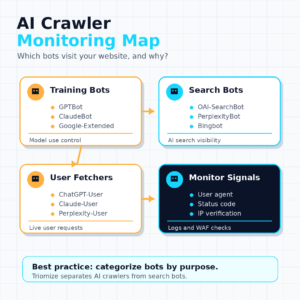
Start with these fields:
- User agent. Identify names like GPTBot, ClaudeBot, PerplexityBot, GoogleOther, or Bingbot.
- IP address. Verify official IP ranges where vendors publish them.
- Status code. Look for
200,403,404, and429patterns. - Path requested. Check whether bots are visiting important content or wasting crawl on low-value URLs.
- Timestamp. Watch crawl frequency and spikes.
- Referrer and landing page. Compare crawler activity with AI referral traffic.
AI crawler monitoring should answer practical questions:
- Which AI bots visit the site?
- Which pages do they request?
- Are important pages returning
200responses? - Are WAF rules blocking useful bots?
- Are training crawlers allowed or blocked by policy?
- Are AI referrals increasing after citation-focused updates?
Manual log analysis works for technical teams. Most WordPress owners need a cleaner view, which is why Triomize is building AI crawler monitoring directly into its workflow.
How Does AI Crawler Monitoring Affect SEO?
AI crawler monitoring affects SEO by adding a new layer of technical visibility beyond traditional search crawling. They do not replace Googlebot, Bingbot, sitemaps, canonical tags, or helpful content. They sit beside them.
Classic SEO still matters because AI systems often rely on crawlable, structured, reputable web documents. Google Search Central still provides useful guidance on content quality, crawlability, and structured data. If your website has broken internal links, thin pages, slow responses, or poor indexing, AI systems have less reliable material to retrieve.
AI crawler monitoring can also reveal technical issues. For example, a WAF may allow Googlebot but block PerplexityBot. A CDN may rate-limit GPTBot with 429 responses. A robots.txt rule may block Claude-SearchBot unintentionally. These issues do not always show up in normal keyword tracking.
SEO teams should treat AI crawler data as another diagnostic layer. It helps explain why a page may rank in Google but fail to appear in AI search or citation workflows.
How Does AI Crawler Monitoring Affect GEO?
AI crawler monitoring affects GEO because generative engines need accessible, trustworthy content before they can cite it. GEO, or Generative Engine Optimization, focuses on making content citable by AI systems.
The GEO layer includes:
- Crawlable public pages.
- Clear entities and schema markup.
- Original statistics and cited sources.
- Direct answers and structured sections.
- Brand consistency and topical authority.
- Fresh publication and update signals.
The Princeton University, Georgia Tech, Allen Institute, and IIT Delhi GEO study tested optimization tactics across 10,000 queries and nine datasets. It found that adding statistics, citing sources, and adding quotations improved position-adjusted word count by 30% to 40% and subjective impression by 15% to 30%.
That research does not mean every AI crawler uses the same formula. It does support the broader point. AI systems need content they can access, parse, trust, and cite. For the strategy layer, read What Is GEO? and SEO vs AEO vs GEO.
How Can Triomize Help with AI Crawler Monitoring?
As AI-powered search continues to evolve, website owners need better visibility into which AI crawlers are visiting their websites and how those crawlers interact with their content.
To address this, Triomize is developing an AI Crawler Monitoring feature that will help WordPress users distinguish AI crawlers from traditional search engine bots, understand crawler activity, and make informed decisions about AI accessibility.
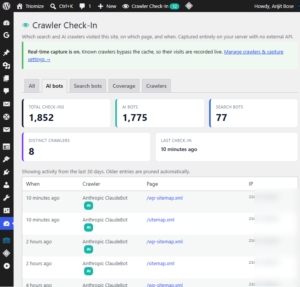
The planned feature will provide insights such as:
- AI crawler and search crawler activity.
- Pages accessed by different crawlers.
- Crawl frequency and recent check-ins.
- Separate reporting for AI bots and traditional search engine bots.
In addition, Triomize is being built with the future in mind. We are actively working toward supporting emerging global standards for AI bot identification, transparency, and crawler compliance, making it easier for website owners to adapt as AI search continues to mature.
The AI Crawler Monitoring feature is currently under development and will be released in an upcoming version of Triomize. Our goal is to give WordPress users a simple, privacy-friendly way to understand and manage AI crawler activity without relying on complex server log analysis or third-party services.
If you are already optimizing for Google AI Overviews, ChatGPT Search, or Perplexity SEO, crawler monitoring is the technical layer that shows whether AI systems can actually reach your content.
Conclusion
AI crawler monitoring is quickly becoming an important part of technical SEO and Generative Engine Optimization. As AI-powered search engines continue to grow, website owners need to understand not only whether their content is indexed, but also which AI systems can access it, how they access it, and what role those crawlers play.
Not every AI crawler serves the same purpose. Some support model training, others power AI search experiences, while some retrieve content only when a user explicitly requests it. Treating every crawler the same can lead to poor decisions that reduce visibility or block legitimate AI access.
The best approach is to understand your crawler traffic before making policy changes. Monitor which bots visit your website, decide which ones align with your business goals, and implement selective controls rather than blanket blocks.
As AI search continues to evolve, visibility will depend on more than rankings alone. Websites that combine strong SEO, structured content, and a clear understanding of AI crawler activity will be better positioned for both traditional search engines and the growing ecosystem of AI-powered discovery.
Frequently Asked Questions
What is AI crawler monitoring?
Which AI bots should I monitor?
Should AI crawler monitoring decide which bots I block?
How do I identify AI crawlers in logs?
Does AI crawler monitoring affect SEO and GEO?