
EEAT for AI Search is the practice of proving experience, expertise, authoritativeness, and trustworthiness so search engines and AI systems can evaluate your content as credible. It is not a single technical setting or ranking score. It is a trust framework built through accurate content, transparent authorship, reliable sources, topical authority, entity clarity, and consistent quality. Triomize helps WordPress teams improve these signals through SEO, AEO, and GEO-focused analysis.
Table of Contents
- What Is EEAT for AI Search?
- Why Did Google Create EEAT?
- Does EEAT Matter for AI Search?
- How Do AI Systems Evaluate Trust?
- How Can You Improve Your Website’s EEAT?
- How Do You Build Author Profiles?
- How Do You Demonstrate Real Experience?
- How Do You Cite Reliable Sources?
- How Do You Keep Content Updated?
- How Do You Strengthen Topical Authority?
- How Do You Build Entity Recognition?
- What Are Common EEAT Mistakes?
- How Can Triomize Help Improve EEAT for AI Search?
- What Should You Remember About EEAT for AI Search?
What Is EEAT for AI Search?
EEAT for AI Search is the process of strengthening credibility signals that help search engines and AI systems decide whether your content deserves visibility. EEAT stands for Experience, Expertise, Authoritativeness, and Trustworthiness.
Google uses the hyphenated form EEAT in its quality guidance. Many marketers write it as EEAT for simplicity. Both refer to the same idea: content should demonstrate that it comes from a source users can trust.
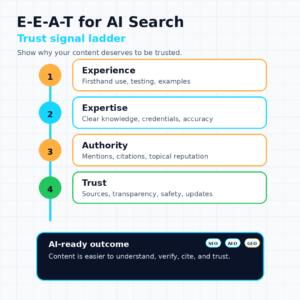
Each part has a distinct role:
| Element | Meaning | Practical signal |
|---|---|---|
| Experience | Firsthand involvement with the topic | Product use, case studies, examples, original screenshots |
| Expertise | Knowledge or skill in the subject | Author credentials, detailed explanations, correct terminology |
| Authoritativeness | Recognition by others | Mentions, citations, backlinks, industry references |
| Trustworthiness | Safety, accuracy, transparency | Sources, policies, contact info, corrections, secure site |
Google’s Search Central documentation says its systems identify a mix of factors that help determine whether content demonstrates experience, expertise, authoritativeness, and trustworthiness. It also states that trust is the most important of these aspects.
For AI search, this matters because AI systems need to decide which sources are safe to summarize, cite, or use for answers. If your page lacks trust signals, it is harder for an AI system to rely on it.
Why Did Google Create EEAT?
Google created EEAT to help evaluate whether search results are helpful, reliable, and people-first. The framework comes from Google’s Search Quality Rater Guidelines, which human quality raters use to assess search result quality.
The original framework was E-A-T: Expertise, Authoritativeness, and Trustworthiness. In December 2022, Google added another E for Experience. This change emphasized that firsthand experience can matter, especially for reviews, tutorials, product comparisons, and lived-experience topics.
Google’s helpful content guidance explains that EEAT is not a single ranking factor. Instead, Google uses many factors that can identify content with good EEAT. The guidance also says stronger EEAT matters more for topics that can affect health, financial stability, safety, welfare, or well-being.
That distinction is important. You do not optimize EEAT by adding one badge or plugin. You improve it by building a trustworthy website over time.
Does EEAT Matter for AI Search?
EEAT matters for AI search because AI systems need credible sources before they can generate useful answers. Google AI Overviews, ChatGPT Search, Perplexity AI, and other AI-powered tools all need to judge source quality in some way, even if they do not use Google’s exact EEAT framework.
AI answer systems typically need to evaluate:
- Whether the page can be crawled or retrieved.
- Whether the content answers the query directly.
- Whether the source is trustworthy.
- Whether claims are backed by evidence.
- Whether the author or organization is identifiable.
- Whether the topic is covered deeply across the site.
The search landscape is already shifting. Pew Research Center analyzed 68,879 Google searches in 2025 and found that when an AI summary appeared, users clicked a traditional result 8% of the time, compared with 15% when no AI summary appeared. That makes trust and citation eligibility more important because users may see fewer classic blue-link results.
Generative Engine Optimization research supports the same direction. The Princeton University, Georgia Tech, Allen Institute, and IIT Delhi GEO study tested optimization tactics across 10,000 queries and nine datasets. It found that adding citations, statistics, and authoritative language improved position-adjusted word count by 30% to 40% and subjective impression by 15% to 30%.
Those findings do not prove that every AI platform uses EEAT directly. They do show that trust, authority, and evidence affect AI visibility.
How Do AI Systems Evaluate Trust?
AI systems evaluate trust by combining signals from content, sources, entities, links, structure, freshness, and user-visible credibility. No major AI platform has published a full trust algorithm, but practical patterns are clear.
Trust signals include:
- Author identity. Is there a real author, reviewer, or organization?
- Source evidence. Are claims backed by credible references?
- Topical authority. Does the site cover the topic deeply?
- Entity clarity. Are people, brands, products, and topics clearly identified?
- Structured data. Does schema help machines understand the page?
- Freshness. Is the content updated when facts change?
- Transparency. Does the site show contact details, policies, and ownership?
- Content quality. Is the page useful, accurate, and written for people?
Google’s Knowledge Graph gives a useful example of entity-based trust. In 2020, Google said its Knowledge Graph had amassed over 500 billion facts about 5 billion entities. That system helps Google understand people, places, organizations, and things. AI systems also need entity understanding to decide which sources deserve confidence.
This is why EEAT for AI Search overlaps with Entity SEO, Topical Authority, and Schema Markup for AI Search.
How Can You Improve Your Website’s EEAT?
You can improve your website’s EEAT by making credibility visible across content, authors, sources, structure, and site architecture. The goal is to help both humans and machines see why your website deserves trust.
Start with these priorities:
- Publish content based on real expertise or experience.
- Show who created or reviewed important content.
- Cite reliable sources for factual claims.
- Keep pages updated when information changes.
- Build topical authority with connected content clusters.
- Use structured data to clarify authors, organization, breadcrumbs, and articles.
- Make contact, privacy, editorial, and business details easy to find.
- Avoid exaggerated claims, anonymous advice, and unsupported statistics.
EEAT is cumulative. A single author box is not enough. A single citation is not enough. Trust grows when signals repeat consistently across the website.
How Do You Build Author Profiles?
You build author profiles by making the person or organization behind the content clear. An author profile should help users understand why the creator is qualified to write about the topic.
Strong author profiles include:
- Full name.
- Role or expertise.
- Short professional bio.
- Relevant experience.
- Links to related content.
- SameAs links where appropriate.
- Review or editorial responsibility for sensitive topics.
Author profiles matter more when content affects decisions. Health, finance, legal, security, and technical implementation topics need stronger author clarity than casual entertainment content.
For WordPress sites, author clarity should also connect to Article schema and Organization schema where relevant.
How Do You Demonstrate Real Experience?
You demonstrate real experience by showing that the content comes from firsthand use, observation, testing, or practical work. Experience is what separates a lived explanation from a generic summary.
Useful experience signals include:
- Original screenshots.
- Case studies.
- Before-and-after examples.
- Product testing notes.
- Process photos.
- Lessons learned.
- Client or project examples.
- Firsthand limitations and caveats.
For AI search, firsthand experience helps create content that is harder to replace with generic summaries. It gives AI systems and users more reason to treat your page as a useful source.
How Do You Cite Reliable Sources?
You cite reliable sources by linking important claims to credible documentation, research, government sources, academic studies, or official product pages. This improves trust for users and gives AI systems stronger evidence trails.
Good source choices include:
- Google Search Central documentation.
- Official platform documentation.
- Academic research.
- Government databases.
- Standards bodies.
- Primary data reports.
- Original company announcements.
Do not cite random blogs for critical claims if a primary source exists. Use the closest original source whenever possible.
For example, an article about AI crawlers should cite OpenAI, Anthropic, Perplexity, Google, or Bing documentation. An article about schema should cite Schema.org and Google structured data guidance.
How Do You Keep Content Updated?
You keep content updated by reviewing important pages on a regular schedule and changing them when facts, policies, product features, or search behavior changes. Freshness is part of trust.
Use a simple update workflow:
- Identify pages that cover fast-changing topics.
- Review external references and statistics.
- Check whether screenshots or examples are outdated.
- Update publication or modified dates accurately.
- Add new sections when user questions change.
- Remove claims that are no longer true.
- Revalidate schema after edits.
AI search topics need frequent updates. Crawlers, AI Overviews, ChatGPT Search, Perplexity, and structured data policies change quickly.
How Do You Strengthen Topical Authority?
You strengthen topical authority by publishing connected content around a subject instead of isolated posts. A single article can be useful, but a cluster proves broader expertise.
A strong cluster includes:
- A pillar page.
- Supporting articles.
- Clear internal links.
- Consistent entities.
- Schema markup.
- External citations.
- Updated examples.
For example, a site that wants to own AI search should connect guides on Google AI Overviews, ChatGPT Search, AI Crawler Monitoring, and Topical Authority.
Topical authority helps AI systems understand that your site has subject depth, not just one optimized page.
How Do You Build Entity Recognition?
You build entity recognition by making your brand, authors, products, topics, and relationships consistent across your website. Search engines need to understand who you are and what you cover.
Important entity signals include:
- Consistent brand name.
- Organization schema.
- Author schema.
- SameAs links.
- About page details.
- Clear product or service pages.
- Descriptive internal links.
- Mentions from trusted external sources.
Entity recognition is essential for AI search because AI systems need to connect content to a trusted source. For a deeper explanation, read our Entity SEO guide.
What Are Common EEAT Mistakes?
Common EEAT mistakes happen when websites try to look trustworthy without actually improving trust. AI systems and users both notice weak signals.
Avoid these mistakes:
- Anonymous high-stakes content. Sensitive advice needs clear authorship or review.
- Unsupported claims. Important facts need sources.
- Thin author pages. A name alone does not demonstrate expertise.
- Outdated statistics. Old data weakens credibility.
- Generic AI summaries. Content without experience is easy to ignore.
- No editorial transparency. Users should understand who publishes the content.
- Weak internal links. Isolated pages do not prove topical authority.
- Schema conflicts. Broken or duplicate schema can confuse machines.
- Overclaiming expertise. Trust is earned through evidence, not adjectives.
The solution is not cosmetic. Build real quality, then make the signals visible.
How Can Triomize Help Improve EEAT for AI Search?
Triomize can help improve EEAT for AI Search by making trust signals part of the WordPress publishing workflow. Building strong EEAT requires more than publishing quality content. Search engines and AI systems look for clear signals that demonstrate expertise, authority, and trustworthiness across your website.
Triomize helps website owners strengthen these foundations by improving content quality through SEO, AEO, and GEO analysis while encouraging best practices such as structured content, schema implementation, and comprehensive topic coverage. Together, these improvements make it easier for search engines and AI systems to understand and trust your website.
As the AI search landscape evolves, Triomize will continue expanding its capabilities to help WordPress users align with emerging best practices for trustworthy, AI-ready content.
A practical Triomize workflow can help teams check whether content includes a direct answer, credible sources, internal links, schema opportunities, topical coverage, and GEO signals before publication.
What Should You Remember About EEAT for AI Search?
As search evolves beyond keywords, trust has become one of the most valuable visibility signals. Whether a user finds your content through Google Search, AI Overviews, ChatGPT, Perplexity, or another AI-powered platform, credibility plays a central role in determining which sources are surfaced.
EEAT is not a technical setting you can switch on. It is built over time through genuine expertise, accurate information, transparent authorship, and consistent content quality.
Websites that combine strong EEAT with solid technical SEO, structured data, and topical authority will be better positioned to earn visibility in both traditional search engines and the next generation of AI-powered search experiences.
Frequently Asked Questions
What is EEAT for AI Search?
Does ChatGPT use EEAT?
Does EEAT affect Google AI Overviews?
How can I improve EEAT on my website?
Is EEAT a ranking factor?