
Structured data types are Schema.org categories that describe what a webpage, person, organization, product, FAQ, video, or local business represents in a machine-readable format. For AI search, the most useful structured data types depend on the page, but common choices include Article, Person, Organization, BreadcrumbList, Product, LocalBusiness, FAQPage, WebSite, and VideoObject. These types help search engines understand content and relationships, but they do not guarantee rankings or AI citations.
Table of Contents
- What Are Structured Data Types?
- Why Does Structured Data Matter for AI Search?
- Which Structured Data Types Matter Most for AI Search?
- What Is Article Structured Data?
- What Is Person Structured Data?
- What Is Organization Structured Data?
- What Is BreadcrumbList Structured Data?
- What Is Product Structured Data?
- What Is LocalBusiness Structured Data?
- What Is FAQPage Structured Data?
- What Is WebSite Structured Data?
- Which Other Structured Data Types Are Useful?
- Which Structured Data Types Should a Blog Use?
- Which Structured Data Types Should an Ecommerce Website Use?
- Can Structured Data Help AI Systems Understand Your Content?
- Does Structured Data Help You Get Cited by AI Search Engines?
- How Can Triomize Help Choose Structured Data Types?
- What Are Common Structured Data Mistakes?
- How Do You Choose the Right Structured Data Type?
What Are Structured Data Types?
Structured data types are machine-readable categories that define what something on a webpage represents. A type tells search engines whether the page is an article, product, person profile, organization, FAQ page, video, event, job posting, or local business.
Structured data usually uses Schema.org vocabulary. Most modern websites implement it with JSON-LD, which is a script format that can sit in the page HTML without changing the visible page design.
Think of it this way:
Type: Article
Properties: headline, author, datePublished, dateModified, image
The type tells machines what the item is. The properties describe useful details about that item.
For example, a blog post can use Article structured data. The author can be described with Person structured data. The publisher can be described with Organization structured data. The navigation path can use BreadcrumbList structured data.
According to Google’s structured data documentation, structured data provides explicit clues about the meaning of a page. Google also recommends JSON-LD in most cases because it is easier to implement and maintain at scale.
This is why structured data types matter for SEO, AEO, and GEO. They help machines interpret content, but they still need accurate visible content to support them.
Why Does Structured Data Matter for AI Search?
Structured data matters for AI search because AI systems need context. Human readers can infer meaning from layout, brand signals, headings, and design. Machines benefit when important details are described explicitly.
A visible article might say:
Written by Arijit BoseStructured data can say:
This person is the author of this article.That extra clarity can help search engines and AI systems understand entities, relationships, content type, authorship, organization identity, and site hierarchy.
Structured data can communicate:
- What the page is.
- Who created it.
- Which organization published it.
- Which product is described.
- Which questions are answered.
- Which page sits above it in the site hierarchy.
- Which entity the content is about.
According to Google’s structured data case studies, Rotten Tomatoes added structured data to 100,000 unique pages and measured a 25% higher click-through rate for pages enhanced with structured data. Food Network converted 80% of its pages to enable search features and saw a 35% increase in visits. Rakuten reported users spent 1.5x more time on structured data pages, and Nestlé measured an 82% higher click-through rate for rich result pages.
Those examples are not AI citation guarantees. They show that accurate structured data can improve how search systems interpret and display content.
For the bigger strategy, read Schema Markup for AI Search. This article focuses on which structured data types to choose.
Which Structured Data Types Matter Most for AI Search?
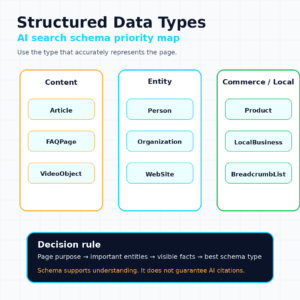
The structured data types that matter most for AI search are the ones that accurately describe your content, authors, organization, products, location, and page hierarchy. You do not need every Schema.org type. You need the right type for the page.
| Structured Data Type | Best Used For | Importance |
|---|---|---|
| Article | Blog posts and articles | High |
| Person | Authors and experts | High |
| Organization | Companies and brands | High |
| BreadcrumbList | Site hierarchy | High |
| Product | Product pages | High for ecommerce |
| LocalBusiness | Local businesses | High for local sites |
| FAQPage | Genuine FAQ content | Situational |
| WebSite | Website identity | Useful |
| VideoObject | Video content | Useful |
| HowTo | Instructional content | Situational |
| Event | Events and webinars | Situational |
| JobPosting | Job listings | Situational |
The most important rule is simple: use the type that accurately represents the page.
Do not add Product schema to a blog post. Do not add FAQPage schema to hidden FAQs. Do not add LocalBusiness schema if the website is not representing a real local business location.
The goal is clarity, not volume.
What Is Article Structured Data?
Article structured data describes blog posts, guides, news articles, and editorial content. It helps search engines understand the headline, author, publisher, image, publication date, modified date, and main page identity.
Useful Article properties include:
headlineauthordatePublisheddateModifiedimagepublishermainEntityOfPage
Article structured data is especially useful for content marketing, SEO blogs, documentation, tutorials, news updates, and educational content.
For AI search, Article markup helps identify the page as a piece of content, not a product page, category page, or profile page. It also connects the content to the author and publisher.
This matters for freshness and trust. A guide about AI search should show when it was published and updated. A guide about technical SEO should identify who wrote it and who published it.
Article structured data should match the visible page. If the visible author name, date, or headline differs from the schema, clean it up.
What Is Person Structured Data?
Person structured data describes a real person, such as an author, expert, founder, reviewer, or subject matter specialist. It is especially important for websites that publish expert-led content.
Useful Person properties include:
nameimagejobTitledescriptionsameAsworksForurl
The sameAs property can connect an author to relevant external profiles such as LinkedIn, GitHub, X, personal websites, or professional profiles.
This does not automatically prove expertise. It provides machine-readable identity information. Search engines still need visible content, author bios, topical consistency, and trust signals.
Person structured data works best when paired with a visible author bio and a dedicated author page. For a deeper workflow, read Author Bio SEO.
For GEO, Person schema can help connect content to identifiable people, which supports author trust and entity clarity.
What Is Organization Structured Data?
Organization structured data describes the company, brand, publisher, nonprofit, or institution behind a website. It is one of the most important structured data types for brand identity.
Useful Organization properties include:
nameurllogosameAscontactPointfounderdescription
Organization schema helps search systems identify who publishes the content. This is useful for business websites, SaaS companies, agencies, ecommerce stores, publishers, and WordPress product companies.
For AI search, organization clarity matters because AI systems need to understand source identity. A page published by an identifiable brand with consistent schema, footer details, About page information, and social profiles is easier to interpret than anonymous content.
Organization structured data should be consistent across the site. Use the same brand name, URL, logo, and profile links everywhere.
What Is BreadcrumbList Structured Data?
BreadcrumbList structured data describes the path from the homepage to the current page. It helps search engines understand site hierarchy and parent-child relationships.
Example:
Home → SEO → AI Search → Structured DataBreadcrumbList is useful because it explains where a page fits in the website. A page about FAQ schema may belong under structured data, AEO, or AI search. Breadcrumbs make that relationship clearer.
This also connects directly to internal linking and site architecture. Breadcrumbs are not a replacement for contextual internal links, but they reinforce hierarchy.
A strong site architecture might connect:
AI Search Optimization → Schema Markup for AI Search → Structured Data TypesFor the content architecture side, read Internal Linking Strategy.
What Is Product Structured Data?
Product structured data describes a product page. It is highly relevant for ecommerce websites, SaaS product pages, digital product pages, and some plugin pages.
Product schema can include:
- Product name.
- Brand.
- Description.
- Image.
- Offers.
- Price.
- Availability.
- Reviews where legitimate.
- AggregateRating where legitimate.
Product schema is powerful when the page genuinely represents a product. It is not something every blog post should add.
Use Product schema when the page is about a specific product that users can evaluate, buy, download, or compare. Do not add Product schema to an informational article just because you mention a product inside it.
For AI search, Product schema can help identify product attributes, pricing, brand, and availability. But AI systems still need useful content, trust signals, and accessible pages.
What Is LocalBusiness Structured Data?
LocalBusiness structured data describes a real local business or physical service location. It matters for websites that depend on local search visibility.
Useful LocalBusiness properties include:
nameaddresstelephoneopeningHoursgeourlpriceRangesameAs
LocalBusiness schema can be useful for:
- Restaurants.
- Clinics.
- Jewellery stores.
- Agencies.
- Salons.
- Local service businesses.
- Repair companies.
- Real estate offices.
Only use it when the business genuinely qualifies. A national blog should not add LocalBusiness schema unless it represents a real local business location.
LocalBusiness schema works best with consistent Google Business Profile details, visible contact information, location pages, and real customer trust signals.
What Is FAQPage Structured Data?
FAQPage structured data describes visible frequently asked questions and answers on a page. It is situational, but useful when the page contains genuine FAQ content.
FAQ content can help structure conversational questions and direct answers. This supports AEO, voice search, and some AI search workflows. However, FAQPage markup is not an SEO shortcut.
Important rules:
- The FAQ content should be visible.
- The schema should match the visible FAQ exactly.
- Questions should be real user questions.
- Answers should be accurate and useful.
- Do not add FAQPage to every page automatically.
Google reduced and deprecated many FAQ rich result experiences for most sites in 2026. That means FAQPage should now be viewed mainly as a clarity signal, not a guaranteed visual enhancement.
Triomize includes FAQ insertion and FAQ schema functionality, which helps WordPress users create consistent question-and-answer blocks without writing JSON-LD manually.
For the detailed guide, read FAQ Schema Markup.
What Is WebSite Structured Data?
WebSite structured data describes the website as a whole. It can communicate the site name, URL, and search functionality where appropriate.
Useful WebSite properties include:
nameurlpublisherpotentialActionfor site search where appropriate.
WebSite schema is usually implemented globally, not manually on every article. It helps clarify the identity of the website itself.
For most WordPress sites, WebSite schema may already be handled by an SEO plugin or schema system. The main job is to make sure it does not conflict with Organization schema or duplicate output from multiple plugins.
Which Other Structured Data Types Are Useful?
Other useful structured data types depend on the website. There are hundreds of Schema.org types, but most websites only need a focused set.
Useful examples include:
| Type | Use case |
|---|---|
| VideoObject | Pages with original or embedded videos |
| HowTo | Step-by-step instructional content |
| Event | Webinars, conferences, and live events |
| Review | Legitimate review content |
| JobPosting | Hiring pages and job listings |
| Course | Educational courses |
| Dataset | Data or research pages |
| SoftwareApplication | Software, plugins, and apps |
Do not add a type because it sounds advanced. Add it because it accurately represents the page.
The best structured data strategy is specific, not excessive.
Which Structured Data Types Should a Blog Use?
A typical expert-led blog should usually start with Article, Person, Organization, and BreadcrumbList structured data. FAQPage can be added when the page genuinely contains visible FAQ content.
For a blog post, a practical setup looks like this:
| Blog element | Suggested structured data |
|---|---|
| Blog post | Article |
| Author | Person |
| Publisher | Organization |
| Site path | BreadcrumbList |
| FAQ section | FAQPage where applicable |
| Embedded video | VideoObject where applicable |
This setup works well for content-heavy websites because it clarifies authorship, publishing identity, topic hierarchy, and answer structure.
For example, an article about AI Visibility can use Article schema, connect to the author’s Person schema, reference Organization schema, and use BreadcrumbList to show the page’s location in the AI search cluster.
Which Structured Data Types Should an Ecommerce Website Use?
An ecommerce website should usually prioritize Product, Organization, BreadcrumbList, and WebSite structured data. Review or AggregateRating markup may be useful when the review data is legitimate and visible.
A practical ecommerce setup:
| Ecommerce element | Suggested structured data |
|---|---|
| Product page | Product |
| Brand or seller | Organization |
| Product category path | BreadcrumbList |
| Site identity | WebSite |
| Product videos | VideoObject |
| Real reviews | Review or AggregateRating |
| Store location | LocalBusiness where relevant |
Product schema should be accurate. Price, availability, reviews, and ratings should reflect visible content and real data.
Do not create fake reviews or ratings. Misleading structured data can damage trust and eligibility.
Can Structured Data Help AI Systems Understand Your Content?
Structured data can help AI systems understand your content by providing explicit information about entities, authors, organizations, products, content type, and relationships. It is one clarity signal among many.
Structured data can help clarify:
- The page type.
- The author.
- The publisher.
- The product.
- The location.
- The site hierarchy.
- The FAQ structure.
- The relationship between entities.
However, AI systems can use many other signals too. They can analyze visible content, links, headings, citations, freshness, page quality, source reputation, and retrieval context.
Structured data should support your content, not replace it. If the visible content is weak, schema will not make it authoritative.
For broader AI search planning, read AI Search Optimization and AI Visibility.
Does Structured Data Help You Get Cited by AI Search Engines?
Structured data can help machines understand the entities and context represented on a webpage, but it does not guarantee that an AI search engine will cite the page. AI citations depend on broader factors including relevance, content quality, authority, accessibility, freshness, and the system’s retrieval process.
This distinction is important. Schema markup can clarify meaning. It cannot force ChatGPT, Perplexity, Google AI Overviews, Gemini, or Claude to cite your site.
AI citations are more likely when structured data supports strong visible content. That means:
- The page is crawlable.
- The answer is clear.
- The source is trustworthy.
- The author and organization are identifiable.
- The content is current.
- The topic is covered deeply.
- Claims are supported by evidence.
Structured data is part of the foundation. It is not the whole building.
How Can Triomize Help Choose Structured Data Types?
Triomize can help choose structured data types by bringing schema decisions into the WordPress publishing workflow. Instead of treating schema as a separate technical task, Triomize connects structured data with SEO, AEO, and GEO checks.
For example, Triomize can help WordPress users think through whether a post needs Article schema, whether an FAQ section should use FAQPage markup, whether author details should connect to Person schema, and whether the publisher identity should connect to Organization schema.
Triomize already includes tools for commonly used schema workflows, including FAQ Schema, and continues to expand structured data capabilities for AI-ready content. The goal is not to add every possible schema type. The goal is to add the right schema type for the right page.
This helps website owners avoid common schema mistakes, reduce manual JSON-LD work, and create content that is easier for search engines and AI systems to understand.
What Are Common Structured Data Mistakes?
Common structured data mistakes happen when website owners add schema without matching the real content of the page.
Avoid these mistakes:
- Using the wrong type. Do not mark a blog post as Product.
- Adding schema that does not match visible content. Users should see what schema describes.
- Adding fake reviews. Reviews must be real and visible.
- Creating duplicate markup. Multiple plugins can output conflicting schema.
- Missing required properties. Incomplete markup can reduce eligibility.
- Using outdated markup. Search documentation changes.
- Adding every possible schema type. More schema is not always better.
- Treating schema as a ranking shortcut. It is a clarity layer.
- Forgetting validation. Test JSON-LD before and after publishing.
- Failing to update schema. Structured data should reflect the current page.
The guiding rule is simple: schema should accurately describe what the page really contains.
How Do You Choose the Right Structured Data Type?
You choose the right structured data type by identifying what the page represents and which entities matter most. Start with the page’s purpose, not a plugin dropdown.
Use this decision process:
- What does the page represent? Is it an article, product, person, organization, local business, video, or FAQ page?
- What entities are important? Does the page involve an author, company, product, location, or event?
- What information is visible? Schema should accurately represent the page.
- Does Schema.org provide an appropriate type? Choose the most specific legitimate type.
- Which Google documentation applies? Google Search behavior may differ from general Schema.org vocabulary.
- Can you validate it? Test syntax and implementation.
- Can you keep it updated? Schema should change when the visible page changes.
For WordPress websites, the best approach is to standardize schema templates by page type. Blog posts should use one pattern. Product pages should use another. Local pages should use another.
Triomize can help by making schema decisions part of the SEO, AEO, and GEO workflow rather than a separate technical afterthought.
Frequently Asked Questions
What are structured data types?
Which structured data type is best for SEO?
Which structured data types help AI search?
Does structured data improve Google rankings?
Does schema markup help AI citations?
What is the difference between Schema.org and JSON-LD?
Should every webpage have structured data?
Which schema is best for blog posts?