
Voice search optimization is the process of structuring website content so it can be easily understood and retrieved for spoken search queries. It involves using conversational language, answering specific questions directly, organizing content clearly, and optimizing relevant local and technical SEO signals. In 2026, voice search optimization works best as part of AEO, because both focus on clear answers, natural language, and useful content.
Table of Contents
- What Is Voice Search Optimization?
- How Is Voice Search Different From Traditional Search?
- Why Does Voice Search Matter in 2026?
- How Do You Optimize Content for Voice Search?
- How Do You Answer Questions Directly?
- How Do You Use Conversational Language?
- How Do You Target Long-Tail Questions?
- How Do You Structure Content With Clear Headings?
- How Do You Keep Direct Answers Concise?
- How Do You Optimize for Local Voice Search?
- What Types of Content Work Best for Voice Search?
- Does FAQ Content Help With Voice Search?
- Does Structured Data Help Voice Search?
- How Does Voice Search Optimization Relate to AEO?
- Does Voice Search Optimization Help AI Search?
- What Are Common Voice Search Optimization Mistakes?
- How Do You Create Voice Search-Friendly Content?
- What Is the Voice Search Optimization Checklist?
- How Can Triomize Help With Voice Search Optimization?
What Is Voice Search Optimization?
Voice search optimization is the process of making website content easier for voice assistants, search engines, and conversational interfaces to understand and answer. It focuses on natural language questions, concise answers, clear structure, and search intent.
Voice search happens when a user speaks a query instead of typing it. The query may go through Google voice search, a mobile assistant, a smart speaker, an in-car assistant, or another conversational search interface.
Typed searches are often short. Spoken searches are usually longer and more natural.
Example:
| Search type | Example query |
|---|---|
| Typed search | best restaurants Delhi |
| Voice search | What are the best restaurants near me? |
| Typed search | core web vitals score |
| Voice search | What is a good Core Web Vitals score? |
| Typed search | internal linking SEO |
| Voice search | How does internal linking improve SEO? |
This does not mean traditional keyword research is irrelevant. It means your content should include the natural questions people ask around a topic.
Voice search optimization is closely connected to Answer Engine Optimization, because both reward direct, well-structured answers.
How Is Voice Search Different From Traditional Search?
Voice search is different from traditional search because spoken queries are usually more conversational, question-based, specific, and contextual. Typed searches often use fewer words and more fragmented keyword phrases.
Traditional typed searches often look like this:
- voice search SEO
- technical SEO audit
- schema markup AI
- restaurants near me
- WordPress SEO checklist
Voice search queries often look like this:
- How do I optimize my website for voice search?
- What is technical SEO?
- How do I add schema markup to WordPress?
- Which restaurants are open near me right now?
- What belongs on a WordPress SEO checklist?
The core difference is intent clarity. A voice query often tells you exactly what the user wants. It may include a question word, location, urgency, or action.
This changes content strategy. Instead of writing only for short keyword phrases, website owners should answer complete questions. The goal is not to stuff conversational keywords into every paragraph. The goal is to understand how people naturally ask for information.
According to Google’s link and content guidance, descriptive anchor text and useful surrounding context help users and Google understand content. The same principle applies to voice search content because spoken answers need clear wording and context.
Why Does Voice Search Matter in 2026?
Voice search matters in 2026 because search is becoming more conversational across many interfaces. Users now ask questions through mobile devices, voice assistants, smart speakers, car systems, AI chat tools, and multimodal search experiences.
The larger shift is not only voice. It is conversational search.
Search behavior is moving toward:
- Natural language questions.
- Follow-up queries.
- Direct answers.
- AI-generated responses.
- Multimodal search with text, voice, and images.
- Local intent such as near me, open now, and closest.
According to Google’s AI features documentation, AI Mode can help with complex questions and follow-up exploration. Google also says its AI features surface relevant links and rely on the same foundational SEO best practices as Search overall.
That makes voice search optimization more important, not less. The same content traits that help spoken search also help answer engines and AI search systems:
- Clear questions.
- Direct answers.
- Natural language.
- Structured sections.
- Useful context.
- Reliable sources.
- Strong topical coverage.
Voice search should not be treated as a separate SEO trick. It is a practical extension of conversational search, AEO, and modern AI search behavior.
The broader answer-led search trend is measurable. According to Pew Research Center, a study of 68,879 Google searches from 900 U.S. adults found that users clicked a traditional result 8% of the time when an AI summary appeared, compared with 15% when no AI summary appeared. That data is not a voice-search percentage, but it shows why direct answers and conversational search visibility matter.
How Do You Optimize Content for Voice Search?
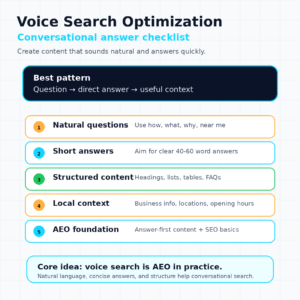
You optimize content for voice search by answering natural-language questions clearly, using conversational phrasing, and organizing information so users and machines can understand it quickly. The best voice search content is useful even when read aloud.
How Do You Answer Questions Directly?
Answer the question immediately after the heading. Do not bury the answer under five paragraphs of setup.
Example:
What is technical SEO?

Technical SEO is the process of optimizing a website's technical structure so search engines can crawl, understand, and index its content effectively.
Then expand with details, examples, and steps. This format supports voice search optimization because the answer is easy to extract and easy to speak.
How Do You Use Conversational Language?
Use language that sounds natural. People do not usually speak like keyword tools.
Instead of:
Internal linking strategy implementation methodologyUse:
How should you structure internal links on a website?Conversational language does not mean casual or weak writing. It means clear, human phrasing.
How Do You Target Long-Tail Questions?
Long-tail questions match how users speak. They also map well to answer engines.
Examples:
- How do I improve website SEO?
- What is voice search optimization?
- How does internal linking improve SEO?
- How do I optimize my website for AI search?
- What is the difference between SEO, AEO, and GEO?
This approach matches Triomize’s broader question-led content strategy and connects naturally to SEO vs AEO vs GEO.
How Do You Structure Content With Clear Headings?
Use headings that describe the question or topic. Clear H2s and H3s help readers scan and help machines identify answer blocks.
Use:
- H2s for main questions.
- H3s for supporting questions.
- Short paragraphs.
- Bullet lists.
- Tables.
- FAQs.
This also supports Internal Linking Strategy because clear sections make contextual links easier to place.
How Do You Keep Direct Answers Concise?
Use this pattern:
Question → direct answer → explanation → evidence or examplesA concise answer should usually be 40 to 60 words. The expansion can be longer. This supports featured snippets, AEO, and voice search.
How Do You Optimize for Local Voice Search?
Local voice search matters when users include location or urgency. Queries often include phrases like:
- near me
- nearby
- open now
- closest
- in Mumbai
- in Nagpur
For local voice search, optimize:
- Google Business Profile.
- Consistent name, address, and phone details.
- Location-specific landing pages.
- Local service descriptions.
- Opening hours.
- Reviews and trust signals.
- LocalBusiness schema where appropriate.
Local SEO should support voice search when location matters, but it should not become the entire strategy for non-local topics.
What Types of Content Work Best for Voice Search?
The best content for voice search answers specific questions in a natural, structured way. It should be easy to read, easy to scan, and easy to speak aloud.
| Content Type | Voice Search Opportunity |
|---|---|
| FAQs | Direct question answering |
| How-to guides | Step-by-step queries |
| Definitions | Short factual answers |
| Lists | What are the best queries |
| Local pages | Near-me searches |
| Comparison pages | Which is better queries |
| Troubleshooting guides | Problem-based searches |
For example, a troubleshooting guide can answer: “Why is my website slow on mobile?” A comparison page can answer: “Which is better for AI search, AEO or GEO?” A local page can answer: “Which WordPress SEO agency is near me?”
The content format should match the question. A definition needs a short answer. A how-to query needs steps. A comparison query often needs a table. A local query needs location details.
Does FAQ Content Help With Voice Search?
FAQ content can help with voice search when the questions are relevant and the answers are clear. Simply adding an FAQ section does not guarantee voice search visibility.
FAQ content is useful because it mirrors conversational queries. Users often ask complete questions, and FAQ sections give you a natural place to answer those questions.
A strong FAQ section should include:
- Real user questions.
- Direct answers.
- Clear language.
- Helpful context.
- No keyword stuffing.
- Accurate information.
- Internal links where useful.
FAQ schema can support machine understanding when the visible page contains the same questions and answers. But FAQ schema alone is not a ranking shortcut. The visible content still needs to be useful.
For related structure, see Schema Markup for AI Search.
Does Structured Data Help Voice Search?
Structured data can help voice search by giving machines more context about the page, organization, author, local business, FAQ, product, or article. It does not guarantee a voice result.
Useful schema types include:
- Article schema.
- Organization schema.
- FAQPage schema where appropriate.
- LocalBusiness schema for local pages.
- BreadcrumbList schema.
- Person or Author schema.
Schema helps search engines understand what the content represents. For voice search, this can support clarity. For AI search, it can also support entity understanding and trust.
The important distinction is this: structured data helps machines understand content, but it does not replace content quality. A poorly written answer with perfect schema is still a poor answer.
How Does Voice Search Optimization Relate to AEO?
Voice search optimization relates to AEO because both focus on answering questions clearly. SEO helps content become discoverable. AEO helps content answer questions directly. Voice search is one conversational interface where users ask those questions.
Think of the relationship like this:
SEO → makes content discoverable
AEO → makes answers extractable
Voice search → delivers answers through spoken or conversational interfaces
That is why voice search optimization should not be treated as a replacement for SEO. It is better understood as one practical application of conversational and answer-focused optimization.
This is also why AEO for ChatGPT is the strongest related internal link for this article. Both topics focus on direct answers, question-led structure, and content that can be extracted by answer systems.
Triomize scores SEO, AEO, and GEO separately because these layers work together. Voice search belongs closest to the AEO layer, but it still depends on SEO foundations and trust signals.
Does Voice Search Optimization Help AI Search?
Voice search optimization can help AI search indirectly because it encourages natural language, direct answers, question-based content, structured information, and concise explanations. These traits also make content easier for AI-powered systems to process.
However, optimizing for voice search does not guarantee AI citations. AI search involves additional signals, including:
- Authority.
- Relevance.
- Freshness.
- Entity clarity.
- Source citations.
- Content quality.
- AI crawler accessibility.
- Topical authority.
For example, a page may answer a voice-style question clearly but still lack the trust signals needed for Perplexity or ChatGPT Search citations. That page needs stronger sources, schema, internal links, author information, and topical coverage.
Voice search optimization supports AI Search Optimization because both reward content that is easy to understand. But GEO adds the citation and trust layer.
According to the GEO study from Princeton University, Georgia Tech, Allen Institute, and IIT Delhi, researchers tested optimization tactics across 10,000 queries and nine datasets. They found that adding citations, statistics, and authoritative language improved visibility in generative engine responses by 30% to 40% on one metric and 15% to 30% on another. This supports the idea that clear, source-backed answers are valuable beyond voice interfaces.
What Are Common Voice Search Optimization Mistakes?
Common voice search optimization mistakes happen when website owners chase voice search as a gimmick instead of improving answer quality.
Avoid these mistakes:
- Stuffing conversational keywords. Natural language should not sound forced.
- Writing unnatural questions. Use questions people actually ask.
- Creating thin FAQ pages. FAQs need useful answers and supporting content.
- Answering vaguely. Voice search needs direct answers.
- Ignoring search intent. Match the user’s real need.
- Treating FAQ schema as a shortcut. Schema supports clarity, not guaranteed visibility.
- Ignoring traditional SEO. Voice results still depend on discoverable content.
- Writing only for machines. Content must help real users.
- Making unsupported voice search statistics. Avoid repeating outdated or unverified claims.
The best voice search content is simply good answer-first content. It sounds natural, answers quickly, and expands helpfully.
How Do You Create Voice Search-Friendly Content?
You create voice search-friendly content by starting with real conversational questions and building clear, helpful answers around them.
Use this workflow:
- Identify conversational questions. Find how users naturally ask about the topic.
- Group questions by intent. Separate definitions, how-to queries, comparisons, and local searches.
- Answer each important question directly. Put the answer near the heading.
- Expand with useful context. Add examples, steps, tables, and supporting details.
- Add appropriate structured data. Use FAQPage, Article, Organization, or LocalBusiness schema when relevant.
- Connect relevant internal pages. Link to deeper resources and topic clusters.
- Review natural language. Read the answer aloud and remove awkward phrasing.
This workflow supports voice search, AEO, and AI search. It is also easy to apply to existing blog posts. You do not need to rewrite your whole website. Start with pages that already rank or answer common customer questions.
For topic cluster support, read Topical Authority.
What Is the Voice Search Optimization Checklist?
A voice search optimization checklist helps you review whether a page is ready for conversational search and answer extraction.
| Check | Done |
|---|---|
| Target a clear conversational search intent | ☐ |
| Include relevant questions | ☐ |
| Answer important questions directly | ☐ |
| Use natural language | ☐ |
| Keep answers concise | ☐ |
| Use descriptive headings | ☐ |
| Organize information logically | ☐ |
| Add relevant structured data | ☐ |
| Strengthen internal linking | ☐ |
| Optimize local information where relevant | ☐ |
| Maintain traditional SEO fundamentals | ☐ |
| Review readability aloud | ☐ |
Triomize can help by checking whether your content is structured for SEO, AEO, and GEO. For voice search, the AEO layer is especially important because spoken queries often need concise, extractable answers.
How Can Triomize Help With Voice Search Optimization?
Triomize can help with voice search optimization by making answer structure part of the WordPress publishing workflow. Voice search depends on content that is easy to understand, easy to extract, and useful to users.
Triomize can support voice-search-friendly content through:
- SEO checks for discoverability.
- AEO checks for direct answers.
- GEO checks for trust and citation readiness.
- Question-led heading review.
- FAQ structure checks.
- Schema opportunities.
- Internal linking recommendations.
- Content readability signals.
The goal is not to create robotic content. The goal is to make your best answers clear enough for search engines, voice assistants, and AI systems to understand.
Frequently Asked Questions
What is voice search optimization?
How do I optimize my website for voice search?
Does voice search affect SEO?
What keywords are best for voice search?
Does FAQ schema help voice search?
Does voice search optimization help AI search?
Is voice search optimization the same as AEO?