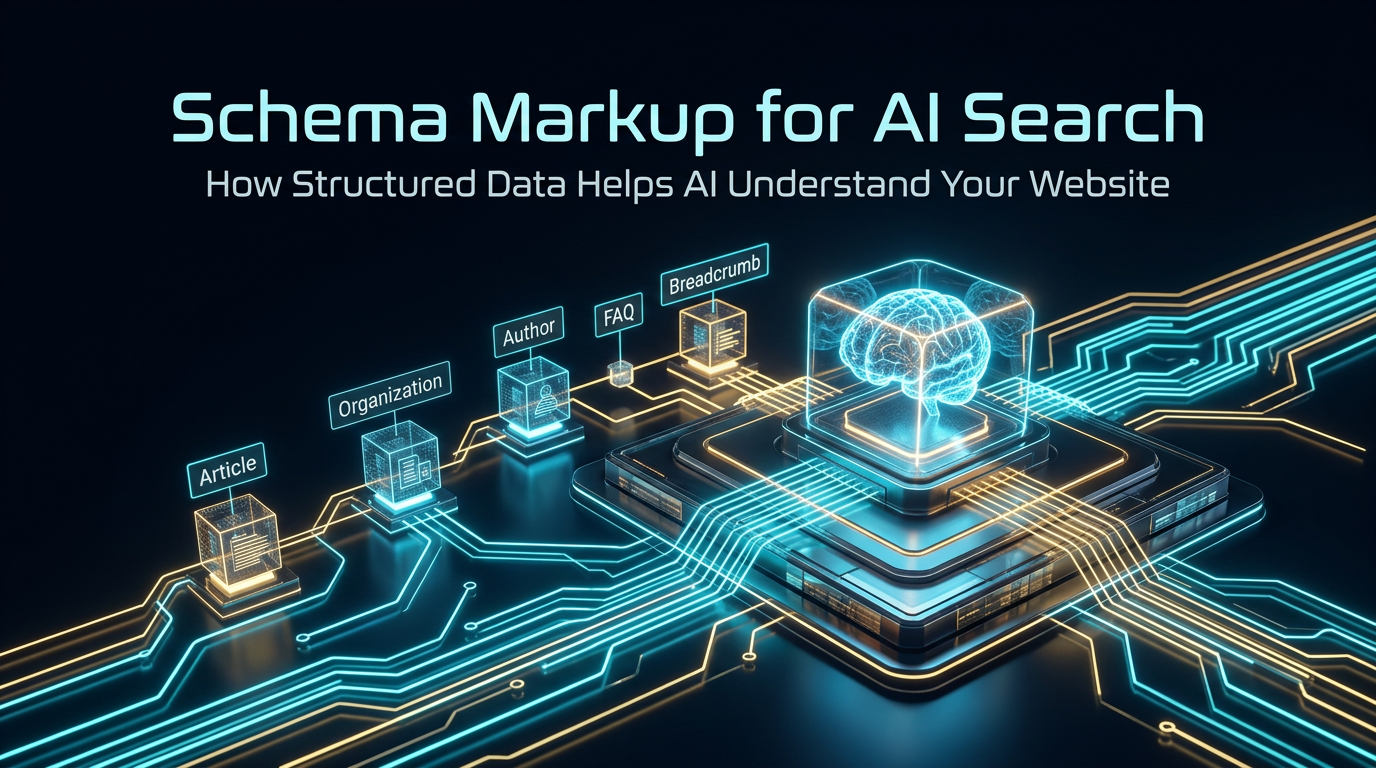
Schema Markup for AI Search is the practice of adding structured data to web pages so search engines and AI systems can better understand content, entities, authors, organizations, breadcrumbs, and FAQs. Schema does not guarantee rankings, AI citations, or inclusion in Google AI Overviews. What it provides is clarity. When paired with helpful content, strong SEO, AEO structure, and GEO trust signals, schema markup helps machines interpret your website with less ambiguity. Triomize helps WordPress owners make this workflow easier.
Table of Contents
- What Is Schema Markup for AI Search?
- How Does AI Search Use Structured Data?
- Does ChatGPT Read Schema Markup?
- Does Google AI Overviews Use Schema Markup?
- Which Schema Types Matter Most for AI Search?
- What Is Article Schema?
- What Is FAQ Schema?
- What Is Author Schema?
- What Is Organization Schema?
- What Is Breadcrumb Schema?
- How Do You Validate Schema Markup?
- What Are Common Schema Mistakes?
- How Does Schema Support SEO, AEO, and GEO?
- How Can Triomize Help with Schema Markup?
- What Is the Schema Markup for AI Search Checklist?
What Is Schema Markup for AI Search?
Schema Markup for AI Search is structured data added to a web page so machines can understand what the page is about, who published it, which entities it mentions, and how its parts relate to each other. Most websites implement schema using JSON-LD, a script format that sits in the page HTML.
Schema markup uses the shared vocabulary at Schema.org. Google says most Search structured data uses Schema.org vocabulary, while Google Search Central remains the definitive source for which properties matter for Google rich results. Google also supports three structured data formats: JSON-LD, Microdata, and RDFa. It recommends JSON-LD in most cases because it is easier to implement and maintain at scale.
Structured data is already widespread across the public web. The 2024 HTTP Archive Web Almanac structured data chapter found RDFa on 66% of pages, Open Graph on 64%, Twitter meta tags on 45%, JSON-LD on 41%, and Microdata on 26%. JSON-LD adoption grew from 34% of pages in 2022 to 41% in 2024, showing why this format has become the practical default for modern schema implementation.
For AI search, schema is best understood as a clarity layer. It tells machines that this page is an Article, this publisher is an Organization, this person is an Author, this question belongs to an FAQ, and this trail is a BreadcrumbList. That does not force ChatGPT, Perplexity, or Google AI Overviews to cite your page. It makes your content easier to interpret.
This is why Triomize treats structured data as part of the SEO, AEO, and GEO workflow. Schema supports search engines, answer engines, and generative engines, but it works best when the visible content is useful and trustworthy.
How Does AI Search Use Structured Data?
AI search uses structured data as one signal that can help systems interpret page meaning, entities, relationships, and content type. It is not the only signal. AI systems also evaluate visible content, crawlability, internal links, external references, freshness, and authority.
Structured data helps because AI-powered search increasingly depends on context. A page is not just a bag of keywords. It may contain a brand, author, product, service, tutorial, question, answer, statistic, citation, and update date. Schema markup organizes these details into machine-readable fields.
A practical example:
| Page element | Visible content | Structured data role |
|---|---|---|
| Article title | Blog headline | headline in Article schema |
| Author name | Writer or reviewer | author in Article schema |
| Publisher | Brand or company | Organization schema |
| FAQ section | Questions and answers | FAQPage schema |
| Site path | Home > Blog > Guide | BreadcrumbList schema |
| Entity details | Brand, person, topic | SameAs, name, url, description |
Research also supports the value of clarity. The GEO study from Princeton University, Georgia Tech, Allen Institute, and IIT Delhi tested optimization tactics across 10,000 queries and nine datasets. It found that adding citations, statistics, and authoritative language improved position-adjusted word count by 30% to 40% and subjective impression by 15% to 30%. Schema is not the same tactic, but it serves the same goal: reducing ambiguity for machines.
Large-scale crawl data also shows that structured data is no longer niche. The WebDataCommons October 2023 release extracted structured data from 1.7 billion HTML pages out of 3.4 billion pages, equal to 50.60% of the crawl. Those pages came from 15 million pay-level domains out of 34 million covered domains, or 42.89%. The same release reported 97.7 billion quads and found JSON-LD annotations on about 9.5 million websites.
Does ChatGPT Read Schema Markup?
ChatGPT may use information from web pages that include schema markup when those pages are fetched or retrieved, but OpenAI has not published a rule saying schema guarantees ChatGPT citations. The safer answer is that schema can help machine understanding, but it is not a direct ChatGPT ranking switch.
OpenAI documents different crawlers for different purposes. OAI-SearchBot is used to surface websites in ChatGPT Search, while GPTBot is related to model training. If your site blocks the relevant crawler or hides key content behind scripts, schema alone will not solve discoverability.
For ChatGPT Search, prioritize the full stack:
- Crawlable public pages.
- Clear headings and direct answers.
- Article, Organization, BreadcrumbList, and FAQPage schema where relevant.
- Cited sources and original data.
- Internal links that show topical depth.
- Fresh updates on fast-moving topics.
Schema markup for ChatGPT should be treated as support, not magic. It helps clarify the page, but ChatGPT still needs accessible, useful, trustworthy content. For more, see our guide to How to Optimize for ChatGPT Search.
Does Google AI Overviews Use Schema Markup?
Google AI Overviews may benefit from the same SEO fundamentals that help Google understand pages, but Google says there is no special schema markup required for AI Overviews or AI Mode. Its AI features documentation says existing SEO best practices remain relevant and that no special markup is necessary.
That does not make schema useless. Google also says structured data helps Google understand page content and can make pages eligible for rich results when they follow the relevant documentation. In other words, schema remains useful for Google Search, even if it is not a guaranteed AI Overview trigger.
The correct framing is simple:
- Schema can help Google understand your page.
- Schema can support eligibility for rich results.
- Schema does not guarantee rankings.
- Schema does not guarantee AI Overview inclusion.
- Schema should match visible page content.
For 2026, the best strategy is to combine schema with strong content quality, crawlability, internal links, topical authority, and current evidence. This is the same position we take in Google AI Overviews Explained.
Which Schema Types Matter Most for AI Search?
The schema types that matter most for AI search are the ones that clarify the page, the publisher, the author, the site structure, and the answers on the page. You do not need every possible schema type. You need the right schema for the page.
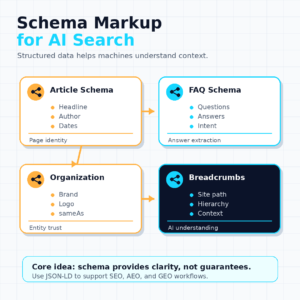
Start with these common types:
| Schema type | Best use | Why it helps |
|---|---|---|
| Article | Blog posts, guides, news, explainers | Clarifies headline, author, date, publisher, and article body |
| FAQPage | Real question and answer sections | Helps identify direct answer pairs |
| Person or Author | Author identity | Supports expertise and entity clarity |
| Organization | Brand or publisher | Connects the page to the company entity |
| BreadcrumbList | Site hierarchy | Explains where the page fits in the website |
| Product | Product pages | Clarifies offers, reviews, price, and product details where valid |
| LocalBusiness | Local service sites | Clarifies address, phone, service area, and business identity |
The most common mistake is adding schema because a plugin allows it, not because the page needs it. Schema must describe the visible content accurately. If the page does not have real FAQs, do not add FAQ schema. If the page is not a product page, do not force Product schema.
What Is Article Schema?
Article Schema is structured data that describes a blog post, guide, report, or news article. It can include fields like headline, author, date published, date modified, image, publisher, and main entity of page.
Article Schema matters for AI search because it clarifies the basic identity of the page. AI systems and search engines can see who published the content, when it was updated, and what the article is about. That supports trust and freshness signals.
Use Article Schema on blog posts and educational guides. For a WordPress site, this should usually be generated automatically by a theme, SEO plugin, or structured data tool.
What Is FAQ Schema?
FAQ Schema is structured data that marks up real question and answer pairs on a page. It should only be used when the visible page includes the same questions and answers.
FAQ Schema helps AEO because answer engines need clean question-answer relationships. It can also support AI discoverability by making the FAQ structure unambiguous. The answer still needs to be useful, concise, and accurate.
Triomize already includes tools for generating commonly used schema types, including FAQ Schema. This helps WordPress users create valid structured data without writing JSON-LD manually.
What Is Author Schema?
Author Schema identifies the person or organization responsible for the content. It may use Person schema, Organization schema, or author properties inside Article schema.
Author clarity matters because AI search increasingly evaluates trust and entity relationships. If the author has a consistent name, profile, sameAs links, and related expertise, machines can connect the content to a clearer entity.
For sensitive topics like finance, health, legal, or security, author clarity is especially important. It does not replace content quality, but it helps reduce ambiguity.
What Is Organization Schema?
Organization Schema describes the company, publisher, nonprofit, or brand behind a website. It can include name, URL, logo, sameAs links, contact details, and other identity fields.
Organization Schema supports entity SEO because it connects your content to a recognized brand entity. For AI search, that helps systems understand who is speaking and how the website fits into a broader knowledge graph.
For Triomize, Organization Schema is part of the broader GEO picture. Brand consistency across schema, footer, About page, social profiles, and internal links makes the entity easier to understand.
What Is Breadcrumb Schema?
Breadcrumb Schema describes the path from the homepage to the current page. It helps search engines and AI systems understand site hierarchy.
A breadcrumb path might look like this:
Home > Blog > AI Search > Schema Markup for AI SearchBreadcrumb Schema is useful because AI systems need context. A page about schema may belong to SEO, AEO, GEO, WordPress, or technical documentation. Breadcrumbs help identify the content cluster and site architecture.
How Do You Validate Schema Markup?
You validate schema markup by testing whether the JSON-LD is technically valid and whether it matches the visible content on the page. Validation is not only about passing a tool. It is about accuracy.
Use this process:
- Check syntax. Make sure JSON-LD is valid and does not contain broken commas, missing brackets, or invalid values.
- Use Google’s Rich Results Test. Test schema types that are eligible for Google rich results.
- Use Schema.org Validator. Check general Schema.org structured data validity.
- Compare with visible content. Make sure every marked-up claim appears on the page.
- Avoid duplicate conflicts. Do not let multiple plugins output conflicting schema for the same entity.
- Retest after edits. Update schema when you change FAQs, authors, titles, images, or dates.
Google’s structured data documentation is clear that markup must be valid and properly implemented. Invalid or misleading schema can reduce trust and eligibility rather than improve it.
What Are Common Schema Mistakes?
Common schema mistakes happen when website owners add structured data without matching the real page content. Schema should describe the page, not invent signals that are not visible.
Avoid these mistakes:
- Adding FAQ schema without visible FAQs. The questions and answers should appear on the page.
- Using Product schema on non-product pages. Do not force a type that does not match intent.
- Creating duplicate Organization schema conflicts. Multiple plugins may output different details.
- Marking fake reviews. Review markup must follow Google’s policies.
- Forgetting dateModified. Updated guides should show accurate modified dates.
- Using vague author data. A name without context is weaker than a clear author entity.
- Ignoring validation. Always test the final published page, not only the draft.
Schema errors are often invisible to readers but visible to machines. That makes them easy to miss and important to audit.
How Does Schema Support SEO, AEO, and GEO?
Schema supports SEO, AEO, and GEO by improving machine understanding across three different search layers. It does not replace content quality or authority. It strengthens the technical clarity of the page.
| Layer | What schema supports | Example schema types |
|---|---|---|
| SEO | Rich results, page understanding, site hierarchy | Article, Product, BreadcrumbList, Organization |
| AEO | Direct answer extraction and question-answer clarity | FAQPage, HowTo, Speakable where appropriate |
| GEO | Entity trust, author clarity, source interpretation | Organization, Person, Article, sameAs, citation fields |
For GEO, schema is especially useful because generative engines need to understand entities and relationships. Who published the page? Who wrote it? What is the topic? What sources does it cite? How does it connect to the rest of the site?
Schema is only one part of that answer. Content depth, topical authority, crawler access, statistics, outbound references, and internal links still matter. But schema is one of the simplest technical improvements a site owner can implement.
How Can Triomize Help with Schema Markup?
Triomize can help with schema markup by making structured data part of the publishing workflow instead of a separate technical task. Implementing structured data correctly can be time-consuming, especially for website owners who are unfamiliar with Schema.org vocabulary or JSON-LD syntax.
To simplify this process, Triomize already includes tools for generating commonly used schema types, including FAQ Schema, with additional structured data types planned for future releases.
As Triomize evolves, we are expanding schema capabilities to help WordPress users implement structured data that supports traditional search engines, answer engines, and AI-powered search experiences without requiring manual code generation.
The goal is to make structured data implementation simple, standards-compliant, and accessible to every WordPress website owner.
What Is the Schema Markup for AI Search Checklist?
A Schema Markup for AI Search checklist helps you apply structured data carefully before publishing. Use it with every important blog post, guide, product page, and FAQ section.
- Use JSON-LD unless your setup requires another supported format.
- Add Article Schema to blog posts and educational guides.
- Add Organization Schema for the publisher or brand entity.
- Add Author or Person data where author identity matters.
- Add BreadcrumbList Schema to clarify site hierarchy.
- Add FAQPage Schema only when real FAQs are visible on the page.
- Match every schema field to visible content or true page metadata.
- Validate with Google’s Rich Results Test and Schema.org Validator.
- Avoid duplicate or conflicting schema from multiple plugins.
- Update schema when titles, FAQs, authors, dates, or images change.
- Use Triomize to review SEO, AEO, and GEO signals before publishing.
Frequently Asked Questions
Does schema markup help AI search?
Does ChatGPT read schema markup?
Does Google AI Overviews require schema markup?
Which schema types are best for AI search?
Can Triomize generate schema markup?