
Topical Authority is the trust a website earns by covering a subject deeply, consistently, and with clear connections between related pages. Instead of publishing isolated articles, a site builds a structured knowledge base around a topic. Search engines and AI systems can then see that the website understands the subject, not just one keyword. Triomize helps WordPress teams strengthen topical authority through content analysis, schema workflows, internal linking, and SEO, AEO, and GEO checks.
Table of Contents
- What Is Topical Authority?
- Why Does Topical Authority Matter?
- How Does Topical Authority vs Domain Authority Compare?
- How Does Google Measure Topical Authority?
- How Does AI Search Use Topical Authority?
- How Do You Build Topical Authority?
- How Do You Create Content Clusters?
- How Do You Strengthen Internal Linking?
- How Do You Cover Topics in Depth?
- How Do You Demonstrate Expertise?
- What Are Common Topical Authority Mistakes?
- How Can Triomize Help Build Topical Authority?
- What Should You Remember About Topical Authority?
What Is Topical Authority?
Topical Authority is the perceived expertise a website has around a specific subject area. A site with strong topical authority does not only publish one article on a topic. It covers the topic from multiple useful angles and connects those pages clearly.
For example, a website that wants authority around AI search should not publish only one post about ChatGPT Search. It should also explain Google AI Overviews, Perplexity AI, AI crawler monitoring, schema markup, entity SEO, GEO, AEO, and related technical topics. The cluster proves breadth and depth.
Topical authority is not the same as publishing volume. A site can publish 200 disconnected posts and still look unfocused. Another site can publish 20 connected, high-quality pages and look much more authoritative on a narrow subject.
Google has publicly discussed a related idea in its topic authority system for news. In a 2023 Search Central post, Google said this system helps surface expert sources for specialized topics such as health, politics, and finance. Google named signals like source notability, original reporting, citations by other publishers, and source reputation. That is not a complete ranking formula for every site, but it confirms the direction of search: expertise around a topic matters.
Why Does Topical Authority Matter?
Topical authority matters because search engines and AI systems need to decide which sources are most reliable for a subject. A single page can answer one query. A strong content cluster can prove broader expertise.
Modern search is no longer only about matching keywords. Google, Bing, ChatGPT Search, Perplexity, and Google AI Overviews all need context. They need to understand who covers a topic well, which pages support each other, and whether the website has a clear knowledge structure.
Topical authority helps with:
- Ranking potential. Related pages can support each other through internal links.
- Crawl discovery. Search engines can find related content more easily.
- Entity understanding. Repeated, connected coverage clarifies the site’s main entities.
- AI citations. AI systems prefer sources that appear complete and trustworthy.
- User trust. Visitors can explore a topic without leaving the site.
Third-party research also supports the value of clustering. A 2024 Graphite study reported that pages with high topical authority gained traffic 57% faster than pages with low topical authority. Industry analyses of topic clusters also report stronger organic performance for connected content than for standalone posts. One 2026 analysis of AI topic clusters reported that websites with topic clusters received 3.2x more AI citations than single-page competitors, that 86% of AI citations came from sites with 5 or more interconnected pages on the topic, and that the average architecture used 1 pillar page plus 8 cluster pages. Treat exact figures as directional, but the pattern is consistent: connected expertise compounds.
How Does Topical Authority vs Domain Authority Compare?
Topical authority and domain authority measure different kinds of strength. Domain authority is a broad estimate of a whole domain’s backlink strength and credibility. Topical authority is subject-specific expertise.
| Attribute | Topical Authority | Domain Authority |
|---|---|---|
| Scope | Specific topic or subject area | Entire website or domain |
| Main signal | Depth, relevance, internal links, entity coverage | Backlinks, domain strength, historical trust |
| Best question | Does this site know this topic well? | Is this domain generally strong? |
| Content strategy | Build clusters and hubs | Earn links and strengthen site reputation |
| AI search value | Helps AI understand expertise around a topic | Helps show general trust and authority |
| Risk | Thin clusters or shallow coverage | Strong domain with weak topic relevance |
A strong domain can still fail on a topic if it lacks coverage. A smaller domain can win visibility in a niche if it covers the subject better than larger competitors.
That is why topical authority is important for newer websites. You may not beat large domains everywhere, but you can become the clearest source for a focused topic.
How Does Google Measure Topical Authority?
Google does not publish a single topical authority score for normal websites. However, Google has described related signals in its topic authority system for news and in its broader helpful content guidance.
In its 2023 Search Central explanation, Google said topic authority looks at signals such as:
- How notable a source is for a topic or location.
- How original reporting is cited by other publishers.
- A source’s reputation for high-quality reporting.
- Recommendations from expert sources.
- Evidence of expertise in specialized areas.
For non-news websites, the same principles translate into practical SEO signals:
- Do you cover the subject deeply?
- Do your pages link together logically?
- Do you cite credible sources?
- Do users and other websites recognize your content?
- Do your authors and brand show expertise?
- Does your schema clarify entities and relationships?
Google’s link best practices also say internal links help people and Google make sense of a site, and every page you care about should have a link from at least one other page. Industry internal linking studies often report measurable gains, including analyses across more than 1 million websites that associate proper internal linking with ranking lifts of up to 40%. That aligns directly with topical authority.
How Does AI Search Use Topical Authority?
AI search uses topical authority to evaluate whether a source looks complete, trustworthy, and contextually relevant. AI systems do not only read one page in isolation. They can evaluate patterns across a website, including related pages, entity consistency, source evidence, and internal links.
For AI search, topical authority supports three jobs:
- Retrieval. The system can find relevant pages across a cluster.
- Understanding. Related content helps the system understand the site’s expertise.
- Citation. A complete source may be more attractive to cite than a shallow page.
The GEO study from Princeton University, Georgia Tech, Allen Institute, and IIT Delhi tested optimization tactics across 10,000 queries and nine datasets. It found that adding citations, statistics, and authoritative language improved position-adjusted word count by 30% to 40% and subjective impression by 15% to 30%. That study did not measure topical authority directly, but it supports the broader idea that AI systems reward sources that appear credible, specific, and well-supported.
Topical authority is especially important for Google AI Overviews, ChatGPT Search, and Perplexity-style citation systems. A single article may be useful. A cluster makes the site easier to trust.
How Do You Build Topical Authority?
You build topical authority by creating a connected content system around a subject. The process starts with topic planning and continues through internal linking, schema, updates, and evidence.
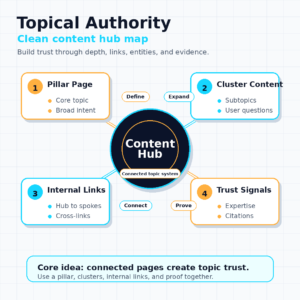
A simple workflow looks like this:
- Choose a core topic.
- Define the main entities and subtopics.
- Create a pillar page for the broad topic.
- Publish supporting pages for specific subtopics.
- Link every supporting page back to the pillar.
- Cross-link related supporting pages.
- Add structured data where appropriate.
- Update pages as the topic changes.
- Track rankings, impressions, citations, and AI referrals.
- Use Triomize to review SEO, AEO, and GEO gaps.
For an AI search cluster, the pillar might be “AI Search Optimization.” Supporting pages might cover Entity SEO, Schema Markup for AI Search, AI Crawler Monitoring, Google AI Overviews, ChatGPT Search, Perplexity citations, and GEO.
How Do You Create Content Clusters?
You create content clusters by organizing related pages around a central pillar page. The pillar covers the broad topic. Supporting pages cover specific subtopics in more depth.
A strong cluster includes:
- One clear pillar page.
- Several supporting articles.
- A logical URL structure where possible.
- Internal links from the pillar to supporting pages.
- Internal links from supporting pages back to the pillar.
- Cross-links between related supporting pages.
- Consistent terminology and entities.
A cluster should answer the full set of questions users have around the topic. If your pillar is “Entity SEO,” supporting pages might explain Knowledge Graph SEO, schema markup, author entities, internal links, topical authority, and AI search visibility.
How Do You Strengthen Internal Linking?
You strengthen internal linking by connecting related pages with descriptive anchor text. Internal links help users navigate and help search engines understand relationships between pages.
Google’s link guidance says anchor text should be descriptive, concise, and relevant. It also says internal links can help people and Google make sense of a site more easily.
Good internal links use clear anchors like:
- “Entity SEO” instead of “click here.”
- “Schema Markup for AI Search” instead of “this post.”
- “AI Crawler Monitoring” instead of “learn more.”
Every important page should have at least one internal link pointing to it. For topical authority, important pages should have more than one link from related cluster content.
How Do You Cover Topics in Depth?
You cover topics in depth by answering the full range of questions users have before, during, and after the main search query. Depth is not word count alone. It is usefulness across the topic.
Cover these content angles:
- Definitions.
- How it works.
- Comparisons.
- Mistakes.
- Examples.
- Checklists.
- Technical setup.
- Measurement.
- FAQs.
- Related entities.
Depth also means updating content when the field changes. AI search, for example, changes quickly. A 2024 article may need updates for 2026 crawler policies, AI Overview behavior, and Perplexity citations.
How Do You Demonstrate Expertise?
You demonstrate expertise by showing evidence that your site understands the topic. This includes practical examples, source citations, original insights, clear author identity, and consistent coverage.
Useful expertise signals include:
- Author bios and credentials where appropriate.
- Links to credible external sources.
- Original statistics or examples.
- Screenshots, workflows, or templates.
- Structured data for authors and organizations.
- Updated publication dates.
- Internal links to related guides.
Expertise is not created by saying “we are experts.” It is demonstrated by publishing helpful, accurate, connected content over time.
What Are Common Topical Authority Mistakes?
Common topical authority mistakes happen when websites publish content without a clear cluster strategy. The result is a blog full of isolated posts that do not support each other.
Avoid these mistakes:
- Publishing random topics. Stay focused on themes your site wants to own.
- Creating thin pillar pages. A pillar page should guide the whole cluster.
- Ignoring internal links. Isolated pages are harder to discover and interpret.
- Targeting only keywords. Include entities, subtopics, and relationships.
- Publishing duplicate intent pages. Avoid several pages competing for the same query.
- Skipping updates. Old content weakens authority in fast-moving topics.
- Missing author context. Expertise should be visible and consistent.
- Forgetting schema. Structured data helps machines understand the page and publisher.
Topical authority is earned through consistency. A single post cannot do the job alone.
How Can Triomize Help Build Topical Authority?
Triomize can help build topical authority by making connected content part of the publishing workflow. Building topical authority is not about publishing more content. It is about publishing connected content.
Triomize helps website owners improve the quality and structure of their content by identifying opportunities across SEO, AEO, and GEO. Features such as content analysis, schema generation, internal linking recommendations, and AI-focused optimization help create content that is easier for search engines and AI systems to understand.
As Triomize continues to evolve, we are expanding recommendations to help website owners build stronger topical coverage and better-organized content clusters that improve long-term discoverability.
For example, a WordPress team can use Triomize to review whether a new article has internal links to related pages, a direct answer near the top, relevant schema, credible citations, and GEO-friendly trust signals. That workflow turns individual posts into a stronger topic cluster.
What Should You Remember About Topical Authority?
Topical authority is earned through consistency, depth, and relevance. Instead of publishing isolated articles, successful websites build interconnected knowledge around a subject, making it easier for search engines and AI systems to recognize their expertise.
As AI search becomes more sophisticated, topical authority will become an even stronger trust signal. Websites that combine comprehensive content, clear internal linking, and semantic organization will be better positioned to earn visibility across traditional search engines and AI-powered search experiences.
Keywords still matter, but they are no longer enough. The future of search rewards websites that can prove they understand a topic deeply.
Frequently Asked Questions
What is topical authority?
How do I build topical authority?
Is topical authority the same as domain authority?
Does topical authority help AI search visibility?
How does Triomize support topical authority?